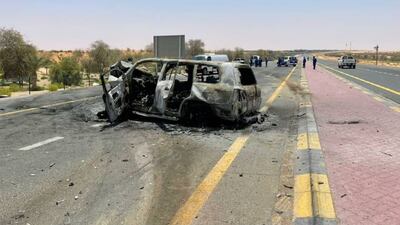
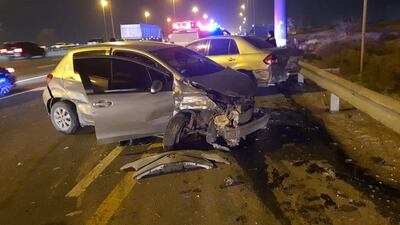
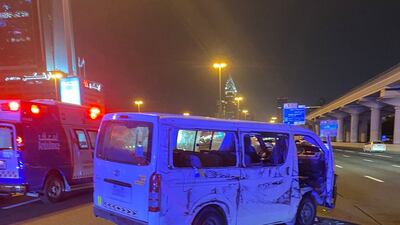
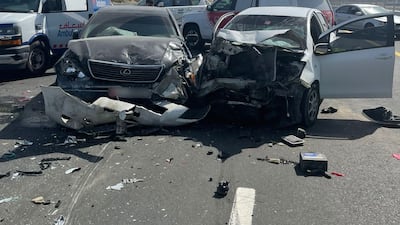
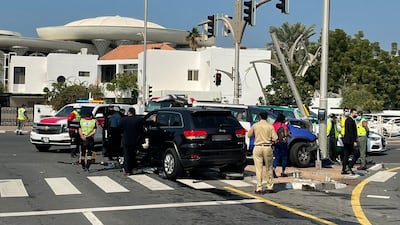
Every year, about 1.35 million people die from road traffic injuries, the World Health Organisation has said.
A further 50 million people worldwide are hurt or disabled by such injuries, placing the issue of road safety high on the UN agenda.
However, much of the world has fallen short of a target to halve the number of road deaths and injuries by 2020.
People aged 15 to 29 were found to have the greatest chance of dying in a road crash. Traffic injuries are currently thought to be the eighth leading cause of death across the world. This is predicted to climb to seventh by 2030.
But how does the Middle East compare when it comes to keeping people safe on the roads?
Anyone can get a driver's licence without even taking the driver's test. All one would have to do is 'grease the wheel' a little bit
Tammam Nakkash,
road safety campaigner, Lebanon
Dave Cliff, chief executive of the Global Road Safety Partnership at the International Federation of Red Cross and Red Crescent Societies, told The National there is a problem in the region of "significant underreporting" of accidents and deaths.
“Underreporting of fatal and serious-injury crashes is a major global problem, particularly in low and middle-income countries," he said.
“GRSP highlighted this exact issue to the recent UN high-level meeting on road safety."
He suggested that lower traffic volumes in many countries as a result of Covid-19 restrictions could also have had an effect.
The next WHO global status report is due in 2023.
UAE
Despite increasing levels of traffic, road deaths in the UAE have almost halved since 2014 due to a series of safety measures and regulations.
In 2014, 712 deaths were recorded in road traffic accidents by the Ministry of Interior. This fell to 675 in 2015, 448 in 2019 and 381 last year.
Government figures show that road deaths have fallen by two thirds since 2008, when 1,072 were reported.
But despite the drop in the number of recorded UAE road deaths, WHO figures suggest considerably more people could have lost their lives in these circumstances.
In 2015, the WHO estimated there were 1,676 road deaths compared with 870 in 2019 — about double the 448 figure recorded in the Emirates.
The WHO estimates road traffic deaths by assessing a range of national variables.
They include gross domestic product, total vehicles for every 1,000 people, the number of roads, national speed limits, access to health care, the working population, percentage of motorbikes, corruption and national policies for walking and cycling.
Saudi Arabia
The number of people killed as a result of road traffic crashes in Saudi Arabia has more than doubled in a decade to 27.4 for every 100,000 people.
The country aims to reduce the number of road traffic deaths to fewer than 10 for every 100,000 people by 2030.
In 2015, the WHO reported 8,313 road deaths but that number leapt to 12,317 in 2019 — the most recent annual data set.
Road safety strategies include a penalty point system and ensuring motorcycle helmet laws apply to all riders, both drivers and passengers.
Seat-belt laws have been extended to include all occupants in the rear, while drink-driving laws are also in effect despite a nationwide alcohol ban.
In 2018, the National Ministerial Traffic Safety Committee began a four-year road safety strategy. It established collaborative relationships between the Ministry of Health, Ministry of Interior and others to address the different causes of road traffic accidents.
Oman
Speeding and poor driving skills are being blamed as the main causes of road accidents in the sultanate.
In 2015, the country's number of road deaths was 696 — that fell to 527 in 2019.
Revised seat-belt laws to apply to passengers as well as drivers, new child-restraint laws and a ban on using mobile phones at the wheel addressed some of the main causes of road deaths.
Bahrain
In 2021, Bahrain achieved the largest reduction in road deaths and injuries in the region — a 35 per cent drop.
Overall since 2015, road deaths have fallen from an annual number of 103 to 85 in 2019.
Although the development of new cities increased traffic volume, it did not result in more road injuries and fatalities.
This was a result of better traffic monitoring, more rigorous law enforcement by increased foot and car patrols, and engineering solutions in congested areas.
Jordan
The number of road deaths have fallen in Jordan from 2,220 in 2015 to 1,717 in 2018 according to the WHO — but the country remains plagued by high traffic-related fatalities and injuries.
National seat-belt laws apply only to drivers and are moderately enforced.
According to the GRSP, only 42 per cent of front-seat occupants were found to be wearing seat-belts.
There are no child-restraint laws and a third of those killed on the roads are pedestrians.
The Traffic Department has been more active in campaigning publicly for road safety, mainly by publishing regular statistics and shaming reckless drivers on social media and publishing photos of horrific accidents.
Roads in Jordan are poorly maintained although the Saudi Fund for Development has paid in the past decade for major motorways, including a large proportion of the desert road south, a new motorway to Zarqa — Jordan’s second city — and the airport road.
There is the occasional speed camera but not to the degree that exists in the Gulf.
The Traffic Department often cites speeding as a cause of accidents.
Lebanon
A 2021 study by the Faculty of Medicine at the American University of Beirut found 72 per cent of those injured in road accidents were men, with an average age of 32.
It also found almost half of those injured (48 per cent) were passengers aged 15-29, while motorcyclists suffered the greatest proportion of injuries at 38 per cent.
Figures from the WHO showed traffic deaths rose from 1,058 in 2015, to 1,127 in 2019.
Half of the accidents occurred on unmarked two-way roads.
A national assessment in 2016 looked at the functional and structural condition of the roads and rated the safety of the network for vehicle occupants, motorcyclists, pedestrians and cyclists from one to five stars.
Only 10 per cent of the network was awarded the benchmark three-star rating or better.
Since then, a $170 million loan from the World Bank under the Safer Roads Investment Plan aimed to improve safety on roads to give 70 per cent of routes a three-star rating by 2030.
In 2021, a further 20 auditors were trained to monitor improvements and conduct regular safety checks at traffic pinch-points in Beirut.
Tammam Nakkash, a transport systems expert and public transportation advocate, says traffic safety laws are rarely enforced consistently.
"Anyone can get a driver's licence without even taking the driver's test," Mr Nakkash said. "All one would have to do is 'grease the wheel' a little bit."
Despite being legally obliged to, drivers and front-seat passengers rarely wear their seat-belts and the law is often not enforced — neither is a law stipulating that babies and infants must ride in child-seats until they are 5.
Mr Nakkash, who had long advocated a reliable public transport system in Lebanon, said road safety in the country had essentially crumbled.
"We are worse off than it ever was in the past, we are similar to how Beirut was around 1994-1995," he said, referring to a turbulent era of post-war reconstruction, when much of the capital's infrastructure was in disarray after 15 years of civil war.
"It's chaos."
Additional reporting by Nada Homsi in Beirut and Khaled Yacoub Oweis in Jordan

Find the right policy for you
Don’t wait until the week you fly to sign up for insurance – get it when you book your trip. Insurance covers you for cancellation and anything else that can go wrong before you leave.
Some insurers, such as World Nomads, allow you to book once you are travelling – but, as Mr Mohammed found out, pre-existing medical conditions are not covered.
Check your credit card before booking insurance to see if you have any travel insurance as a benefit – most UAE banks, such as Emirates NBD, First Abu Dhabi Bank and Abu Dhabi Islamic Bank, have cards that throw in insurance as part of their package. But read the fine print – they may only cover emergencies while you’re travelling, not cancellation before a trip.
Pre-existing medical conditions such as a heart condition, diabetes, epilepsy and even asthma may not be included as standard. Again, check the terms, exclusions and limitations of any insurance carefully.
If you want trip cancellation or curtailment, baggage loss or delay covered, you may need a higher-grade plan, says Ambareen Musa of Souqalmal.com. Decide how much coverage you need for emergency medical expenses or personal liability. Premium insurance packages give up to $1 million (Dh3.7m) in each category, Ms Musa adds.
Don’t wait for days to call your insurer if you need to make a claim. You may be required to notify them within 72 hours. Gather together all receipts, emails and reports to prove that you paid for something, that you didn’t use it and that you did not get reimbursed.
Finally, consider optional extras you may need, says Sarah Pickford of Travel Counsellors, such as a winter sports holiday. Also ensure all individuals can travel independently on that cover, she adds. And remember: “Cheap isn’t necessarily best.”
Manchester City transfers:
OUTS
Pablo Zabaleta, Bacary Sagna, Gael Clichy, Willy Caballero and Jesus Navas (all released)
INS
Ederson (Benfica) £34.7m, Bernardo Silva (Monaco) £43m
ON THEIR WAY OUT?
Joe Hart, Eliaquim Mangala, Samir Nasri, Wilfried Bony, Fabian Delph, Nolito and Kelechi Iheanacho
ON THEIR WAY IN?
Dani Alves (Juventus), Alexis Sanchez (Arsenal)
The%20specs
%3Cp%3E%3Cstrong%3EEngine%3A%20%3C%2Fstrong%3ETwin-turbo%2C%20V8%3Cbr%3E%3Cstrong%3ETransmission%3A%20%3C%2Fstrong%3E8-speed%20automatic%20and%20manual%3Cbr%3E%3Cstrong%3EPower%3A%20%3C%2Fstrong%3E503%20bhp%3Cbr%3E%3Cstrong%3ETorque%3A%20%3C%2Fstrong%3E513Nm%3Cbr%3E%3Cstrong%3EPrice%3A%20%3C%2Fstrong%3Efrom%20Dh646%2C800%20(%24176%2C095)%3Cbr%3E%3Cstrong%3EOn%20sale%3A%20%3C%2Fstrong%3Enow%3C%2Fp%3E%0A
WORLD CUP SEMI-FINALS
England v New Zealand
(Saturday, 12pm UAE)
Wales v South Africa
(Sunday, 12pm, UAE)
Our family matters legal consultant
Name: Hassan Mohsen Elhais
Position: legal consultant with Al Rowaad Advocates and Legal Consultants.
Scorecard
Scotland 220
K Coetzer 95, J Siddique 3-49, R Mustafa 3-35
UAE 224-3 in 43,5 overs
C Suri 67, B Hameed 63 not out
ENGLAND SQUAD
Joe Root (c), Moeen Ali, Jimmy Anderson, Jonny Bairstow, Stuart Broad, Jos Buttler, Alastair Cook, Sam Curran, Keaton Jennings, Ollie Pope, Adil Rashid, Ben Stokes, James Vince, Chris Woakes
Intercontinental Cup
Namibia v UAE Saturday Sep 16-Tuesday Sep 19
Table 1 Ireland, 89 points; 2 Afghanistan, 81; 3 Netherlands, 52; 4 Papua New Guinea, 40; 5 Hong Kong, 39; 6 Scotland, 37; 7 UAE, 27; 8 Namibia, 27
How to register as a donor
1) Organ donors can register on the Hayat app, run by the Ministry of Health and Prevention
2) There are about 11,000 patients in the country in need of organ transplants
3) People must be over 21. Emiratis and residents can register.
4) The campaign uses the hashtag #donate_hope
TOP%2010%20MOST%20POLLUTED%20CITIES
%3Cp%3E1.%20Bhiwadi%2C%20India%0D%3Cbr%3E2.%20Ghaziabad%2C%20India%0D%3Cbr%3E3.%20Hotan%2C%20China%0D%3Cbr%3E4.%20Delhi%2C%20India%0D%3Cbr%3E5.%20Jaunpur%2C%20India%0D%3Cbr%3E6.%20Faisalabad%2C%20Pakistan%0D%3Cbr%3E7.%20Noida%2C%20India%0D%3Cbr%3E8.%20Bahawalpur%2C%20Pakistan%0D%3Cbr%3E9.%20Peshawar%2C%20Pakistan%0D%3Cbr%3E10.%20Bagpat%2C%20India%3C%2Fp%3E%0A%3Cp%3E%3Cem%3ESource%3A%20IQAir%3C%2Fem%3E%3C%2Fp%3E%0A
On racial profiling at airports
Company%20Profile
%3Cp%3E%3Cstrong%3ECompany%20name%3A%20%3C%2Fstrong%3ENamara%0D%3Cbr%3E%3Cstrong%3EStarted%3A%20%3C%2Fstrong%3EJune%202022%0D%3Cbr%3E%3Cstrong%3EFounder%3A%20%3C%2Fstrong%3EMohammed%20Alnamara%0D%3Cbr%3E%3Cstrong%3EBased%3A%20%3C%2Fstrong%3EDubai%20%0D%3Cbr%3E%3Cstrong%3ESector%3A%20%3C%2Fstrong%3EMicrofinance%0D%3Cbr%3E%3Cstrong%3ECurrent%20number%20of%20staff%3A%20%3C%2Fstrong%3E16%0D%3Cbr%3E%3Cstrong%3EInvestment%20stage%3A%20%3C%2Fstrong%3ESeries%20A%0D%3Cbr%3E%3Cstrong%3EInvestors%3A%20%3C%2Fstrong%3EFamily%20offices%0D%3Cbr%3E%3C%2Fp%3E%0A
The biog
Favourite book: Men are from Mars Women are from Venus
Favourite travel destination: Ooty, a hill station in South India
Hobbies: Cooking. Biryani, pepper crab are her signature dishes
Favourite place in UAE: Marjan Island
THE%20STRANGERS'%20CASE
%3Cp%3E%3Cstrong%3EDirector%3C%2Fstrong%3E%3A%20Brandt%20Andersen%3Cbr%3E%3Cstrong%3EStarring%3A%20%3C%2Fstrong%3EOmar%20Sy%2C%20Jason%20Beghe%2C%20Angeliki%20Papoulia%3Cbr%3E%3Cstrong%3ERating%3A%3C%2Fstrong%3E%204%2F5%3C%2Fp%3E%0A
Dubai Bling season three
Cast: Loujain Adada, Zeina Khoury, Farhana Bodi, Ebraheem Al Samadi, Mona Kattan, and couples Safa & Fahad Siddiqui and DJ Bliss & Danya Mohammed
Rating: 1/5
Anna and the Apocalypse
Director: John McPhail
Starring: Ella Hunt, Malcolm Cumming, Mark Benton
Three stars
Tips on buying property during a pandemic
Islay Robinson, group chief executive of mortgage broker Enness Global, offers his advice on buying property in today's market.
While many have been quick to call a market collapse, this simply isn’t what we’re seeing on the ground. Many pockets of the global property market, including London and the UAE, continue to be compelling locations to invest in real estate.
While an air of uncertainty remains, the outlook is far better than anyone could have predicted. However, it is still important to consider the wider threat posed by Covid-19 when buying bricks and mortar.
Anything with outside space, gardens and private entrances is a must and these property features will see your investment keep its value should the pandemic drag on. In contrast, flats and particularly high-rise developments are falling in popularity and investors should avoid them at all costs.
Attractive investment property can be hard to find amid strong demand and heightened buyer activity. When you do find one, be prepared to move hard and fast to secure it. If you have your finances in order, this shouldn’t be an issue.
Lenders continue to lend and rates remain at an all-time low, so utilise this. There is no point in tying up cash when you can keep this liquidity to maximise other opportunities.
Keep your head and, as always when investing, take the long-term view. External factors such as coronavirus or Brexit will present challenges in the short-term, but the long-term outlook remains strong.
Finally, keep an eye on your currency. Whenever currency fluctuations favour foreign buyers, you can bet that demand will increase, as they act to secure what is essentially a discounted property.
Islamophobia definition
A widely accepted definition was made by the All Party Parliamentary Group on British Muslims in 2019: “Islamophobia is rooted in racism and is a type of racism that targets expressions of Muslimness or perceived Muslimness.” It further defines it as “inciting hatred or violence against Muslims”.
Mercer, the investment consulting arm of US services company Marsh & McLennan, expects its wealth division to at least double its assets under management (AUM) in the Middle East as wealth in the region continues to grow despite economic headwinds, a company official said.
Mercer Wealth, which globally has $160 billion in AUM, plans to boost its AUM in the region to $2-$3bn in the next 2-3 years from the present $1bn, said Yasir AbuShaban, a Dubai-based principal with Mercer Wealth.
“Within the next two to three years, we are looking at reaching $2 to $3 billion as a conservative estimate and we do see an opportunity to do so,” said Mr AbuShaban.
Mercer does not directly make investments, but allocates clients’ money they have discretion to, to professional asset managers. They also provide advice to clients.
“We have buying power. We can negotiate on their (client’s) behalf with asset managers to provide them lower fees than they otherwise would have to get on their own,” he added.
Mercer Wealth’s clients include sovereign wealth funds, family offices, and insurance companies among others.
From its office in Dubai, Mercer also looks after Africa, India and Turkey, where they also see opportunity for growth.
Wealth creation in Middle East and Africa (MEA) grew 8.5 per cent to $8.1 trillion last year from $7.5tn in 2015, higher than last year’s global average of 6 per cent and the second-highest growth in a region after Asia-Pacific which grew 9.9 per cent, according to consultancy Boston Consulting Group (BCG). In the region, where wealth grew just 1.9 per cent in 2015 compared with 2014, a pickup in oil prices has helped in wealth generation.
BCG is forecasting MEA wealth will rise to $12tn by 2021, growing at an annual average of 8 per cent.
Drivers of wealth generation in the region will be split evenly between new wealth creation and growth of performance of existing assets, according to BCG.
Another general trend in the region is clients’ looking for a comprehensive approach to investing, according to Mr AbuShaban.
“Institutional investors or some of the families are seeing a slowdown in the available capital they have to invest and in that sense they are looking at optimizing the way they manage their portfolios and making sure they are not investing haphazardly and different parts of their investment are working together,” said Mr AbuShaban.
Some clients also have a higher appetite for risk, given the low interest-rate environment that does not provide enough yield for some institutional investors. These clients are keen to invest in illiquid assets, such as private equity and infrastructure.
“What we have seen is a desire for higher returns in what has been a low-return environment specifically in various fixed income or bonds,” he said.
“In this environment, we have seen a de facto increase in the risk that clients are taking in things like illiquid investments, private equity investments, infrastructure and private debt, those kind of investments were higher illiquidity results in incrementally higher returns.”
The Abu Dhabi Investment Authority, one of the largest sovereign wealth funds, said in its 2016 report that has gradually increased its exposure in direct private equity and private credit transactions, mainly in Asian markets and especially in China and India. The authority’s private equity department focused on structured equities owing to “their defensive characteristics.”