

For more than four billion years Mars remained alone in the Solar System, a dusty, cold, desert world out of reach of mankind.
But on July 14, 1965, all that changed with the arrival of its first visitor, a deep space probe consisting of a camera, a satellite dish and four solar panels.
Mariner 4, launched by Nasa, was on a dramatic two day flyby of the Red Planet, the first time Earth had successfully visited Mars.
Scientists hoped their spacecraft could obtain closeup pictures of the Martian surface and transmit the results directly back home.
At that time, some 55 years ago, mankind had long speculated about the fourth planet from the Sun. Astronomers in the 19th Century believed their telescopes had detected canals built by intelligent life, while the writer H G Wells imagined a hostile invasion in his War of the Worlds.
-
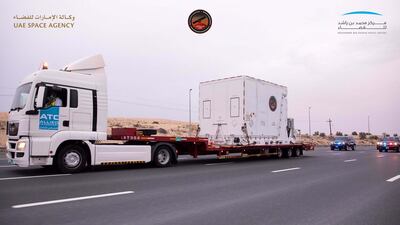
A lorry slowly carries the Mars Hope probe - contained in this special sealed container - from the space centre near Dubai International Airport to Dubai World Central. The normally 45-minute journey took 12 hours to minimise bumps. Courtesy: MBRSC -

The three and half-day journey involved painstaking planning to ensure the probe was not damaged -
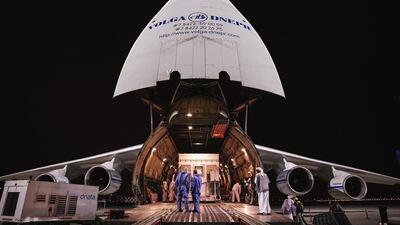
Maximus Air, an Abu Dhabi aviation firm specilising in huge cargo shipments, used an Antonov 124 to carry the probe -
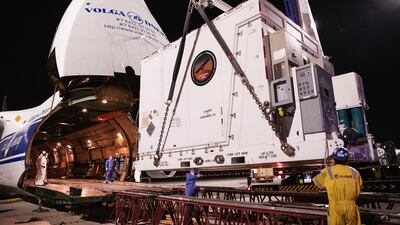
The box is loaded onto the Antonov ahead of the flight to Japan -

Emirati engineers travelling with the probe secured special permission to enter Japan, which has been on lockdown due to the coronavirus -

Engineers discuss the journey to the launch centre on Tanegashima Island, about 1,000km south of Tokyo -

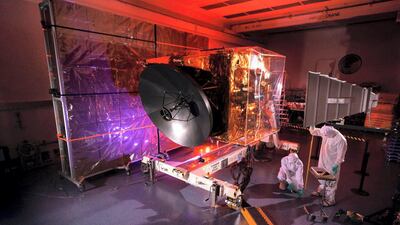
Emirati engineers have spent years constructing the device at a lab in Dubai -

An earlier picture showing the probe before it was completed -
The total journey took 83 hours -
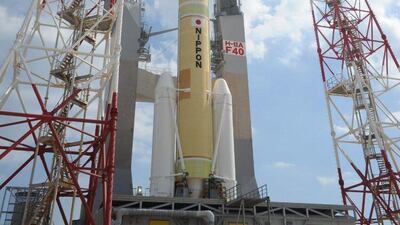
A launch date is yet to be confirmed for the Arab world's first deep space mission, but it has to be from July 14 to August 3, when Earth and Mars align and make the mission possible


The reality was captured by Mariner’s camera, returning to Earth along via a 140 million kilometre signal that took six hours to arrive. Images revealed a bleak, arid landscape, cratered and inhospitable.
That portrait did not put off further attempts to explore our nearest planetary neighbour, however.
The UAE's Hope mission, which coincidentally is due to lift-off on the same day that Mariner 4 first arrived, will take the number of attempts to reach Mars to nearly 60.
Note the word “attempts”. Getting there is notoriously difficult. Around six out of 10 missions have failed, sending billions of dollars often literally up in smoke.
The old Soviet Union was the first to try. Back in 1960, Marsnik 1 exploded just five minutes after launch. The next four Soviet missions were also lost, one frustratingly to a communications failure at the halfway point in 1962.
When Sputnik 22 exploded in flight during the Cuban Missile Crisis, it briefly prompted fears in the West that the falling debris was an incoming nuclear attack.
Mariner 4, Nasa's first attempt to reach Mars, was one of a pair of probes sent towards the Red Planet. Its twin, Mariner 3, should have been first but went off course shortly after launch and was lost in space. Mariner 8 failed to even to leave Earth orbit in 1971.
As the missions became more spectacular, so did the failures. The Soviet Union suffered four more launch explosions before successfully placing Mars 2 in orbit in May 1971, although its lander crashed.
Four further Soviet attempts, launched in July and August 1973, also failed. Two reached the planet but failed to stop. Mars 5 made it into orbit but broke down after a couple of weeks. Mars 6 crash-landed.
The European Space Agency's Schiaparelli lander also failed to put on the brakes when attempting a landing in 2016, leaving nothing but a black smudge on the planet's surface.
Britain's Beagle 2, a relative bargain at £50 million (Dh234m) hoped to land inside giant airbags but then promptly vanished.
It was found, intact, by an American orbiter, in 2015, its solar panels only partially deployed and trapping its communications antenna.
Meanwhile, Japan's Nozomi probe ran out of fuel and was abandoned in space in 2003. China attempted to reach Mars for the first time in 2011, travelling with a Russian lander that was intended to come back with samples of Martian soil.
The Yinghou-1 probe was lost when the Russian craft failed to make it out of Earth orbit, leaving both to burn up in the atmosphere.

The successes, though, have been spectacular, capturing the imagination of the whole world. It was Russia that first proved it was possible to make a soft landing when Mars 3 touched down in December 1971, even if the spacecraft ceased communication after 90 seconds.
Seven months earlier, Nasa's Mariner 9 became the first spacecraft to complete a full orbit of the Red Planet, sending back over 7,000 close up images of Mars over the next 18 months.
The United States also succeeded in its first attempt to land on Mars, with Viking 1 touching down on July 20, 1975, the anniversary of the Apollo 11 Moon landing.
Viking 1 continued to send back photographs and carry out experiments until November 1982.
It was joined by Viking 2 in September 1976, but no further attempts to land were made until the 1990s. Mars Pathfinder was the most ambitious mission yet, touching down on July 4, 1997 carrying Sojourner, the first wheeled vehicle on Mars.

For the next 85 days Sojourner trundled around the planet, or rather a 100 metres, until communication was lost. Both Pathfinder and Sojourner would reappear in the film The Martian when stranded astronaut Mark Watney revived them to communicate with Earth.
America had shown it was possible to remotely explore another planet, even if the failure of its next three Mars missions underlined the risk of sending humans there.
The Mars Climate Orbiter burned up in the planet's atmosphere in 1998, while the Mars Polar Lander was destroyed in a crash landing the following year.
Undeterred, Nasa tried again, this time with spectacular success. In the space of a month, in January 2004, it successfully deployed two rovers, Spirit and Opportunity, sending back thousands of colour photographs and finding important clues about the prospect of water on Mars.

Spirit would continue working until contact was lost in early 2010. Opportunity would exceed its mission by 14 years, travelling more than 45 kilometres to the rim of a giant crater until it went silent following a dust storm.
By then the two rovers had become global celebrities, even rivaling their human explorer counterparts such as Yuri Gagarin or Neil Armstrong.
Phoenix, in 2007, was another effort by Nasa, this time as part of a search for water at the Martian north pole. It proved the sixth successful landing in seven attempts by the USA.
Five years later Nasa was confident enough to attempt an even more complex - and untested - landing using a combination of rocket thrusters, a giant parachute and something called a “sky crane.”
At the end of what the space agency dubbed "seven minutes of terror", Curiosity, a rover the size of a small car, was ready to begin its mission of exploration.
Curiosity is still out there, its initial two year mission extended indefinitely and having travelled more than 21 kilometres.

Its achievements include determining the possibility of life on Mars and broadcasting the first song from another planet - Happy Birthday to mark the first anniversary of its landing.
Curiosity is one of five spacecraft still operating from Mars. They include InSight, another Nasa lander that uses instruments from the European Space Agency to study the planet's interior, and Mangalyaan, or Mars Orbiter Mission, a probe launched by India in 2013 to study the planet's atmosphere.
Four space agencies, America, Europe, Russia and India have now visited Mars. This summer sees more attempts.
Three days after the UAE's Hope departs, Nasa launches Mars 2020, carrying Perseverance, an upgraded version of Curiosity that will include a tiny remote controlled helicopter.
The rover will continue the search for evidence of life, but with a difference. It will store the samples it collects ready for a future mission that will return them to Earth, possibly by the end of the decade.
Less is known about Tianwen 1, or “Questions to Heaven”, marked in the calendar for a launch in late July with a combined payload of a rover and orbiter that will be China’s first independent mission to another planet.
Not all may succeed, but others will follow. Mariner 9 was the first, but Hope is certainly not the last.

