
The UAE’s milestone Mars mission will inspire children for generations to come, Hazza Al Mansouri said with less than 48 hours to the launch of the probe.
The former military fighter jet pilot said the UAE’s progress in the space sector – which included his journey to the International Space Station last year – had already inspired young people across the Arab world.
Like hundreds of thousands of people at home, he too plans on watching the live-stream of the launch of the Hope probe at 12.51am on Wednesday morning. He will be joined by his children, who he said have become obsessed with space science since his landmark mission.
“You won’t believe what’s happening in my home," Maj Al Mansouri told The National.
"My kids are all about space. They are really excited [about the Mars mission].”
“We watched the SpaceX launch together. It was late, but they insisted on watching that. Now, they said they want to watch the launch of the Hope probe.
“They’ve started drawing a lot of pictures of Mars and asking me a lot of questions about what the probe will do and why it’s going there.”
His four children travelled to Kazakhstan to watch their father make history by being launched to space on September 25 last year.
Two of them even watched him put on his space suit three hours before lift-off.
Maj Al Mansouri’s space mission was broadcast live all around the world, and had a particularly high viewership in Arab countries.
Since then, there has been a growing interest in space among young Arabs, said Maj Al Mansouri, who filmed numerous question-and-answer sessions with pupils and students during his eight-day stay on the ISS.

He expects the Mars mission to push that excitement further and encourage children to pursue careers in the space industry.
“For the UAE, this is one of the milestone missions in the space sector,” he said.
“The announcement [of the Mars project] came in 2014 and it was really challenging for Mohammed bin Rashid Space Centre’s engineers to get it ready in six years," because such missions usually take nearly 10 years.
"But we managed and it will reach Mars at the same time of our Union’s 50th anniversary.”
-
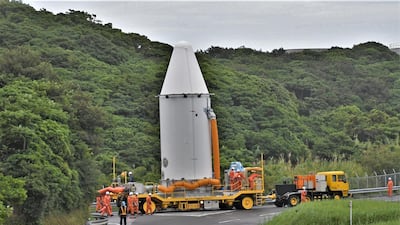
The Hope probe was placed inside this payload fairing last week and was transferred to building where the rocket is kept. Courtesy: Shoma Watanbe -
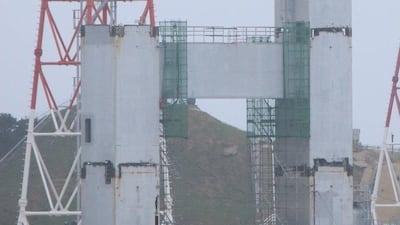
The launch pad is ready to receive the H-IIA rocket, which will deliver the Hope probe to space. It will take 30 to 40-minutes for the rocket to be transported to the launch pad. Courtesy: Yoshiaki Sakita -
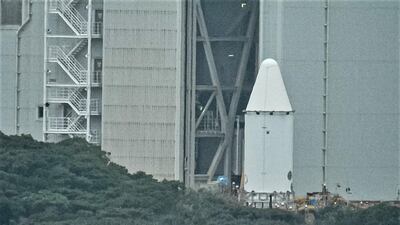
The payload fairing, which is holding the spacecraft, has been mounted on top of the rocket. The structure is meant to protect the probe from dynamic pressure and aerodynamic heating it experiences during its launch into an atmosphere. Courtesy: Shoma Watanbe -
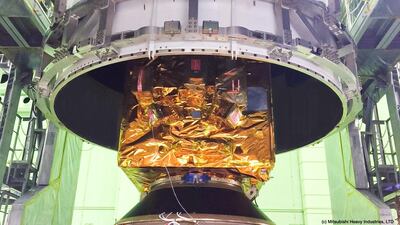
The probe was already fuelled with 800kgs of hydrogen for its seven-month-long journey to Mars. Courtesy: Emirates Mars Mission -
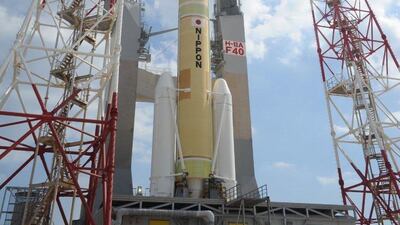
The H-IIA rocket that will carry the Hope probe into space. Dubai Twitter account -

All launch viewing events in Tanegashima have been suspended as part of the Covid-19 safety measures. Signs have been up in all of popular spots, asking the public to keep a 3km distance from the Tanegashima Space Centre on launch day. Courtesy: Yoshiaki Sakita -
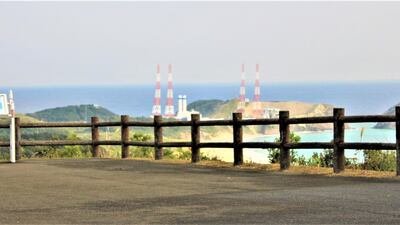
The most popular launch viewing site is the Rocket Hill. It is a five-minute drive from the main building of the Tangashima Space Centre and offers a clear view of the launch. It remains closed to the public. The National -

The free bus tour and exhibition at the Tanegashima Space Centre has also been suspended in efforts to contain the Covid-19 spread. Signs were placed outside of the centre, alerting the public. Courtesy: Yoshiaki Sakita -
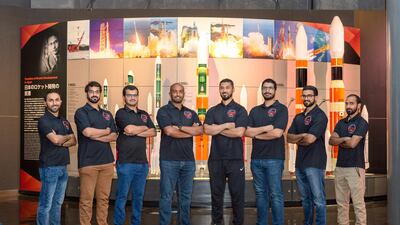
Engineers at the launch site in Tanegashima island, Japan. Courtesy: Emirates Mars Mission -

The completed Hope spacecraft. It will study the lower and upper atmosphere of Mars. Courtesy: Emirates Mars Mission


He said he was most excited about the images and data the Hope probe will send to Earth from the Red Planet.
The spacecraft will capture high-resolution photos and study the relationship between the upper and lower atmospheres of the planet.
Maj Al Mansouri said the mission would be critical to help scientists understand how life can be enhanced for humans on Earth.
“This probe will give a full picture of Mars and more understanding of the planet,” he said.
Research has indicated that life may have existed on Mars.
But the planet’s water dried up and the atmosphere is now too thin for any life to exist.
The Hope probe will also study why gases are leaking from the atmosphere.
“This is really important because what happened on Mars so many years ago can happen here," Maj Al Mansouri said.
"Analysing all of the factors and reasons behind it will help us learn how to live a better life on Earth.”
More than anything, Maj Al Mansouri said he was proud to see the UAE reach another major space milestone.
“I’m really honoured to be living at a time when there are so many space achievements happening here in the UAE," he said.
The launch can be watched live on the Emirates Mars Mission website.

