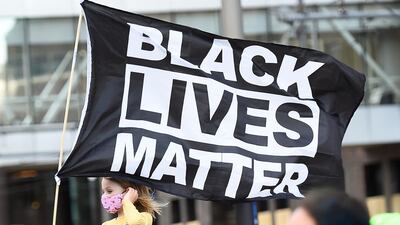
A young girl holds a flag reading 'Black Lives Matter' as protesters march through downtown Minneapolis on the first day of opening statements for the murder trial of former Minneapolis police officer Derek Chauvin who was charged in the death of George Floyd. EPA
A young girl holds a flag reading 'Black Lives Matter' as protesters march through downtown Minneapolis on the first day of opening statements for the murder trial of former Minneapolis police officer

Millennials effect change on corporate behaviour in the US


  • English
  • Arabic

A push to attract young and diverse talent and global consumers is behind some of corporate America's willingness to speak out on politically charged issues like Georgia's new voting law, executives and corporate governance experts said.

Georgia's decision last month to strengthen identification requirements for absentee ballots and make it a misdemeanour to offer food and water to voters waiting in line, among other changes, drew condemnation from many US companies this week, including Microsoft and Citigroup.

A number of companies say it disenfranchises some voters. Some, such as Delta Air Lines and Coca-Cola, are based in Georgia, where state lawmakers have the power to raise state taxes. Delta chief executive Ed Bastian said in a public memo that his decision to speak out was informed by discussions with leaders and employees in the Black community.

The companies criticising the law so far represent a sliver of the US business landscape. Yet they are part of a growing group of companies shedding their reluctance to speak out on politically controversial social issues that matter to many of their employees and customers globally, business leaders interviewed by Reuters said.

"Young people want more than words, they want action," Debra Lee, the former chair and chief executive of BET Networks, a TV network owned by ViacomCBS, said in an interview on Thursday. ViacomCBS has also criticised the Georgia law.

A new focus from investors on environmental, social and governance issues such as climate change and the Black Lives Matter and #MeToo movements has also emboldened companies.

Recent examples range from companies criticising former President Donald Trump's claims of election fraud, to Washington Redskins football stadium sponsor Fedex asking for a team name change. Retailers Walmart and Dick's Sporting Goods, for example, have adopted new restrictions on gun sales following mass shootings.

Some companies that are reluctant to criticise specific laws or policies are still willing to come out with more general statements. For example, roughly 330 of the 500 companies in the S&P 500 Index issued comments last year in support of social justice in the wake of the death of George Floyd, a Black man, in the custody of Minneapolis police, according to shareholder advocacy group As You Sow.

This approach, however, does not always appease activists looking for bigger change. Olivia Knight, the group's racial justice initiative coordinator, said companies often did not follow up with any action, and that many were limited to vague statements of support.

"I don’t think we can make the assumption the corporate world is a pot of social justice advocacy and should be looked to for guidance on these issues," she said.

On Thursday, Reuters reported that Ford Motor's political action committee is resuming making political donations. It said it will not rule out making donations to Republican lawmakers who voted against President Joe Biden's election certification on January 6.

Former American Express chief executive Ken Chenault, who co-authored a letter with other Black business leaders this week calling on companies to condemn the Georgia voting law, said in an interview that some firms may be hesitant to speak out for fear of appearing partisan.

But he noted that more than 60 big US companies recently signed a statement opposing state bills focused on sexual orientation, showing a willingness to weigh in at least on some topics. In the battle on voting bills, "we are in the early stages," Mr Chenault said.

Workers and consumers

Speaking out against politically sensitive issues can be risky. Shares of some western apparel companies declined after they faced boycotts in China over their statements expressing concern about labour conditions, amid investor worries they would lose access to a vast, growing market. However, companies that spoke out against the Georgia voting law saw little impact on their share price.

Shivaram Rajgopal, a Columbia Business School professor who follows corporate cultural issues, said corporate America is focused on satisfying its skilled young workers, who are getting more politically active on social media.

"The younger workforce expects you to take a stand on these social justice issues," Mr Rajgopal said.

A 2019 study by the Pew Research Center found members of the US generations known as Millennials, born between 1981 and 1996, and Gen Z, born after 1996, share more liberal attitudes than older generations on a range of issues, such as favouring more racial diversity and activist government.

"If we are not speaking up against these voter suppression efforts, we're really taking a chunk out of ourselves and who we are as aviation," said Sara Nelson, president of the Association of Flight Attendants, speaking at a US aviation summit on Wednesday.

The views of global customers and investors also matter more to international conglomerates like Coke and Delta than local politics, said Ric Marshall, executive director at sustainability ratings firm MSCI.

"Management at these companies is much more beholden to this broader stakeholder group," Mr Marshall said. Conversely, companies that have said less about voting rights could be wary of alienating a more domestic customer base, he said.


UAE jiu-jitsu squad

Men: Hamad Nawad and Khalid Al Balushi (56kg), Omar Al Fadhli and Saeed Al Mazroui (62kg), Taleb Al Kirbi and Humaid Al Kaabi (69kg), Mohammed Al Qubaisi and Saud Al Hammadi (70kg), Khalfan Belhol and Mohammad Haitham Radhi (85kg), Faisal Al Ketbi and Zayed Al Kaabi (94kg)

Women: Wadima Al Yafei and Mahra Al Hanaei (49kg), Bashayer Al Matrooshi and Hessa Al Shamsi (62kg)

Scorecard

Scotland 220

K Coetzer 95, J Siddique 3-49, R Mustafa 3-35

UAE 224-3 in 43,5 overs

C Suri 67, B Hameed 63 not out

Skoda Superb Specs

Engine: 2-litre TSI petrol

Power: 190hp

Torque: 320Nm

Price: From Dh147,000

Available: Now

Desert Warrior

Starring: Anthony Mackie, Aiysha Hart, Ben Kingsley

Director: Rupert Wyatt

Rating: 3/5

Mercer, the investment consulting arm of US services company Marsh & McLennan, expects its wealth division to at least double its assets under management (AUM) in the Middle East as wealth in the region continues to grow despite economic headwinds, a company official said.

Mercer Wealth, which globally has $160 billion in AUM, plans to boost its AUM in the region to $2-$3bn in the next 2-3 years from the present $1bn, said Yasir AbuShaban, a Dubai-based principal with Mercer Wealth.

Within the next two to three years, we are looking at reaching $2 to $3 billion as a conservative estimate and we do see an opportunity to do so,” said Mr AbuShaban.

Mercer does not directly make investments, but allocates clients’ money they have discretion to, to professional asset managers. They also provide advice to clients.

“We have buying power. We can negotiate on their (client’s) behalf with asset managers to provide them lower fees than they otherwise would have to get on their own,” he added.

Mercer Wealth’s clients include sovereign wealth funds, family offices, and insurance companies among others.

From its office in Dubai, Mercer also looks after Africa, India and Turkey, where they also see opportunity for growth.

Wealth creation in Middle East and Africa (MEA) grew 8.5 per cent to $8.1 trillion last year from $7.5tn in 2015, higher than last year’s global average of 6 per cent and the second-highest growth in a region after Asia-Pacific which grew 9.9 per cent, according to consultancy Boston Consulting Group (BCG). In the region, where wealth grew just 1.9 per cent in 2015 compared with 2014, a pickup in oil prices has helped in wealth generation.

BCG is forecasting MEA wealth will rise to $12tn by 2021, growing at an annual average of 8 per cent.

Drivers of wealth generation in the region will be split evenly between new wealth creation and growth of performance of existing assets, according to BCG.

Another general trend in the region is clients’ looking for a comprehensive approach to investing, according to Mr AbuShaban.

“Institutional investors or some of the families are seeing a slowdown in the available capital they have to invest and in that sense they are looking at optimizing the way they manage their portfolios and making sure they are not investing haphazardly and different parts of their investment are working together,” said Mr AbuShaban.

Some clients also have a higher appetite for risk, given the low interest-rate environment that does not provide enough yield for some institutional investors. These clients are keen to invest in illiquid assets, such as private equity and infrastructure.

“What we have seen is a desire for higher returns in what has been a low-return environment specifically in various fixed income or bonds,” he said.

“In this environment, we have seen a de facto increase in the risk that clients are taking in things like illiquid investments, private equity investments, infrastructure and private debt, those kind of investments were higher illiquidity results in incrementally higher returns.”

The Abu Dhabi Investment Authority, one of the largest sovereign wealth funds, said in its 2016 report that has gradually increased its exposure in direct private equity and private credit transactions, mainly in Asian markets and especially in China and India. The authority’s private equity department focused on structured equities owing to “their defensive characteristics.”

The specs

Engine: 3-litre twin-turbo V6

Power: 400hp

Torque: 475Nm

Transmission: 9-speed automatic

Price: From Dh215,900

On sale: Now

The specs

Price, base / as tested Dh960,000
Engine 3.9L twin-turbo V8 
Transmission Seven-speed dual-clutch automatic
Power 661hp @8,000rpm
Torque 760Nm @ 3,000rpm
Fuel economy, combined 11.4L / 100k

Saturday's results

West Ham 2-3 Tottenham
Arsenal 2-2 Southampton
Bournemouth 1-2 Wolves
Brighton 0-2 Leicester City
Crystal Palace 1-2 Liverpool
Everton 0-2 Norwich City
Watford 0-3 Burnley

Manchester City v Chelsea, 9.30pm 

Kanye%20West
%3Cp%3EYe%20%E2%80%94%20the%20rapper%20formerly%20known%20as%20Kanye%20West%20%E2%80%94%20has%20seen%20his%20net%20worth%20fall%20to%20%24400%20million%20in%20recent%20weeks.%20That%E2%80%99s%20a%20precipitous%20drop%20from%20Bloomberg%E2%80%99s%20estimates%20of%20%246.8%20billion%20at%20the%20end%20of%202021.%3Cbr%3EYe%E2%80%99s%20wealth%20plunged%20after%20business%20partners%2C%20including%20Adidas%2C%20severed%20ties%20with%20him%20on%20the%20back%20of%20anti-Semitic%20remarks%20earlier%20this%20year.%3Cbr%3EWest%E2%80%99s%20present%20net%20worth%20derives%20from%20cash%2C%20his%20music%2C%20real%20estate%20and%20a%20stake%20in%20former%20wife%20Kim%20Kardashian%E2%80%99s%20shapewear%20firm%2C%20Skims.%3C%2Fp%3E%0A
COMPANY PROFILE
Name: HyperSpace
 
Started: 2020
 
Founders: Alexander Heller, Rama Allen and Desi Gonzalez
 
Based: Dubai, UAE
 
Sector: Entertainment 
 
Number of staff: 210 
 
Investment raised: $75 million from investors including Galaxy Interactive, Riyadh Season, Sega Ventures and Apis Venture Partners
Japan 30-10 Russia

Tries: Matsushima (3), Labuschange | Golosnitsky

Conversions: Tamura, Matsuda | Kushnarev

Penalties: Tamura (2) | Kushnarev