At the Aqdar World Summit in Moscow last month, the Minister for Artificial intelligence, Omar Al Olama, spoke enthusiastically about advances in instant translation.
Within a short time, he predicted, it would be possible to communicate instantly and accurately in any language in the world, despite not knowing a single word.
Such a tool has obvious applications in the UAE, where by some estimates there are 200 nationalities in residence.
It is another reason why the UAE has embraced the potential of artificial intelligence, including the appointment of the world’s first AI government minister.
The complex algorithms that underlie simultaneous translation are made possible by artificial intelligence.
A topic that some fear as a threat to humanity from a new form of machine-based consciousness, is recognised as a tool that can help us in the UAE, promoting greater understanding and tolerance.
“The quality of life and improving the lives of citizens is why we embrace artificial intelligence,” the minister told his audience in Russia.
The country has placed AI at the core of its strategy for 2030 and even the centenary in 2071. It aims to boost productivity, promote a knowledge-based economy and create more productive and cost-effective government services.
But artificial intelligence is not something for 10 or even 50 years into the future. The first steps are being taken now, already changing the way we live, learn and work.
One of the most immediate applications is on the roads. From December, new drivers in Abu Dhabi will have their skills assessed using artificial intelligence.
Test cars will be fitted with nearly a dozen cameras constantly using AI to monitor the driver’s use of mirrors, signalling and general road use to see if they are ready to be given a licence. A similar system is being introduced in Dubai.
Once on the road, drivers will encounter AI at every journey. Surveillance cameras use number plate and facial recognition to keep traffic flowing and spot infringements.
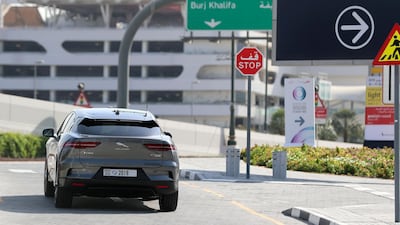
A Jaguar iPace autonomous vehicle takes people on a drive to show driverless cars at work. Chris Whiteoak / The National
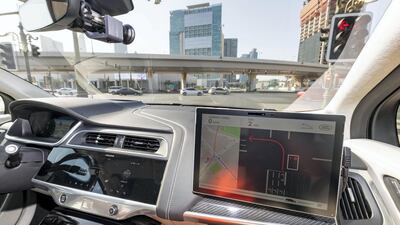
The vehicle's destination is programme into the onboard computer. Chris Whiteoak / The National
Jim O'Donoghue, lead research engineer, observes hands-free as the vehicle drives around the Zabeel area of the city. 'If we were doing more driving around Dubai, we would need an awful lot more sensors', he says. Chris Whiteoak / The National
The driver can take over the controls from the computer should anything go wrong. Chris Whiteoak / The National
A Jaguar I Pace autonomous vehicle was on show at the Dubai World Congress for Self-Driving Transport this week. Chris Whiteoak / The National
They also ensure that the country remains one of the safest and most secure in the world. Dubai’s AI powered CCTV camera network, known as Oyoon, or eyes, is credited with the arrest of over 300 suspects last year.
In Abu Dhabi, it led to the rapid arrest of the killer of a kindergarten teacher in December 2014 after the murderer’s vehicle was identified and tracked.
Similar technology is in use at airports, in this instance using face recognition as part of the e-gates at Dubai and Abu Dhabi, and verifying travellers in seconds as they enter and leave the country.
In the not-to-distant future, AI could provide such an accurate match by mapping individuals, that passports would be unnecessary
Artificial intelligence even helps serve up the UAE’s famous Friday brunches. Concerns about the financial and ethic issue of food waste is being addressed by several hotels, who monitor left-overs on an AI based measuring system that uses a camera and scale to identify the amount and type of food being thrown away and gives it a monetary value.
Omar Al Olama, Minister of State for Artificial Intelligence, is spearheading efforts to cement the UAE as a global hub for the rapidly-developing technology.
Knowing what is not being eaten, allows caterers to reduce food waste by up to half in some cases. The system, known as Winnow, saves the Hilton at JBR $65,000 a year, with Dr Thani Al Zeyoudi, Minister of Climate Change and Environment, urging its introduction across the UAE’s hospitality industry.
In medicine, AI is increasingly taking on a diagnostic role, allow doctors to devote more time to health care and saving hundreds of millions of dirhams
Impressive as these initiatives are, they are just a taste of what is to come. The country’s AI strategy covers sectors ranging from transport, health, space, renewable energy, education and traffic.
It will play a key role in ensuring the UAE remains competitive in global markets as it transitions to a post-oil economy. As the Education Minister, Hussain Al Hammadi pointed out this month “we need new approaches and new schools. The speed of implementation must be very high, otherwise we will not be able to stay abreast of the latest developments worldwide.”
Or, as the Minister for Artificial Intelligence put it recently “making us all smarter as human beings.”

The candidates
Dr Ayham Ammora, scientist and business executive
Ali Azeem, business leader
Tony Booth, professor of education
Lord Browne, former BP chief executive
Dr Mohamed El-Erian, economist
Professor Wyn Evans, astrophysicist
Dr Mark Mann, scientist
Gina MIller, anti-Brexit campaigner
Lord Smith, former Cabinet minister
Sandi Toksvig, broadcaster
Ten tax points to be aware of in 2026
1. Domestic VAT refund amendments: request your refund within five years
If a business does not apply for the refund on time, they lose their credit.
2. E-invoicing in the UAE
Businesses should continue preparing for the implementation of e-invoicing in the UAE, with 2026 a preparation and transition period ahead of phased mandatory adoption.
3. More tax audits
Tax authorities are increasingly using data already available across multiple filings to identify audit risks.
4. More beneficial VAT and excise tax penalty regime
Tax disputes are expected to become more frequent and more structured, with clearer administrative objection and appeal processes. The UAE has adopted a new penalty regime for VAT and excise disputes, which now mirrors the penalty regime for corporate tax.
5. Greater emphasis on statutory audit
There is a greater need for the accuracy of financial statements. The International Financial Reporting Standards standards need to be strictly adhered to and, as a result, the quality of the audits will need to increase.
6. Further transfer pricing enforcement
Transfer pricing enforcement, which refers to the practice of establishing prices for internal transactions between related entities, is expected to broaden in scope. The UAE will shortly open the possibility to negotiate advance pricing agreements, or essentially rulings for transfer pricing purposes.
7. Limited time periods for audits
Recent amendments also introduce a default five-year limitation period for tax audits and assessments, subject to specific statutory exceptions. While the standard audit and assessment period is five years, this may be extended to up to 15 years in cases involving fraud or tax evasion.
8. Pillar 2 implementation
Many multinational groups will begin to feel the practical effect of the Domestic Minimum Top-Up Tax (DMTT), the UAE's implementation of the OECD’s global minimum tax under Pillar 2. While the rules apply for financial years starting on or after January 1, 2025, it is 2026 that marks the transition to an operational phase.
9. Reduced compliance obligations for imported goods and services
Businesses that apply the reverse-charge mechanism for VAT purposes in the UAE may benefit from reduced compliance obligations.
10. Substance and CbC reporting focus
Tax authorities are expected to continue strengthening the enforcement of economic substance and Country-by-Country (CbC) reporting frameworks. In the UAE, these regimes are increasingly being used as risk-assessment tools, providing tax authorities with a comprehensive view of multinational groups’ global footprints and enabling them to assess whether profits are aligned with real economic activity.
Contributed by Thomas Vanhee and Hend Rashwan, Aurifer
PSA DUBAI WORLD SERIES FINALS LINE-UP
Men’s:
Mohamed El Shorbagy (EGY)
Ali Farag (EGY)
Simon Rosner (GER)
Tarek Momen (EGY)
Miguel Angel Rodriguez (COL)
Gregory Gaultier (FRA)
Karim Abdel Gawad (EGY)
Nick Matthew (ENG)
Women's:
Nour El Sherbini (EGY)
Raneem El Welily (EGY)
Nour El Tayeb (EGY)
Laura Massaro (ENG)
Joelle King (NZE)
Camille Serme (FRA)
Nouran Gohar (EGY)
Sarah-Jane Perry (ENG)
December 2014: Former UK finance minister George Osbourne reforms stamp duty, replacing the slab system with a blended rate scheme, with the top rate increasing to 12 per cent from 10 per cent:
Up to £125,000 - 0%; £125,000 to £250,000 – 2%; £250,000 to £925,000 – 5%; £925,000 to £1.5m: 10%; Over £1.5m – 12%
April 2016: New 3% surcharge applied to any buy-to-let properties or additional homes purchased.
July 2020: Rishi Sunak unveils SDLT holiday, with no tax to pay on the first £500,000, with buyers saving up to £15,000.
March 2021: Mr Sunak decides the fate of SDLT holiday at his March 3 budget, with expectations he will extend the perk unti June.
April 2021: 2% SDLT surcharge added to property transactions made by overseas buyers.
Here, Dr Mohamed El Abiary, paediatric consultant at Al Zahra Hospital Dubai, shares some advice for parents whose children are fasting during the holy month of Ramadan:
Gradual fasting and golden points - For children under the age of 10, follow a step-by-step approach to fasting and don't push them beyond their limits. Start with a few hours fasting a day and increase it to a half fast and full fast when the child is ready. Every individual's ability varies as per the age and personal readiness. You could introduce a points system that awards the child and offers them encouragement when they make progress with the amount of hours they fast
Why fast? - Explain to your child why they are fasting. By shedding light on the importance of abstaining from food and drink, children may feel more encouraged to give it there all during the observance period. It is also a good opportunity to teach children about controlling urges, doing good for others and instilling healthy food habits
Sleep and suhoor - A child needs adequate sleep every night - at least eight hours. Make sure to set a routine early bedtime so he/she has sufficient time to wake up for suhoor, which is an essential meal at the beginning of the day
Good diet - Nutritious food is crucial to ensuring a healthy Ramadan for children. They must refrain from eating too much junk food as well as canned goods and snacks and drinks high in sugar. Foods that are rich in nutrients, vitamins and proteins, like fruits, fresh meats and vegetables, make for a good balanced diet
All kick-off times 10.45pm UAE ( 4 GMT) unless stated
Tuesday
Sevilla v Maribor
Spartak Moscow v Liverpool
Manchester City v Shakhtar Donetsk
Napoli v Feyenoord
Besiktas v RB Leipzig
Monaco v Porto
Apoel Nicosia v Tottenham Hotspur
Borussia Dortmund v Real Madrid
Wednesday
Basel v Benfica
CSKA Moscow Manchester United
Paris Saint-Germain v Bayern Munich
Anderlecht v Celtic
Qarabag v Roma (8pm)
Atletico Madrid v Chelsea
Juventus v Olympiakos
Sporting Lisbon v Barcelona
Living in...
This article is part of a guide on where to live in the UAE. Our reporters will profile some of the country’s most desirable districts, provide an estimate of rental prices and introduce you to some of the residents who call each area home.
THE BIO
Bio Box
Role Model: Sheikh Zayed, God bless his soul
Favorite book: Zayed Biography of the leader
Favorite quote: To be or not to be, that is the question, from William Shakespeare's Hamlet