



The UAE has secured a six-month mission to the International Space Station for an Emirati astronaut, after purchasing a seat on a SpaceX rocket from private company Axiom Space.
The astronaut will be part of the SpaceX Crew-6 mission that is scheduled for launch in the first half of 2023 from Florida’s Kennedy Space Centre.
A deal was signed between the Mohammed bin Rashid Space Centre (MBRSC) and Axiom Space on Wednesday at the UAE Embassy in Washington.
This will be the UAE’s second mission to space, following Hazza Al Mansouri’s historic eight-day trip to the orbiting laboratory in 2019 on a Russian Soyuz rocket.
Sheikh Mohammed bin Rashid, Vice President and Ruler of Dubai, announced the landmark news on Twitter on Friday.
"The UAE will be the 11th country in history to send a long-term mission to space," he wrote.
"Proud of the UAE youth."
The latest trip will be the first long-duration mission by an Arab astronaut, who has not yet be named.
Salem Al Marri, director-general of the Mohammed bin Rashid Space Centre, said that the new mission will pave the way for future initiatives that will help the UAE become a “leading nation in the world of space exploration”.
"With the aim of strengthening co-operation between the UAE and the USA that involves prominent institutions such as Axiom Space in the space-exploration sector, we are delighted to announce this important partnership that will help us further advance our space programme,” he said.
The National revealed in June of 2021 that the UAE was trying to secure a second mission to space and that the space centre was in discussions with international partners.
-

UAE astronauts Hazza Al Mansouri and Sultan Al Neyadi are learning how to operate the Canadarm2, a robotic arm on the International Space Station, at the Nasa Johnson Space Centre in Houston. The arm is used by astronauts to capture Cygnus cargo supply vehicles that brings food and science experiments. Photo: Dr Al Neyadi Twitter -
Maj Al Mansouri became the first Arab to go to the ISS in 2019 when he spent eight days there. Photo: Maj Al Mansouri Twitter -
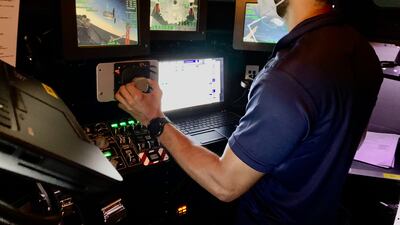
Dr Al Neyadi learning how to operate the Canadarm2 robotic arm on the International Space Station. Photo: Dr Al Neyadi Twitter -

Maj Al Mansouri said operating the robotic arm on the International Space Station requires a lot of teamwork. Photo: Maj Al Mansouri Twitter -
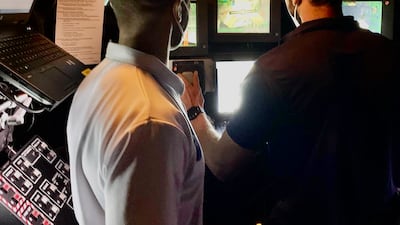
Maj Al Mansouri and Dr Al Neyadi are training at Nasa Johnson Space Centre in Houston. Photo: Dr Al Neyadi Twitter


Which Emirati astronaut is going?
The UAE has four members in its astronaut corps, including Maj Al Mansouri, former IT professional Dr Sultan Al Neyadi, Dubai Police helicopter pilot Mohammed Al Mulla, and mechanical engineer Nora Al Matrooshi, who is the first Arab female astronaut.
Mr Al Marri told The National that they will announce which astronaut has been selected in due course.
All four astronauts have been training at Nasa’s Johnson Space Centre, with Maj Al Mansouri and Dr Al Neyadi completing two years in September.
-
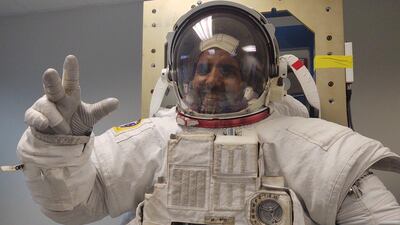
Hazza Al Mansouri, first Emirati man in space, wears a 130 kilogram-heavy extravehicular activities suit for spacewalk training. All photos courtesy of Mohammed bin Rashid Space Centre -
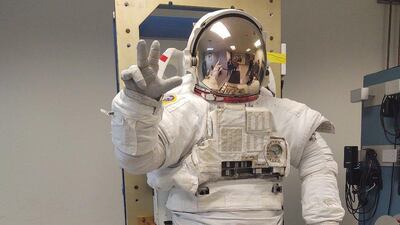
The suit is worn during spacewalks outside of the International Space Station and for training at the world's largest indoor pool at the Johnson Space Centre in Houston, Texas -
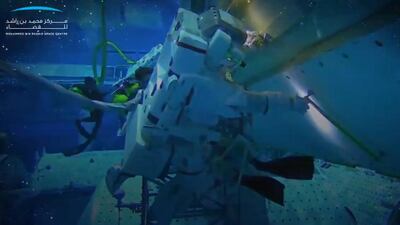
Located at the Neutral Buoyancy Lab (NBL), the indoor pool is 12-metres deep and has 2.4 million litres of water. It helps simulate microgravity and allows astronauts to work on a replica of the International Space Station placed underwater -
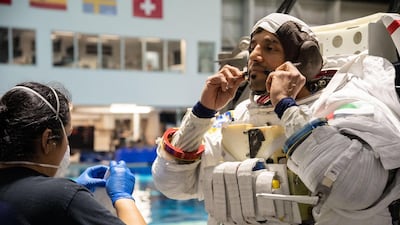
Sultan Al Neyadi, part of the UAE astronaut corps, wears his EVA suit for spacewalk training in the indoor pool -
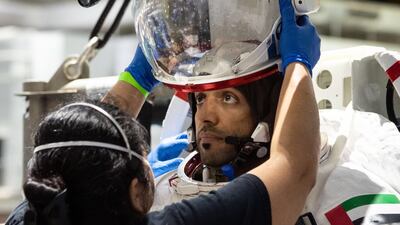
Sultan Al Neyadi puts his helmet on for spacewalk training under water. Mr Al Neyadi was one of two people selected from 4,022 candidates to become the first Emirati astronauts. Mbrsc -
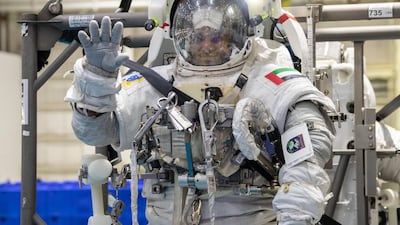
Mr Al Neyadi prepares to go underwater -
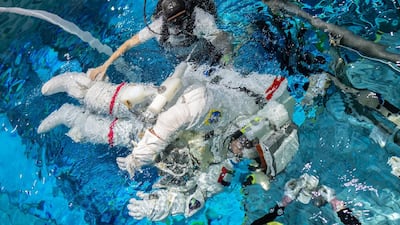
Mr Al Neyadi goes underwater with his EVA suit on for spacewalk training -
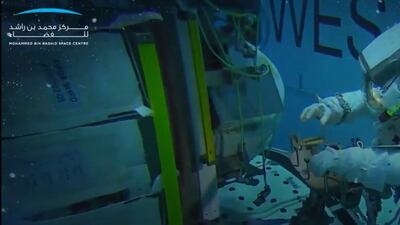
Astronauts can spend up to 10 hours per day at the bottom of the pool to practise maintenance work on the space station model and refine spacewalk techniques. -
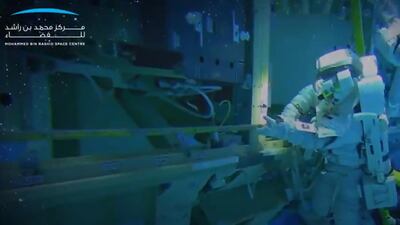
An Emirati astronaut underwater, refining his spacewalk technique. Performing a spacewalk is an extremely dangerous task and requires practise and skill. In 2013, Italian astronaut Luca Parmitano nearly drowned when water leaked into his helmet during a spacewalk. In 2019, Nasa astronaut Chris Cassidy’s wrist mirror broke off, releasing thousands of pieces of space junk -
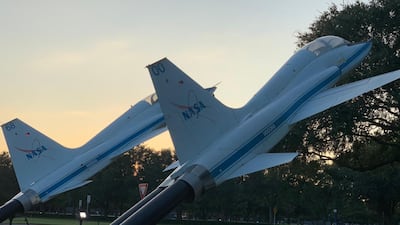
The Emirati astronauts are training for long-haul space missions at the Johnson Space Centre in Houston, Texas. They are also training on T-38 jets, which helps a pilot experience seven G-forces because of the speed. It can fly up to Mach 1.6 and 12,000 metres high – that is 3,000m higher than average airliners.


Mr Al Mulla and Ms Al Matrooshi are the newest members of the astronaut corps, who started their training at Nasa in January.
It is likely that the honour of going on the new trip will be given to one of the UAE’s first two astronauts, who have several years of training and qualify for a long-term science mission on the station.
While in Houston, the astronauts have learned how to perform spacewalks, learn the systems of the ISS, and operate the robotic arm of the station.
What will the astronaut do in space?
The chosen Emirati astronaut will serve as mission specialist on the Dragon capsule, and will fly alongside Nasa astronauts Stephen Bowen, spacecraft commander, and Warren Hoburg, who will serve as Dragon’s pilot. A fourth crew member is yet to be identified.
While on the space station, the Emirati astronaut will carry out several science experiments alongside his colleagues.
Mr Al Marri told The National that Nasa will release a schedule of the astronauts’ activities in space, including if the Emirati astronaut has been selected to perform a spacewalk.
“The exact schedule of the mission has not been completed yet. This will be a mission that is jointly planned with Nasa,” he said.
“It’s something that we'll be discussing extensively with the team at Johnson Space Centre.
“Based on what they are planning for Crew-6 to do, if there's a requirement for a spacewalk, then that's something that Nasa would schedule.
“Will our astronaut be able to conduct that spacewalk? That depends on the way that they select the astronauts for EVA (extravehicular activity).”
How did the UAE secure a seat?
This is the Falcon 9 seat that Axiom Space got in exchange from Nasa, after the company gave up its Russian Soyuz rocket seat for American astronaut, Mark Vande Hei, in 2021.
MBRSC did not disclose how much they paid Axiom for the seat, but the agreement includes transportation to and from the space station; comprehensive mission support; all necessary training and preparation for launch; flight operations; and landing and crew rescue services.
Michael Suffredini, Axiom president and chief executive, said it was “proud to provide the space centre with a flight opportunity”.
“It is our great pleasure to sign the agreement with the United Arab Emirates’ Mohammed bin Rashid Space Centre, marking the first time a US commercial company has made such a mission possible,” he said.
Axiom Space launched on April 8 the first short-duration private mission to the ISS, where each crew member reportedly paid $55 million.
Mr Al Marri told The National that the UAE’s arrangement is “totally different”, and that it is based on a partnership with Axiom Space and Nasa.
Increased access to space
With the rise of private companies such as Elon Musk's SpaceX and Axiom, agencies are benefiting from an increased access to space.
For more than a decade, only Russia could deliver astronauts to the ISS on its Soyuz rockets, after the US disbanded its Space Shuttle programme in 2011.
Now, Nasa has partnered with SpaceX to launch government astronauts to the station, as part of its US Commercial Crew Programme.
Nasa's could see another private company sending its astronauts to the ISS in future. Boeing will perform an uncrewed test flight of its CST-100 Starliner spacecraft on May 19.
It will lift off on the United Launch Alliance Atlas V rocket from the Cape Canaveral Space Force Station in Florida.
SpaceX has also carried out private missions to space, including for Axiom Space, which organises trips for private clients.
Axiom Space, a Houston-based space travel and infrastructure company, also has plans to build a commercial space station in low-Earth orbit that would eventually replace the ISS once it retires end of this decade.
Axiom's station will be attached to the ISS, creating access for researchers, astronauts and tourists.
Once the space station retires, Axiom will detach its modules and commence operations on its own.

