


Without the Sun, life on Earth would be impossible. But few of us understand what happens on its surface.
New research has uncovered high-frequency waves that curl around the Sun and could even stretch deep into its heart, and they appeared to travel much faster than predicted by theory.
Teams from New York University Abu Dhabi are behind the discovery, which was detected after a team of researchers looked through a quarter of a century’s data.
Appearing as either anti-clockwise or clockwise motion, they exist both above and below the Sun’s equator, the scientists revealed in a newly published paper with the findings surprising even them.
NYUAD’s Centre for Space Science
“We weren’t looking for them originally,” said Dr Chris Hanson, a research associate in NYUAD’s Centre for Space Science and the study’s first author. “It’s something beyond what we were expecting.”
The waves are termed “retrograde” because they move across the surface in the opposite direction to the sun’s rotation.
The researchers looked at data from telescopes across the globe that continuously record data on the Sun. Small shifts in the sound waves on the Sun’s surface allowed the researchers to detect the high-frequency retrograde (HFR) waves.
Dr Hanson said it is comparable to the way that geophysicists detect oil underground. Large vibrations are generated on the surface of the Earth and these travel down and back up again, and if they pass through oil, the sound wave changes slightly.
Clues about behaviour of the Sun
The HFR waves are found in the same way and may be present through the whole of the Sun’s convective zone, which covers its outer 30 per cent. There are two other main sections, the middle radiative zone and the inner core.
However, the data used in the study covers just the outer three per cent of the sun, so it remains unclear how deep they exist. But detecting them on the surface may still offer clues about the internal behaviour of the Sun.
“In theory, they could be going very deep,” said Dr Hanson. “Unfortunately they’re very weak so we’ve not been able to look that much deeper.”
Astrophysicists already knew of different types of wave on the Sun’s surface, called Rossby waves, which are larger than the HFR waves and travel across the surface in the opposite direction to the sun’s rotation.
How the Sun behaves is of more than academic significance, because disturbances on its surface, such as those that cause solar storms — events when the sun gives off large amounts of electromagnetic radiation — affect Earth, such as by creating electrical surges.
Most exciting missions scheduled for 2022
-

From launching the first Arab mission to the Moon to looking into the early universe using the world’s most powerful telescope – the new year is going to be a busy one for space exploration. The National looks at some of the most exciting missions scheduled for 2022. Photo: Nasa -
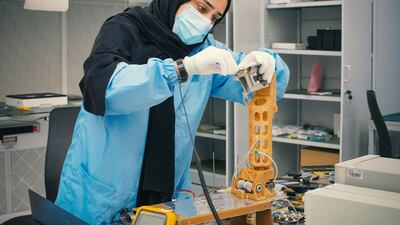
Engineers at the Mohammed bin Rashid Space Centre have been planning a Moon mission since 2017. They have built a 10-kilogram rover called Rashid that will study lunar soil and its properties. It is scheduled for a launch sometime between August to December 2022. Photo: Mohammed bin Rashid Space Centre -
The final prototype of the UAE's Rashid Moon rover. Photo: Mohammed bin Rashid Space Centre -

Two Emirati candidate astronauts are to begin training at Nasa’s Johnson Space Centre in Houston, Texas, in January. Mohammed Al Mulla, a Dubai Police helicopter pilot, and Nora Al Matrooshi, a mechanical engineer, will spend two years in training. Chris Whiteoak / The National -
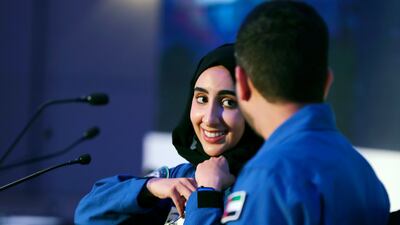
Nora Al Matrooshi and Mohammed Al Mulla will learn the systems of the International Space Station, the Russian language, robotics and how to perform spacewalks. Once they graduate, both astronauts would become eligible for space missions. AP -

Nora Al Matrooshi and Mohammed Al Mulla are the generation of astronauts that could go to the Moon one day. The UAE has its sights set on human missions to the lunar surface. Chris Whiteoak / The National -

US space agency Nasa is preparing the space launch system and Orion spacecraft for the Artemis 1 launch on March 12, which will involve a three-week, uncrewed test flight to the Moon. AFP / Nasa -
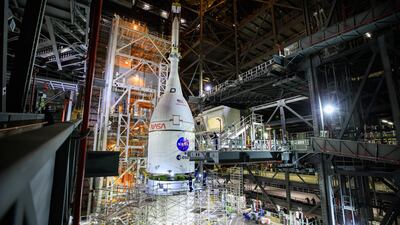
During the mission, the Orion spacecraft will fly 100 kilometres above the Moon’s surface and then use its gravitation force to become captured in an opposite orbit about 70,000 kilometres from the Moon. EPA / Nasa -
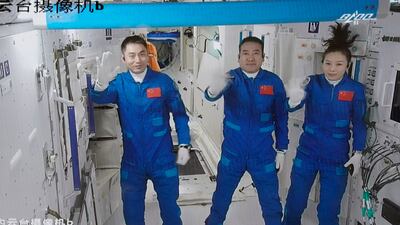
Completion of China’s space station is scheduled for the end of 2022. The Tiangong’s core module Tianhe is already in orbit and has been hosting astronauts, including Wang Yaping, its first female astronaut. Xinhua / AP -
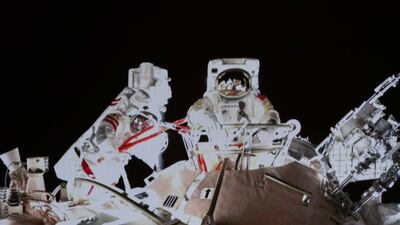
Wang Yaping was sent to the station earlier this year. On November 8, the 41-year-old also became the first Chinese female astronaut to perform a spacewalk. Xinhua / AP -
South Korea plans to launch its first lunar mission in 2022. The Korea Pathfinder orbiter will be launched on a SpaceX Falcon 9 rocket. Photo: Korea Aerospace Research Agency -
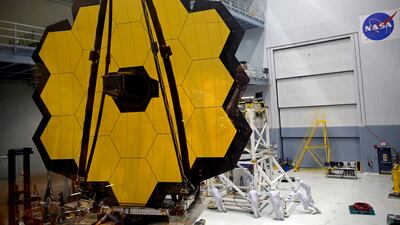
The James Webb Space Telescope will be capable of 'looking back' 13.5 billion years to see the first stars and galaxies of the universe and search for signs of life. It was launched on Saturday, December 25, 2021, and it is expected to make several discoveries when it becomes operational in 2022. Reuters


Like the Sun, the Earth has waves on its surface consisting of movement of air and water that generate currents and wind patterns.
However, whether other stars exhibit similar patterns of movement to the Sun is unclear. Finding out is extremely difficult because the distances involved are so huge.
The second-closest star, Proxima Centauri, at a distance of more than 4.2 light years, is more than 260,000 times further from Earth than the Sun.
“The other stars, they’re very, very far away,” said Dr Hanson. “We don’t get that spatial resolution. It would be great if we could see these waves in other stars.
“There are oceanic and atmospheric waves. These patterns in other astrophysical bodies, it’s certainly possible.”
The challenge now is to understand how the HFR waves are formed. Researchers will produce mathematical models to simulate wave motion in the Sun and the hope is that as additional elements are added to the calculations, the waves will “pop up”, indicating which astrophysical phenomenon causes them.
“In our minds, we don’t know what ingredients cause it,” said Dr Hanson. “We’ll add all kinds of ingredients and see what causes it.”
For Dr Hanson, who has been studying the Sun for more than a decade, our nearest star remains “quite a unique laboratory”.
“The physics found on the Sun are very hard to replicate on Earth,” he said. “It’s an astrophysical body we can learn so much from.”
Dr Hanson and the study’s other authors, Dr Shravan Hanasoge, co-principal investigator of the Centre for Space Science, and Prof Katepalli Sreenivasan, the centre’s principal investigator, have published their findings in Nature Astronomy.
They carried out their work in collaboration with the Tata Institute of Fundamental Research in India, with which Dr Hanasoge is associated.

