
The familiar boom of the cannon at sunset is a sure sign that Ramadan has arrived.
First fired to herald the beginning of the holy month, the cannon is then used daily to announce sunset prayers, maghrib, thus breaking the fast for the day.
The loud blasts from the heavy pieces of artillery are to inform the entire city it is iftar.
Dubai has six cannons that are placed around the emirate during the holy month.
They are taken to Burj Khalifa, Atlantis The Palm, Al Salam Mosque in Al Barsha, Al Mamzar Beach, Al Habbai Mosque in Al Khawaneej and the prayer ground in Al Mankhool.
The National followed Dubai Police officers as they shuttled the artillery from Al Wasl Road to Burj Khalifa.
-
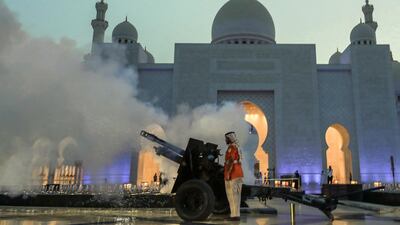
A cannon at Sheikh Zayed Grand Mosque in Abu Dhabi is fired to mark the end of the day's fasting. Victor Besa / The National -
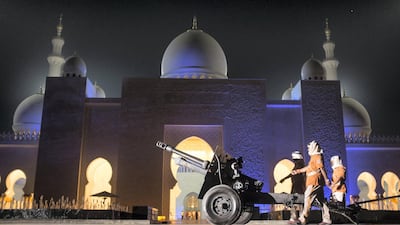
The cannon in front of Sheikh Zayed Grand Mosque is fired daily during Ramadan to signal the sunset, which is when people can break their fast. Reem Mohammed / The National -

The force has been following the custom since the early 1960s in Dubai. EPA -
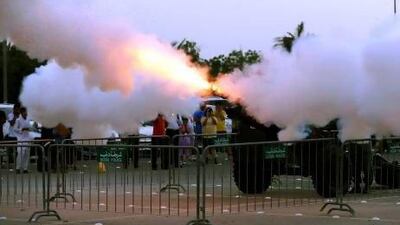
As the first day of Ramadan came to a close yesterday, Dubai Police followed a long tradition by firing their cannon to signal the end of fasting. Satish Kumar / The National -
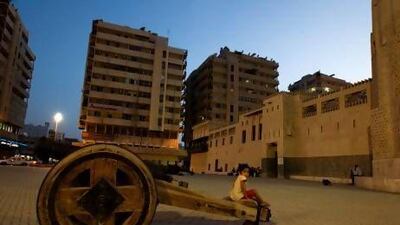
An old cannon stands outside Al Hisn Fort in Al Shuwaiheen, an old neighbourhood in Sharjah. The fort was built in the 1820s by Sheikh Sultan bin Saqr Al Qasimi. It is now open to the public as a museum. Sarah Dea / The National -
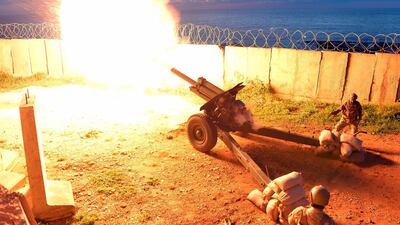
Lebanese military fire a blank from a cannon a day prior to Ramadan to announce the holy month in Beirut, Lebanon, in April 2021. EPA -
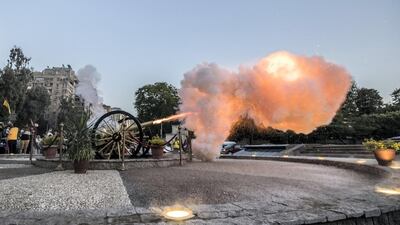
A Ramadan cannon is fired to mark the breaking of the fasting during the Muslim holy month of Ramadan at Giza district in the Egyptian capital Cairo on May 11, 2020. AFP


“We transport the cannons with the help of a police patrol car,” said Maj Abdullah Tarish of the General Department of Protective Security and Emergency.
“We take it three hours before the iftar time at a speed of 70 kilometres per hour. The cannon weighs about two tonnes, so we have to make sure that it arrives safely at the designated spots,” he said.
Some historians say the custom began in 10th-century Egypt to let people know it was time to end their fast.
“In Dubai, the tradition dates back to the 1960s. At that time there were no speaker systems in mosques to announce iftar. People were living a very simple life. The firing of the cannon was the main signal for people to end their fast,” Maj Tarish said.
The cannon were manufactured in Britain in the 1940s and have a sound range of 160 decibels, which can be heard up to 10km away. People are asked to maintain a distance of at least 30 metres from the cannon because of the deafening noise.
According to protocol, four officers operate each cannon. Two of them march towards the cannon, one passes the blank cartridge and the other loads it. Two officers remain at the back as guardians of the cannon and give orders. When it is time for iftar, the officer shouts the order and the cannon is fired.
Two shots are fired to mark the start of Ramadan and once every day to announce iftar. Two blasts signal the start of Eid Al Fitr, marking the end of Ramadan. Two shots are then fired again before the start of prayer on the day of Eid.
“These cannons are very precious for us. They are about 80 years old and they were used in war before. We now use them as a sign of peace and tolerance,” Maj Tarish said.
Although mosques sound the call to prayer from loudspeakers, the cannon-firing tradition lives on.
This year people will not be allowed to witness the firing in person because of coronavirus safety measures. Instead, the ceremony will be broadcast live by local TV channels.
“We hope everyone can watch the event and learn about the rich Arab culture and history. We hope the old generation can tell stories of cannon firing from the 1960s to today’s generation,” Maj Tarish said.
Ramadan in the Gulf – in pictures
-
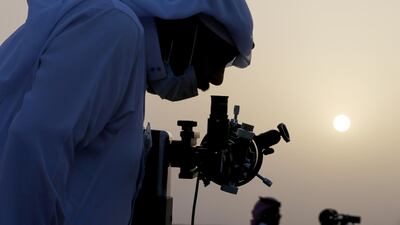
A member of the Moon-sighting committee looks through a telescope near Riyadh, Saudi Arabia, to look for the new crescent moon that will mark the beginning Ramadan the following day. Reuters -
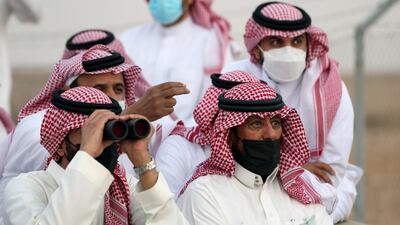
A member of the Moon-sighting committee looks through binoculars, near Riyadh, Saudi Arabia. Reuters -
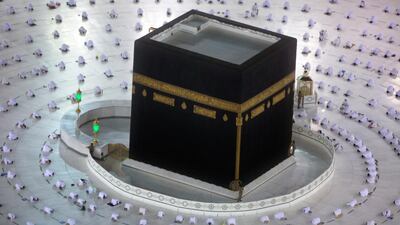
Muslims pray during the first dawn prayers of Ramadan, around the Kaaba, the sacred cube-shaped building at the centre of the Grand Mosque in Makkah, Saudi Arabia. AP Photo -
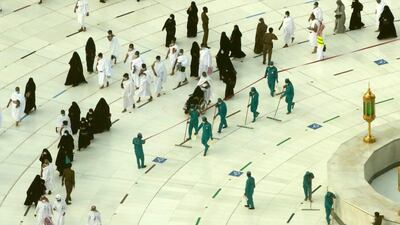
Workers disinfect the ground as Muslim pilgrims walk round the Kaaba, during the Umrah pilgrimage, in Makkah, Saudi Arabia. AP Photo -
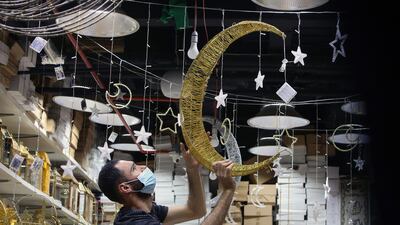
A vendor puts up stars and crescent moon decorations in his shop at a market in Kuwait City, Kuwait, the day before the start of Ramadan. AFP -
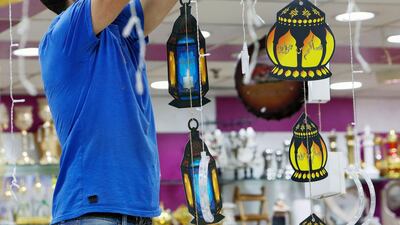
A vendor decorates his shop with lanterns, at a market in Kuwait City, the day before the start of the holy month. AFP -
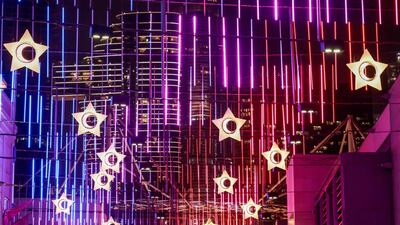
Decorations in the shape of a crescent moon inlaid within a five-pointed star bearing Arabic text reading Ramadan Mubarak – Blessed Ramadan – at the City Walk district of Dubai, with the Burj Khalifa in the background. AFP -
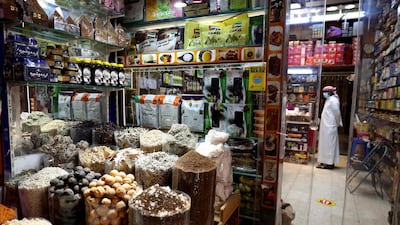
A customer inspects the produce at a spice shop in Dubai, ahead of the holy month. AFP -
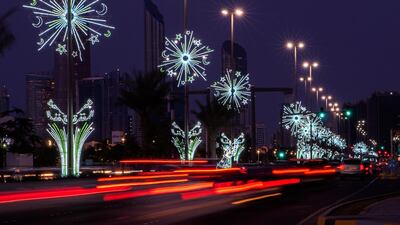
Ramadan lights illuminate the Corniche in Abu Dhabi. Victor Besa / The National -
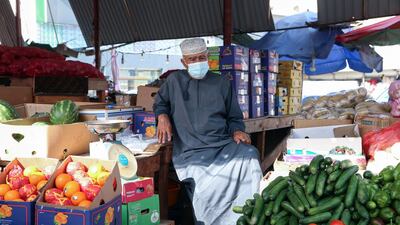
A vendor sells fresh produce at Al Mawaleh market in Oman's capital Muscat, ahead of Ramadan. AFP



