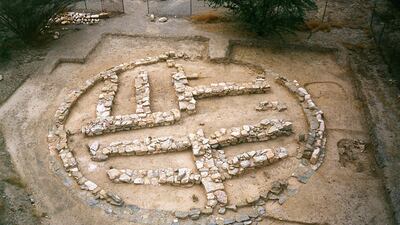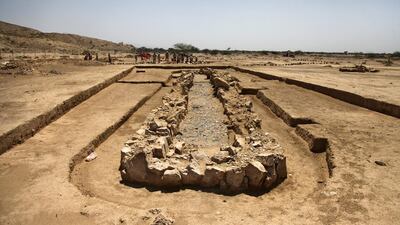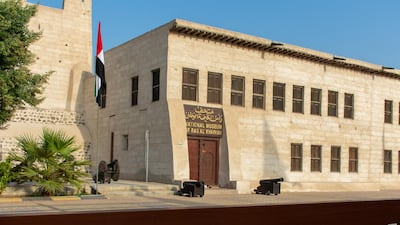
The National Museum of Ras Al Khaimah will welcome back visitors on Saturday. Courtesy: RAK Museum

Ras Al Khaimah National Museum to reopen after six months


  • English
  • Arabic

The National Museum of Ras Al Khaimah​​ will welcome back visitors for the first time in six months on Saturday.

All Covid-19 precautionary and hygiene measures are in place to keep employees and visitors safe, museum officials said on Thursday.

An exhibition about the date palm tree and its significance in the society and culture of Ras Al Khaimah will be held as part of the reopening plans.

The exhibition on "Tamra", which means date palm in Arabic, will explain why the tree was included in the Unesco Intangible Cultural Heritage list for the Middle East in 2019.

A coin that was minted in the 19th century was found in the Falaya palace compound, where the peace treaty between the Trucial States and the British was signed 200 years ago. Courtesy: RAK Museum

“Through the Tamra exhibition, we aim to shine a light on the role of the date palm for the guests,” said Ahmed Alteneiji, general director of Antiquities and Museums Department.

The installations in the museum will tell visitors the importance of palm trees in Khaleeji hospitality.

Some of the artefacts on display in the museum include the ‘Mardhouf Al Quwasim’, a coin that was minted in the 19th century.

It was found in the Falaya palace compound, where the peace treaty between the Trucial States and the British was signed 200 years ago.

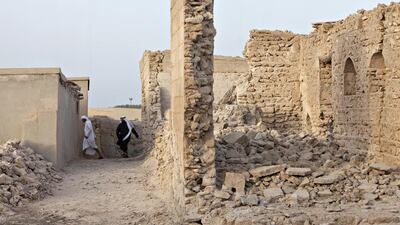
  • The preserved pearling town of Jazirat Al Hamra is one of four listed as tentative Unesco sites from Ras Al Khaimah. This two-storey building belonged to a pearl merchant named Ahmed Al Omran and it is only part of a larger compound. Sarah Dea / The National
    The preserved pearling town of Jazirat Al Hamra is one of four listed as tentative Unesco sites from Ras Al Khaimah. This two-storey building belonged to a pearl merchant named Ahmed Al Omran and it is only part of a larger compound. Sarah Dea / The National
  • Jazirat Al Hamra has courtyard houses, mosques, a souq, a fort and schools built from traditional and modern materials. Jeff Topping / The National
    Jazirat Al Hamra has courtyard houses, mosques, a souq, a fort and schools built from traditional and modern materials. Jeff Topping / The National
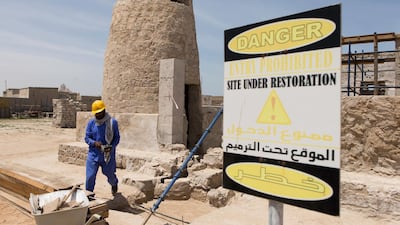
  • A worker at the Jazirat Al Hamra heritage village and archaeological site in Ras Al Khamiah. Christopher Pike / The National
    A worker at the Jazirat Al Hamra heritage village and archaeological site in Ras Al Khamiah. Christopher Pike / The National
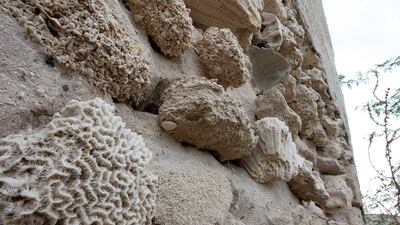
  • Detail of a wall built of coral stone in Jazirat Al Hamra. Pawan Singh / The National
    Detail of a wall built of coral stone in Jazirat Al Hamra. Pawan Singh / The National
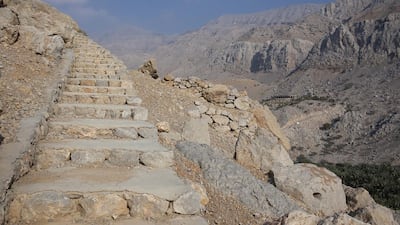
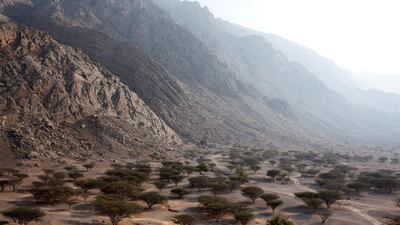
  • A part of the Hajar Mountains from the historic Dhayah Fort north of Ras Al Khaimah. Silvia Razgova / The National
    A part of the Hajar Mountains from the historic Dhayah Fort north of Ras Al Khaimah. Silvia Razgova / The National
  • Dhayah has been added to the list for its mountain and coastal settlements and natural palm gardens. Silvia Razgova / The National
    Dhayah has been added to the list for its mountain and coastal settlements and natural palm gardens. Silvia Razgova / The National
  • Dhayah's varied geography is representative of the northern emirates. Silvia Razgova / The National
    Dhayah's varied geography is representative of the northern emirates. Silvia Razgova / The National
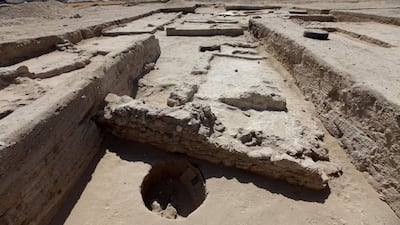
  • The 2010 excavations of the medieval city of Julfar in Ras Al Khaimah. Jaime Puebla / The National
    The 2010 excavations of the medieval city of Julfar in Ras Al Khaimah. Jaime Puebla / The National
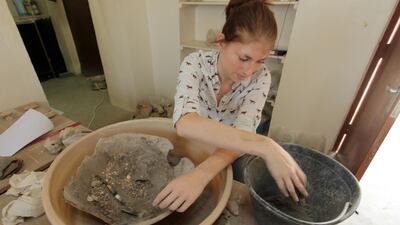
  • Conservator Daniela Boos cleans a ceramic vessel found during the excavations of the medieval city of Julfar in Ras Al Khaimah in 2010. Jaime Puebla / The National
    Conservator Daniela Boos cleans a ceramic vessel found during the excavations of the medieval city of Julfar in Ras Al Khaimah in 2010. Jaime Puebla / The National
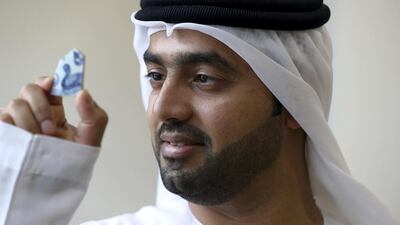
  • Ahmed Al Tenaiji holds a piece of Chinese porcelain unearthed at Al Nudud in Julfar. Chris Whiteoak / The National
    Ahmed Al Tenaiji holds a piece of Chinese porcelain unearthed at Al Nudud in Julfar. Chris Whiteoak / The National
  • Archaeologists have unearthed 700 year old pieces of Chinese porcelain in Julfar through a collaboration with archaeologists from Beijing started in 2017. Chris Whiteoak / The National
    Archaeologists have unearthed 700 year old pieces of Chinese porcelain in Julfar through a collaboration with archaeologists from Beijing started in 2017. Chris Whiteoak / The National
  • A tomb in Ras Al Khaimah’s Shimal area, a prominent archaeological site dating back to the Umm Al Nar period. Courtesy: Ras Al Khaimah Government Media Office
    A tomb in Ras Al Khaimah’s Shimal area, a prominent archaeological site dating back to the Umm Al Nar period. Courtesy: Ras Al Khaimah Government Media Office
  • More than 100 megalithic tombs are scattered over three kilometres on the gravel plains and acacia forests at the foot of the Hajar mountains. Lee Hoagland / The National
    More than 100 megalithic tombs are scattered over three kilometres on the gravel plains and acacia forests at the foot of the Hajar mountains. Lee Hoagland / The National

The emirates of Abu Dhabi, Ajman, Dubai, Ras Al Khaimah​​, Sharjah, and Umm Al Quwain were known as the Trucial States before becoming the UAE in 1971.

Other fascinating artefacts on display are a 4000-year-old date palm seed from the Shamal Bronze Age settlement site, a 12th century gold coin that was found recently, various date palm tree products and a contemporary art collection from Geraldine Chansard, a French artist who lives in Ras Al Khaimah.

Visitors will also be able to see the museum's new discovery, a madbasa, which is an architectural element used to produce date syrup nearly 2,000 years ago.

It was discovered by archaeologists last year during the restoration of the museum building.

The new find is believed to date back to the era before oil was discovered in the region in the early 20th century.

In September, four sites in Ras Al Khaimah with more than 5,000 years of history were added to Unesco's tentative list of world heritage sites.

The sites are the pearling town of Jazirat Al Hamra, the lost metropolis of Julfar, the megalithic tombs of Shimal and the oasis of Dhayah.


Business Insights
  • As per the document, there are six filing options, including choosing to report on a realisation basis and transitional rules for pre-tax period gains or losses. 
  • SMEs with revenue below Dh3 million per annum can opt for transitional relief until 2026, treating them as having no taxable income. 
  • Larger entities have specific provisions for asset and liability movements, business restructuring, and handling foreign permanent establishments.
The specs

Engine: 3.0-litre six-cylinder MHEV

Power: 360bhp

Torque: 500Nm

Transmission: eight-speed automatic

Price: from Dh282,870

On sale: now

Mercer, the investment consulting arm of US services company Marsh & McLennan, expects its wealth division to at least double its assets under management (AUM) in the Middle East as wealth in the region continues to grow despite economic headwinds, a company official said.

Mercer Wealth, which globally has $160 billion in AUM, plans to boost its AUM in the region to $2-$3bn in the next 2-3 years from the present $1bn, said Yasir AbuShaban, a Dubai-based principal with Mercer Wealth.

Within the next two to three years, we are looking at reaching $2 to $3 billion as a conservative estimate and we do see an opportunity to do so,” said Mr AbuShaban.

Mercer does not directly make investments, but allocates clients’ money they have discretion to, to professional asset managers. They also provide advice to clients.

“We have buying power. We can negotiate on their (client’s) behalf with asset managers to provide them lower fees than they otherwise would have to get on their own,” he added.

Mercer Wealth’s clients include sovereign wealth funds, family offices, and insurance companies among others.

From its office in Dubai, Mercer also looks after Africa, India and Turkey, where they also see opportunity for growth.

Wealth creation in Middle East and Africa (MEA) grew 8.5 per cent to $8.1 trillion last year from $7.5tn in 2015, higher than last year’s global average of 6 per cent and the second-highest growth in a region after Asia-Pacific which grew 9.9 per cent, according to consultancy Boston Consulting Group (BCG). In the region, where wealth grew just 1.9 per cent in 2015 compared with 2014, a pickup in oil prices has helped in wealth generation.

BCG is forecasting MEA wealth will rise to $12tn by 2021, growing at an annual average of 8 per cent.

Drivers of wealth generation in the region will be split evenly between new wealth creation and growth of performance of existing assets, according to BCG.

Another general trend in the region is clients’ looking for a comprehensive approach to investing, according to Mr AbuShaban.

“Institutional investors or some of the families are seeing a slowdown in the available capital they have to invest and in that sense they are looking at optimizing the way they manage their portfolios and making sure they are not investing haphazardly and different parts of their investment are working together,” said Mr AbuShaban.

Some clients also have a higher appetite for risk, given the low interest-rate environment that does not provide enough yield for some institutional investors. These clients are keen to invest in illiquid assets, such as private equity and infrastructure.

“What we have seen is a desire for higher returns in what has been a low-return environment specifically in various fixed income or bonds,” he said.

“In this environment, we have seen a de facto increase in the risk that clients are taking in things like illiquid investments, private equity investments, infrastructure and private debt, those kind of investments were higher illiquidity results in incrementally higher returns.”

The Abu Dhabi Investment Authority, one of the largest sovereign wealth funds, said in its 2016 report that has gradually increased its exposure in direct private equity and private credit transactions, mainly in Asian markets and especially in China and India. The authority’s private equity department focused on structured equities owing to “their defensive characteristics.”