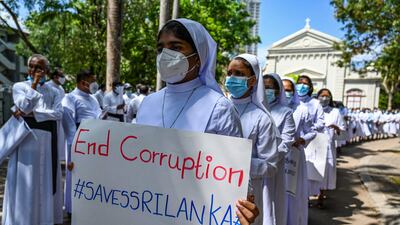
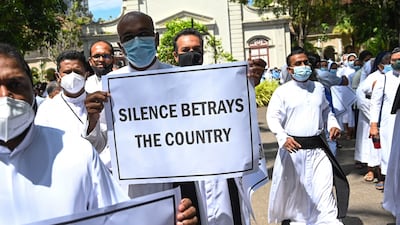
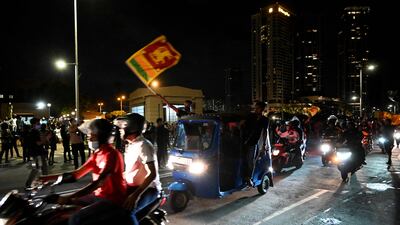
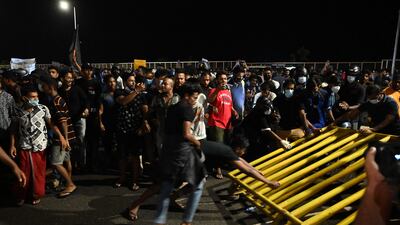
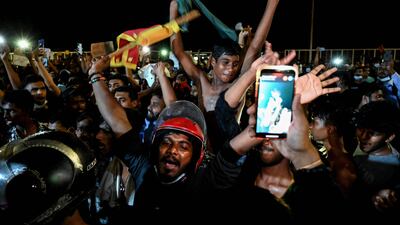
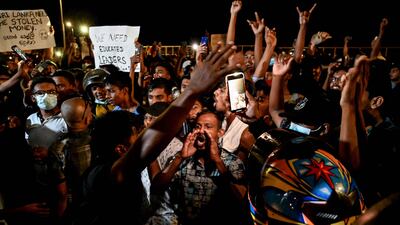
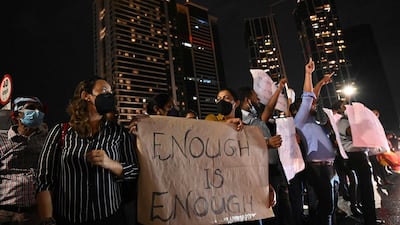
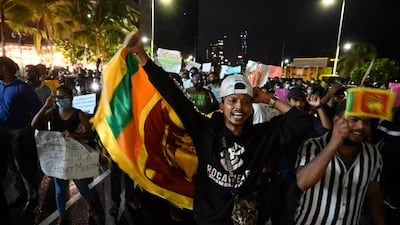
Sri Lankans in the UAE fear fuel shortages will affect travel and worsen food shortages, making life difficult for their families back home as the island nation battles an economic crisis.
A ban on the sale of diesel and petrol to private vehicle owners has been enforced in the country and ordinary people are not permitted to purchase fuel until July 10.
The extraordinary measures were taken as the South Asian nation struggles to cope with its worst financial crisis in several decades.
Grocery stores near my home ran out of essentials like dal and rice — that has never happened before
Ajantha Premarathna,
Dubai resident
Prime Minister Ranil Wickremesinghe told Parliament last week that the economy had “completely collapsed” as he issued a warning that the situation was serious and went beyond fuel, electricity and food shortages.
Officials said the country had less than a week’s worth of fuel and stocks required for essential services such as medical transport, trains and buses.
Schools remain shut and the country’s 22 million residents have been asked to work from home.
Concerns mount for Sri Lankans in UAE
Ranitha Fernando, a Dubai banker set to return to Sri Lanka during the summer holiday, is worried about reaching his home in Colombo, about an hour’s drive from the airport.
His relatives have been limiting travel as they cannot use private cars or bikes while regular taxis are not easily available due to the petrol crunch.
“I am worried if taxis will be available for us to reach home. There are very few private taxis operating and you need to wait a lot is what I have learnt,” he said.
“My in-laws use public transport, trains and buses to travel. Everyone is managing with whatever petrol they are left with.
“My family only leave the house for a specific purpose — to buy essentials, to see the doctor or go to the hospital. It has become very difficult.”
His suitcase is filled with essential medicines the family needs including drugs to treat fever, cholesterol and diabetes, and food items such as rice, lentils and cooking oil.
As with other Sri Lankan residents, Mr Fernando has shipped supplies to his family over the past few months.
“We have sent home solar lamps [and] infrared cookers to help them cook quickly,” he said. “You have to learn to adapt.”
Fuel and food are a lifeline
Sri Lankan expatriates send home money to family regularly but the situation is a growing cause of concern with the doubling of prices of basic items such as bread.
Dubai resident Ajantha Premarathna is constantly worried about food running out at home.
“Grocery stores near my home ran out of essentials like dal and rice — that has never happened before,” said the chartered quantity surveyor who offers advice on construction costs and has lived in the UAE for about 30 years.
“My brother called to say last week the stores were out of rice and vegetable oil. Fuel and gas are the lifeline for people.
“There may be stocks in one place but because transport is scarce, it will impact food and the entire chain.
“My family are so far OK but there is a worry about an imminent scarcity of food.”
Shortages prompt price surge
Acute shortages of food and medicine have sent prices soaring for ordinary Sri Lankans.
People stand in long queues for basic food items and complain of deepening power cuts after the country defaulted on its debt with international lenders for the first time in its history in May.
Unable to cope with rising energy prices and the coronavirus pandemic that affected tourism revenue, the country does not have sufficient foreign currency to pay for fuel, cooking gas, food and medicine imports.
Mr Wickremesinghe told parliament India was the principal source of foreign aid, supplying more than $4 billion in loans this year.
The World Bank has pledged $600 million to meet payments for essential imports and the country is in talks with the International Monetary Fund on a rescue package.
Neighbouring nations such as China and Indonesia have also pledged their assistance.
'Daily life is a challenge'
Riza Muhammed, chairman of the Sri Lankan Business Council, said the next two weeks would be crucial as the government has no option but to curtail fuel usage.
“Daily life is a challenge because transport is a problem, so people don’t have a normal life,” he said.
“There was a feeling that we had reached the bottom and [that] we would start seeing some relief, but that has not happened.
“It is the daily wage-earners who are going through the toughest time. People have to plan much in advance and are trying to prepare for these shocks to their system.”

Nayanthara: Beyond The Fairy Tale
Starring: Nayanthara, Vignesh Shivan, Radhika Sarathkumar, Nagarjuna Akkineni
Director: Amith Krishnan
Rating: 3.5/5
Neil Thomson – THE BIO
Family: I am happily married to my wife Liz and we have two children together.
Favourite music: Rock music. I started at a young age due to my father’s influence. He played in an Indian rock band The Flintstones who were once asked by Apple Records to fly over to England to perform there.
Favourite book: I constantly find myself reading The Bible.
Favourite film: The Greatest Showman.
Favourite holiday destination: I love visiting Melbourne as I have family there and it’s a wonderful place. New York at Christmas is also magical.
Favourite food: I went to boarding school so I like any cuisine really.
'Downton Abbey: A New Era'
Director: Simon Curtis
Cast: Hugh Bonneville, Elizabeth McGovern, Maggie Smith, Michelle Dockery, Laura Carmichael, Jim Carter and Phyllis Logan
Rating: 4/5
How has net migration to UK changed?
The figure was broadly flat immediately before the Covid-19 pandemic, standing at 216,000 in the year to June 2018 and 224,000 in the year to June 2019.
It then dropped to an estimated 111,000 in the year to June 2020 when restrictions introduced during the pandemic limited travel and movement.
The total rose to 254,000 in the year to June 2021, followed by steep jumps to 634,000 in the year to June 2022 and 906,000 in the year to June 2023.
The latest available figure of 728,000 for the 12 months to June 2024 suggests levels are starting to decrease.
Uefa Nations League
League A:
Germany, Portugal, Belgium, Spain, France, England, Switzerland, Italy, Poland, Iceland, Croatia, Netherlands
League B:
Austria, Wales, Russia, Slovakia, Sweden, Ukraine, Republic of Ireland, Bosnia-Herzegovina, Northern Ireland, Denmark, Czech Republic, Turkey
League C:
Hungary, Romania, Scotland, Slovenia, Greece, Serbia, Albania, Norway, Montenegro, Israel, Bulgaria, Finland, Cyprus, Estonia, Lithuania
League D:
Azerbaijan, Macedonia, Belarus, Georgia, Armenia, Latvia, Faroe Islands, Luxembourg, Kazakhstan, Moldova, Liechtenstein, Malta, Andorra, Kosovo, San Marino, Gibraltar
Sustainable Development Goals
1. End poverty in all its forms everywhere
2. End hunger, achieve food security and improved nutrition and promote sustainable agriculture
3. Ensure healthy lives and promote well-being for all at all ages
4. Ensure inclusive and equitable quality education and promote lifelong learning opportunities for all
5. Achieve gender equality and empower all women and girls
6. Ensure availability and sustainable management of water and sanitation for all
7. Ensure access to affordable, reliable, sustainable and modern energy for all
8. Promote sustained, inclusive and sustainable economic growth, full and productive employment and decent work for all
9. Build resilient infrastructure, promote inclusive and sustainable industrialisation and foster innovation
10. Reduce inequality within and among countries
11. Make cities and human settlements inclusive, safe, resilient and sustainable
12. Ensure sustainable consumption and production patterns
13. Take urgent action to combat climate change and its effects
14. Conserve and sustainably use the oceans, seas and marine resources for sustainable development
15. Protect, restore and promote sustainable use of terrestrial ecosystems, sustainably manage forests, combat desertification, and halt and reverse land degradation and halt biodiversity loss
16. Promote peaceful and inclusive societies for sustainable development, provide access to justice for all and build effective, accountable and inclusive institutions at all levels
17. Strengthen the means of implementation and revitalise the global partnership for sustainable development
Background: Chemical Weapons
Sholto Byrnes on Myanmar politics
GCC-UK%20Growth
%3Cp%3EAn%20FTA%20with%20the%20GCC%20would%20be%20very%20significant%20for%20the%20UK.%20%20%20%20%20%20%20%20%20%20%20%20%20%20%20%20%20%20%20%20%20%20%20%20%20%20%20%20%20%20%20%20%20%20%20%20%20%20%20%20%20%20%20%20%20%20%20%20%20%20%20%20%20%20%20%20%20%20%20%20%20%20%20%20%20%20%20%20%20%20%20%20%20%20%20%20%20%20%20My%20Department%20has%20forecast%20that%20it%20could%20generate%20an%20additional%20%C2%A31.6%20billion%20a%20year%20for%20our%20economy.%3Cbr%3EWith%20consumer%20demand%20across%20the%20GCC%20predicted%20to%20increase%20to%20%C2%A3800%20billion%20by%202035%20this%20deal%20could%20act%20as%20a%20launchpad%20from%20which%20our%20firms%20can%20boost%20their%20market%20share.%3C%2Fp%3E%0A
RACE CARD
6.30pm Maiden Dh165,000 (Dirt) 1,200
7.05pm Handicap Dh165,000 (D) 1,600m
7.40pm Maiden Dh165,000 (D) 1,600m
8.15pm Handicap Dh190,000 (D) 1,600m
8.50pm Handicap Dh175,000 (D) 1,400m
9.25pm Handicap Dh175,000 (D) 2,000m
The National selections:
6.30pm Underwriter
7.05pm Rayig
7.40pm Torno Subito
8.15pm Talento Puma
8.50pm Etisalat
9.25pm Gundogdu
UFC%20FIGHT%20NIGHT%3A%20SAUDI%20ARABIA%20RESULTS
%3Cp%3E%0D%3C%2Fp%3E%0A%3Cp%3E%3Cstrong%3EMain%20card%3Cbr%3EMiddleweight%3A%3C%2Fstrong%3E%0D%3Cbr%3ERobert%20Whittaker%20defeated%20Ikram%20Aliskerov%20via%20knockout%20(Round%201)%0D%3Cbr%3E%3Cstrong%3EHeavyweight%3A%3C%2Fstrong%3E%0D%3Cbr%3EAlexander%20Volkov%20def%20Sergei%20Pavlovich%20via%20unanimous%20decision%0D%3Cbr%3E%3Cstrong%3EMiddleweight%3A%3C%2Fstrong%3E%0D%3Cbr%3EKelvin%20Gastelum%20def%20Daniel%20Rodriguez%20via%20unanimous%20decision%0D%3Cbr%3E%3Cstrong%3EMiddleweight%3A%3C%2Fstrong%3E%0D%3Cbr%3EShara%20Magomedov%20def%20Antonio%20Trocoli%20via%20knockout%20(Round%203)%0D%3Cbr%3E%3Cstrong%3ELight%20heavyweight%3A%3C%2Fstrong%3E%0D%3Cbr%3EVolkan%20Oezdemir%20def%20Johnny%20Walker%20via%20knockout%20(Round%201)%0D%3Cbr%3E%3Cstrong%3EPreliminary%20Card%0D%3Cbr%3ELightweight%3A%3C%2Fstrong%3E%0D%3Cbr%3ENasrat%20Haqparast%20def%20Jared%20Gordon%20via%20split%20decision%0D%3Cbr%3E%3Cstrong%3EFeatherweight%3A%3C%2Fstrong%3E%0D%3Cbr%3EFelipe%20Lima%20def%20Muhammad%20Naimov%20via%20submission%20(Round%203)%0D%3Cbr%3E%3Cstrong%3EWelterweight%3A%3C%2Fstrong%3E%0D%3Cbr%3ERinat%20Fakhretdinov%20defeats%20Nicolas%20Dalby%20via%20split%20decision%0D%3Cbr%3E%3Cstrong%3EBantamweight%3A%3C%2Fstrong%3E%0D%3Cbr%3EMuin%20Gafurov%20def%20Kang%20Kyung-ho%20via%20unanimous%20decision%0D%3Cbr%3E%3Cstrong%3ELight%20heavyweight%3A%3C%2Fstrong%3E%0D%3Cbr%3EMagomed%20Gadzhiyasulov%20def%20Brendson%20Ribeiro%20via%20majority%20decision%0D%3Cbr%3E%3Cstrong%3EBantamweight%3A%3C%2Fstrong%3E%0D%3Cbr%3EChang%20Ho%20Lee%20def%20Xiao%20Long%20via%20split%20decision%3C%2Fp%3E%0A
More from Neighbourhood Watch
Mercer, the investment consulting arm of US services company Marsh & McLennan, expects its wealth division to at least double its assets under management (AUM) in the Middle East as wealth in the region continues to grow despite economic headwinds, a company official said.
Mercer Wealth, which globally has $160 billion in AUM, plans to boost its AUM in the region to $2-$3bn in the next 2-3 years from the present $1bn, said Yasir AbuShaban, a Dubai-based principal with Mercer Wealth.
“Within the next two to three years, we are looking at reaching $2 to $3 billion as a conservative estimate and we do see an opportunity to do so,” said Mr AbuShaban.
Mercer does not directly make investments, but allocates clients’ money they have discretion to, to professional asset managers. They also provide advice to clients.
“We have buying power. We can negotiate on their (client’s) behalf with asset managers to provide them lower fees than they otherwise would have to get on their own,” he added.
Mercer Wealth’s clients include sovereign wealth funds, family offices, and insurance companies among others.
From its office in Dubai, Mercer also looks after Africa, India and Turkey, where they also see opportunity for growth.
Wealth creation in Middle East and Africa (MEA) grew 8.5 per cent to $8.1 trillion last year from $7.5tn in 2015, higher than last year’s global average of 6 per cent and the second-highest growth in a region after Asia-Pacific which grew 9.9 per cent, according to consultancy Boston Consulting Group (BCG). In the region, where wealth grew just 1.9 per cent in 2015 compared with 2014, a pickup in oil prices has helped in wealth generation.
BCG is forecasting MEA wealth will rise to $12tn by 2021, growing at an annual average of 8 per cent.
Drivers of wealth generation in the region will be split evenly between new wealth creation and growth of performance of existing assets, according to BCG.
Another general trend in the region is clients’ looking for a comprehensive approach to investing, according to Mr AbuShaban.
“Institutional investors or some of the families are seeing a slowdown in the available capital they have to invest and in that sense they are looking at optimizing the way they manage their portfolios and making sure they are not investing haphazardly and different parts of their investment are working together,” said Mr AbuShaban.
Some clients also have a higher appetite for risk, given the low interest-rate environment that does not provide enough yield for some institutional investors. These clients are keen to invest in illiquid assets, such as private equity and infrastructure.
“What we have seen is a desire for higher returns in what has been a low-return environment specifically in various fixed income or bonds,” he said.
“In this environment, we have seen a de facto increase in the risk that clients are taking in things like illiquid investments, private equity investments, infrastructure and private debt, those kind of investments were higher illiquidity results in incrementally higher returns.”
The Abu Dhabi Investment Authority, one of the largest sovereign wealth funds, said in its 2016 report that has gradually increased its exposure in direct private equity and private credit transactions, mainly in Asian markets and especially in China and India. The authority’s private equity department focused on structured equities owing to “their defensive characteristics.”