The story of the UAE flag is well known, but one always worth retelling.
It was created by Abdullah Mohammed Al Maainah, then just 19, after reading a newspaper article about a contest to design the new nation’s flag.
Mr Al Maainah, who much later would become the UAE ambassador to Chile, only realised he won as he watched the flag being raised for the first time at Mushrif Palace on December 2, 1971.
The flag is celebrated every year on Flag Day, on November 3.
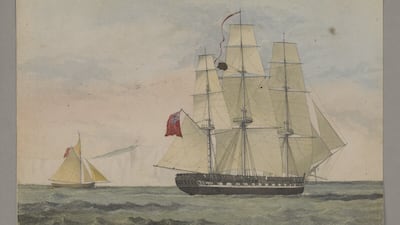
But the full story of flags in the UAE is much older than 50 years. It can be traced back hundreds of years when the sailing dhows of the Arabian Gulf often identified themselves with a red flag, usually in the form of a pennant fluttering from the mast.
How each emirate got its flag before the unification
For British naval ships that increasingly patrolled the Gulf in the early 19th century, though, red flags signalled a potential enemy.
A series of destructive raids by Britain along the coast of the Northern Emirates resulted in a series of enforced treaties, or truces, that effectively gave the British control over the Gulf, and the emirates the name “Trucial States”.
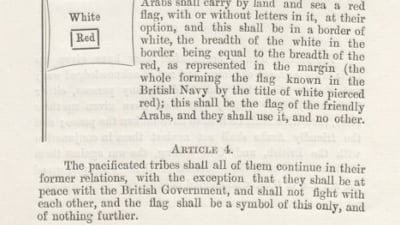
The 1819 General Treaty also established how Arab shipping along the Gulf should identify themselves as non-hostile.
“The friendly Arabs shall carry by land and sea a red flag, with or without letters in it, at their option,” it specified.
“This shall be in a border of white, the breadth of the white in the border being equal to the breadth of the red, as represented in the margin (the whole forming the flag known in the British Navy by the title of white pierced red).”
It concluded “this shall be the flag of the friendly Arabs, and they shall use it, and no other”.
In practice, the designs varied between states, from Bahrain to Ras Al Khaimah. Among the seven Trucial States that now form the UAE, five distinct flags emerged, some with the ruler’s personal touch.
Much later, in the 1950s, the British established the Trucial States Council, a consultative body for the rulers of the seven emirates, and which, almost forgotten, was also given a flag that featured a green seven-point star and a white and red design.
These three shades, along with black, are generally known as the Pan Arab colours, and feature on the flags of nine Arab countries, including the UAE.
Here is the complete guide to the flags of the UAE, past and present.
The current UAE flag
Mr Al Maainah’s design is a green, white and black horizontal tricolour with a vertical red band nearest the flagpole.
To see if it had been chosen, he ran to Mushrif Palace and peeked through the fence as it was raised for the first time on the morning of December 2, 1971.
“There was no wind that day, so I waited until there was a draft to make sure that the flag up there at the pole was mine,” he told The National.
Green represented the Caliphate of the Fatimids, who ruled out of Egypt, while Red was the Ottoman flag and represented blood.
Finally, white symbolised the Prophet Mohammed’s first victory, at the Battle of Badr in 624 CE, but also peace.
Other variations of the Pan Arab colours attribute red to the Hashemite dynasty, but also a quote from the 14th century Iraqi poet Safi Al Din Al Hilli: “White are our acts, black our battles, green our fields, and red our swords”.
He is reported to have been presented with a number of alternatives created by a British diplomat, Sir Mark Sykes.
Ironically, Sykes, with the French diplomat François Picot, would that year also draw up the infamous Sykes-Picot Agreement, which created many of the divisions in the Middle East that still exist today.
Abu Dhabi's flag
The flag of Abu Dhabi is still occasionally seen today. It is red, with a white square in the top corner.
In fact, this is a relatively new version. Until the late 1950s, Abu Dhabi used a plain red flag, at least on land.
In 1958, the then Ruler of Abu Dhabi, Sheikh Shakbut bin Sultan Al Nahyan, announced to Britain that he would be adding a white square “on its upper side corner to take one third of the width and slightly more than one third of the length of the flag”.
It was flown for the first time on February 27, 1958, and was used for state occasions until December 1971, when the UAE flag was adopted.
Dubai and Ajman's flag
The flag of Dubai is red, with a white band next to the hoist, as the flag staff is technically known. In the early 1960s, oil companies also agreed to fly the Dubai flag when operating in the emirate. Ajman’s official flag also uses the same design.
Sharjah and Ras Al Khaimah's flag
The fact Sharjah and Ras Al Khaimah use the same design is also a reflection of their past, with both Emirates ruled by branches of the Al Qasimi family.
The flag is red with a white border, whose width is a quarter of the total and most closely resembles the design proposed by the British in the 1820, perhaps unsurprisingly, since the British military expeditions that led to the signing of the treaty were directed at the Al Qasimis.
Umm Al Quwain's flag
The flag of Umm Al Quwain is a design created in 1961 by the ruler, Sheikh Ahmad bin Rashid Al Mualla, who had ruled the Emirate since 1928 and was the oldest leader at the ceremony to create the UAE in 1971.
The flag features a white band next to the hoist, white crescent moon and a five-point star, both symbols of Islam.
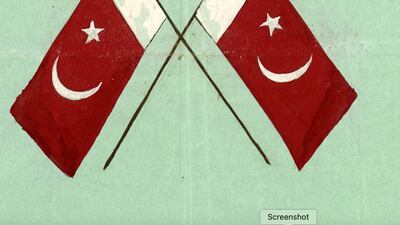
According to British diplomatic files, the ruler initially wished a plain red background, but added a white band after it was pointed out the original design might be confused with the flag of Turkey. Its official use was confirmed in May, 1961.
Before that date, Umm Al Quwain had adopted the same design as Dubai and Ajman.
Fujairah's flag
Fujairah’s flag reflects its history. At the time of the signing of the General Treaty with Britain in 1819, it was considered part of the Sultanate of Muscat, and adopted the plain red flag used there. Around 1850, it came under Sharjah, and was accepted as an emirate in 1902, although the UK government did not recognise it as a Trucial State until 1952.
The Ruler of Fujairah, Sheikh Mohammed bin Hamad Al Sharqi, at this point replaced the red flag with one that included the name of the emirate in white Arabic letters.
In 1961, Fujairah is understood to have reverted to the old red flag until 1975, when the current ruler, Sheikh Hamad bin Mohammed Al Sharqi, replaced it with the flag of the UAE.
The flag of the Trucial States Council
Established in 1952, the Trucial States Council was a consultative body set up by the UK and chaired by the political agent, Britain’s top administrative official who was replaced by an ambassador in 1971.
The council consisted of the rulers of the seven emirates, but lacked funding and met just twice a year. It did, however, have a flag. The design incorporated red stripes at the top and bottom, with white between, and a seven-point green star in the centre, each point presumably to represent an emirate.
The flag is almost identical with that of Lebanon, which features a cedar tree rather than a star, but there is no indication this in anything other than a coincidence.
It does not seem to have been widely used, but badges of the Trucial Oman Scouts, the paramilitary force established by Britain, sometimes use a similar colour scheme, with the crossed khanjar daggers of the regiment instead of a star.

Key facilities
- Olympic-size swimming pool with a split bulkhead for multi-use configurations, including water polo and 50m/25m training lanes
- Premier League-standard football pitch
- 400m Olympic running track
- NBA-spec basketball court with auditorium
- 600-seat auditorium
- Spaces for historical and cultural exploration
- An elevated football field that doubles as a helipad
- Specialist robotics and science laboratories
- AR and VR-enabled learning centres
- Disruption Lab and Research Centre for developing entrepreneurial skills
How to watch Ireland v Pakistan in UAE
When: The one-off Test starts on Friday, May 11
What time: Each day’s play is scheduled to start at 2pm UAE time.
TV: The match will be broadcast on OSN Sports Cricket HD. Subscribers to the channel can also stream the action live on OSN Play.
OIL PLEDGE
At the start of Russia's invasion, IEA member countries held 1.5 billion barrels in public reserves and about 575 million barrels under obligations with industry, according to the agency's website. The two collective actions of the IEA this year of 62.7 million barrels, which was agreed on March 1, and this week's 120 million barrels amount to 9 per cent of total emergency reserves, it added.
The 12 Syrian entities delisted by UK
Ministry of Interior
Ministry of Defence
General Intelligence Directorate
Air Force Intelligence Agency
Political Security Directorate
Syrian National Security Bureau
Military Intelligence Directorate
Army Supply Bureau
General Organisation of Radio and TV
Al Watan newspaper
Cham Press TV
Sama TV
Countries recognising Palestine
France, UK, Canada, Australia, Portugal, Belgium, Malta, Luxembourg, San Marino and Andorra
Specs
Engine: 51.5kW electric motor
Range: 400km
Power: 134bhp
Torque: 175Nm
Price: From Dh98,800
Available: Now
Teaching your child to save
Pre-school (three - five years)
You can’t yet talk about investing or borrowing, but introduce a “classic” money bank and start putting gifts and allowances away. When the child wants a specific toy, have them save for it and help them track their progress.
Early childhood (six - eight years)
Replace the money bank with three jars labelled ‘saving’, ‘spending’ and ‘sharing’. Have the child divide their allowance into the three jars each week and explain their choices in splitting their pocket money. A guide could be 25 per cent saving, 50 per cent spending, 25 per cent for charity and gift-giving.
Middle childhood (nine - 11 years)
Open a bank savings account and help your child establish a budget and set a savings goal. Introduce the notion of ‘paying yourself first’ by putting away savings as soon as your allowance is paid.
Young teens (12 - 14 years)
Change your child’s allowance from weekly to monthly and help them pinpoint long-range goals such as a trip, so they can start longer-term saving and find new ways to increase their saving.
Teenage (15 - 18 years)
Discuss mutual expectations about university costs and identify what they can help fund and set goals. Don’t pay for everything, so they can experience the pride of contributing.
Young adulthood (19 - 22 years)
Discuss post-graduation plans and future life goals, quantify expenses such as first apartment, work wardrobe, holidays and help them continue to save towards these goals.
* JP Morgan Private Bank
Safety 'top priority' for rival hyperloop company
The chief operating officer of Hyperloop Transportation Technologies, Andres de Leon, said his company's hyperloop technology is “ready” and safe.
He said the company prioritised safety throughout its development and, last year, Munich Re, one of the world's largest reinsurance companies, announced it was ready to insure their technology.
“Our levitation, propulsion, and vacuum technology have all been developed [...] over several decades and have been deployed and tested at full scale,” he said in a statement to The National.
“Only once the system has been certified and approved will it move people,” he said.
HyperloopTT has begun designing and engineering processes for its Abu Dhabi projects and hopes to break ground soon.
With no delivery date yet announced, Mr de Leon said timelines had to be considered carefully, as government approval, permits, and regulations could create necessary delays.
Dengue%20fever%20symptoms
%3Cp%3EHigh%20fever%20(40%C2%B0C%2F104%C2%B0F)%3Cbr%3ESevere%20headache%3Cbr%3EPain%20behind%20the%20eyes%3Cbr%3EMuscle%20and%20joint%20pains%3Cbr%3ENausea%3Cbr%3EVomiting%3Cbr%3ESwollen%20glands%3Cbr%3ERash%26nbsp%3B%3C%2Fp%3E%0A
Sreesanth's India bowling career
Tests 27, Wickets 87, Average 37.59, Best 5-40
ODIs 53, Wickets 75, Average 33.44, Best 6-55
T20Is 10, Wickets 7, Average 41.14, Best 2-12
Desert Warrior
Starring: Anthony Mackie, Aiysha Hart, Ben Kingsley
Director: Rupert Wyatt
Rating: 3/5
Key findings of Jenkins report
- Founder of the Muslim Brotherhood, Hassan al Banna, "accepted the political utility of violence"
- Views of key Muslim Brotherhood ideologue, Sayyid Qutb, have “consistently been understood” as permitting “the use of extreme violence in the pursuit of the perfect Islamic society” and “never been institutionally disowned” by the movement.
- Muslim Brotherhood at all levels has repeatedly defended Hamas attacks against Israel, including the use of suicide bombers and the killing of civilians.
- Laying out the report in the House of Commons, David Cameron told MPs: "The main findings of the review support the conclusion that membership of, association with, or influence by the Muslim Brotherhood should be considered as a possible indicator of extremism."
'My Son'
Director: Christian Carion
Starring: James McAvoy, Claire Foy, Tom Cullen, Gary Lewis
Rating: 2/5
The President's Cake
Director: Hasan Hadi
Starring: Baneen Ahmad Nayyef, Waheed Thabet Khreibat, Sajad Mohamad Qasem
Rating: 4/5
Mercer, the investment consulting arm of US services company Marsh & McLennan, expects its wealth division to at least double its assets under management (AUM) in the Middle East as wealth in the region continues to grow despite economic headwinds, a company official said.
Mercer Wealth, which globally has $160 billion in AUM, plans to boost its AUM in the region to $2-$3bn in the next 2-3 years from the present $1bn, said Yasir AbuShaban, a Dubai-based principal with Mercer Wealth.
“Within the next two to three years, we are looking at reaching $2 to $3 billion as a conservative estimate and we do see an opportunity to do so,” said Mr AbuShaban.
Mercer does not directly make investments, but allocates clients’ money they have discretion to, to professional asset managers. They also provide advice to clients.
“We have buying power. We can negotiate on their (client’s) behalf with asset managers to provide them lower fees than they otherwise would have to get on their own,” he added.
Mercer Wealth’s clients include sovereign wealth funds, family offices, and insurance companies among others.
From its office in Dubai, Mercer also looks after Africa, India and Turkey, where they also see opportunity for growth.
Wealth creation in Middle East and Africa (MEA) grew 8.5 per cent to $8.1 trillion last year from $7.5tn in 2015, higher than last year’s global average of 6 per cent and the second-highest growth in a region after Asia-Pacific which grew 9.9 per cent, according to consultancy Boston Consulting Group (BCG). In the region, where wealth grew just 1.9 per cent in 2015 compared with 2014, a pickup in oil prices has helped in wealth generation.
BCG is forecasting MEA wealth will rise to $12tn by 2021, growing at an annual average of 8 per cent.
Drivers of wealth generation in the region will be split evenly between new wealth creation and growth of performance of existing assets, according to BCG.
Another general trend in the region is clients’ looking for a comprehensive approach to investing, according to Mr AbuShaban.
“Institutional investors or some of the families are seeing a slowdown in the available capital they have to invest and in that sense they are looking at optimizing the way they manage their portfolios and making sure they are not investing haphazardly and different parts of their investment are working together,” said Mr AbuShaban.
Some clients also have a higher appetite for risk, given the low interest-rate environment that does not provide enough yield for some institutional investors. These clients are keen to invest in illiquid assets, such as private equity and infrastructure.
“What we have seen is a desire for higher returns in what has been a low-return environment specifically in various fixed income or bonds,” he said.
“In this environment, we have seen a de facto increase in the risk that clients are taking in things like illiquid investments, private equity investments, infrastructure and private debt, those kind of investments were higher illiquidity results in incrementally higher returns.”
The Abu Dhabi Investment Authority, one of the largest sovereign wealth funds, said in its 2016 report that has gradually increased its exposure in direct private equity and private credit transactions, mainly in Asian markets and especially in China and India. The authority’s private equity department focused on structured equities owing to “their defensive characteristics.”
Trump v Khan
2016: Feud begins after Khan criticised Trump’s proposed Muslim travel ban to US
2017: Trump criticises Khan’s ‘no reason to be alarmed’ response to London Bridge terror attacks
2019: Trump calls Khan a “stone cold loser” before first state visit
2019: Trump tweets about “Khan’s Londonistan”, calling him “a national disgrace”
2022: Khan’s office attributes rise in Islamophobic abuse against the major to hostility stoked during Trump’s presidency
July 2025 During a golfing trip to Scotland, Trump calls Khan “a nasty person”
Sept 2025 Trump blames Khan for London’s “stabbings and the dirt and the filth”.
Dec 2025 Trump suggests migrants got Khan elected, calls him a “horrible, vicious, disgusting mayor”
LIVING IN...
This article is part of a guide on where to live in the UAE. Our reporters will profile some of the country’s most desirable districts, provide an estimate of rental prices and introduce you to some of the residents who call each area home.
Healthy tips to remember
Here, Dr Mohamed El Abiary, paediatric consultant at Al Zahra Hospital Dubai, shares some advice for parents whose children are fasting during the holy month of Ramadan:
Gradual fasting and golden points - For children under the age of 10, follow a step-by-step approach to fasting and don't push them beyond their limits. Start with a few hours fasting a day and increase it to a half fast and full fast when the child is ready. Every individual's ability varies as per the age and personal readiness. You could introduce a points system that awards the child and offers them encouragement when they make progress with the amount of hours they fast
Why fast? - Explain to your child why they are fasting. By shedding light on the importance of abstaining from food and drink, children may feel more encouraged to give it there all during the observance period. It is also a good opportunity to teach children about controlling urges, doing good for others and instilling healthy food habits
Sleep and suhoor - A child needs adequate sleep every night - at least eight hours. Make sure to set a routine early bedtime so he/she has sufficient time to wake up for suhoor, which is an essential meal at the beginning of the day
Good diet - Nutritious food is crucial to ensuring a healthy Ramadan for children. They must refrain from eating too much junk food as well as canned goods and snacks and drinks high in sugar. Foods that are rich in nutrients, vitamins and proteins, like fruits, fresh meats and vegetables, make for a good balanced diet