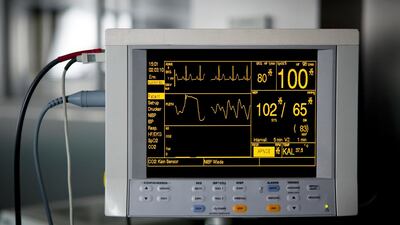
Vital signs such as blood pressure and heart rate could soon be monitored wirelessly via radar following pioneering work by UAE researchers.
A team at Khalifa University believe the technology could be used in hospitals and from homes, reducing the need for doctors' house visits and avoiding the need for patients to be physically hooked up to machines.
Scientists hope that in time the radars could also be deployed in public settings such as airports to monitor the health of passengers and prevent the spread of future pandemics.
A prototype device for individual monitoring has already been built and researchers are now working on refining their design.
They believe the technology could help improve efficiency in operating theatres, reduce dependance on care homes and prevent cot deaths.
Our proposed radar-based vital sign detection system has great potential in monitoring crowds or groups of passengers from a distance
“It’s interesting and challenging work but we also feel good about coming up with a solution that can contribute to society,” said Baker Mohammad, Associate Professor of Electronic Engineering at Khalifa University.
“The four major vital signs are body temperature, heart rate, breath rate and blood pressure.
"They provide almost a complete picture of individuals’ body vital functions and help to assess their general physical health.
“The prototype we have built is a little bit bulky for an operating room or as a mobile device. So our goal now is to build a customised solution for these purposes.”
Radars have been used for monitoring patient breathing and circulation since the 1970s.
However, rapid advances in technology mean researchers believe they can now analyse multiple vital signs at once, with small, highly efficient devices.
The radar works by sending out electromagnetic waves which can detect a person’s heartbeat, breathing patterns and blood pressure.
The data then bounces back to the unit where an onboard processor is able to analyse the information.
Small, portable devices could be used by medics to analyse patients or they could be installed in homes to monitor patients and transmit readings remotely. They could also raise the alarm if abnormal readings were found.
While academics say they have shown the technology does work for individual monitoring provided a patient remains motionless, they admit further study is required before they can be deployed to monitor large groups, for example in airports.
This is because multiple body movements could confuse the radar processors. Prof Mohammad also said there could be privacy concerns about spying on a person’s vital signs without their knowledge.
However, he believes these could be overcome with further research and regulation, and that one day radars may be a far more effective way to check a person’s health than the body temperature cameras which have recently appeared at UAE airports and malls to scan for coronavirus cases.
“Our proposed radar-based vital sign detection system has great potential in monitoring crowds or groups of passengers from a distance,” said Prof Mohammad, who is also director of Khalifa University’s System on Chip Centre (SOCC) and has published his findings in an academic paper.
“Hospitals told us they were already interested in contactless monitoring. We were also thinking we could make a small miniature radar which we could put in a crib, and if the baby was to stop breathing, it would alert the parents.
“But now with coronavirus it has made us think it could be of even more interest.
"If the UAE succeeded in getting this technology to a stage that we could put it in airports, planes or schools to look for abnormalities, it could be very useful.”
Research is already underway on refining the prototype, and the potential for using radar to monitor the health of larger groups.
“To further improve the contactless vital signs detection accuracy, the SOCC team is currently working on implementing the radar at millimetre-wave [extremely high] frequencies,” Prof Mohammad said.
“Moving to higher frequencies enables higher heart rate detection. This feature could help monitor, for example, the vital signs of students in a classroom or passengers in airplane.”

Rock in a Hard Place: Music and Mayhem in the Middle East
Orlando Crowcroft
Zed Books
Slow loris biog
From: Lonely Loris is a Sunda slow loris, one of nine species of the animal native to Indonesia, Malaysia, Thailand and Singapore
Status: Critically endangered, and listed as vulnerable on the International Union for Conservation of Nature red list due to growing demand in the global exotic pet trade. It is one of the most popular primate species found at Indonesian pet markets
Likes: Sleeping, which they do for up to 18 hours a day. When they are awake, they like to eat fruit, insects, small birds and reptiles and some types of vegetation
Dislikes: Sunlight. Being a nocturnal animal, the slow loris wakes around sunset and is active throughout the night
Superpowers: His dangerous elbows. The slow loris’s doe eyes may make it look cute, but it is also deadly. The only known venomous primate, it hisses and clasps its paws and can produce a venom from its elbow that can cause anaphylactic shock and even death in humans
The major Hashd factions linked to Iran:
Badr Organisation: Seen as the most militarily capable faction in the Hashd. Iraqi Shiite exiles opposed to Saddam Hussein set up the group in Tehran in the early 1980s as the Badr Corps under the supervision of the Iran Revolutionary Guards Corps (IRGC). The militia exalts Iran’s Supreme Leader Ali Khamenei but intermittently cooperated with the US military.
Saraya Al Salam (Peace Brigade): Comprised of former members of the officially defunct Mahdi Army, a militia that was commanded by Iraqi cleric Moqtada Al Sadr and fought US and Iraqi government and other forces between 2004 and 2008. As part of a political overhaul aimed as casting Mr Al Sadr as a more nationalist and less sectarian figure, the cleric formed Saraya Al Salam in 2014. The group’s relations with Iran has been volatile.
Kataeb Hezbollah: The group, which is fighting on behalf of the Bashar Al Assad government in Syria, traces its origins to attacks on US forces in Iraq in 2004 and adopts a tough stance against Washington, calling the United States “the enemy of humanity”.
Asaeb Ahl Al Haq: An offshoot of the Mahdi Army active in Syria. Asaeb Ahl Al Haq’s leader Qais al Khazali was a student of Mr Al Moqtada’s late father Mohammed Sadeq Al Sadr, a prominent Shiite cleric who was killed during Saddam Hussein’s rule.
Harakat Hezbollah Al Nujaba: Formed in 2013 to fight alongside Mr Al Assad’s loyalists in Syria before joining the Hashd. The group is seen as among the most ideological and sectarian-driven Hashd militias in Syria and is the major recruiter of foreign fighters to Syria.
Saraya Al Khorasani: The ICRG formed Saraya Al Khorasani in the mid-1990s and the group is seen as the most ideologically attached to Iran among Tehran’s satellites in Iraq.
(Source: The Wilson Centre, the International Centre for the Study of Radicalisation)
What vitamins do we know are beneficial for living in the UAE
Vitamin D: Highly relevant in the UAE due to limited sun exposure; supports bone health, immunity and mood.
Vitamin B12: Important for nerve health and energy production, especially for vegetarians, vegans and individuals with absorption issues.
Iron: Useful only when deficiency or anaemia is confirmed; helps reduce fatigue and support immunity.
Omega-3 (EPA/DHA): Supports heart health and reduces inflammation, especially for those who consume little fish.
ARSENAL IN 1977
Feb 05 Arsenal 0-0 Sunderland
Feb 12 Manchester City 1-0 Arsenal
Feb 15 Middlesbrough 3-0 Arsenal
Feb 19 Arsenal 2-3 West Ham
Feb 26 Middlesbrough 4-1 Arsenal (FA Cup)
Mar 01 Everton 2-1 Arsenal
Mar 05 Arsenal 1-4 ipswich
March 08 Arsenal 1-2 West Brom
Mar 12 QPR 2-1 Arsenal
Mar 23 Stoke 1-1 Arsenal
Apr 02 Arsenal 3-0 Leicester
The%20specs
%3Cp%3E%3Cstrong%3EEngine%3A%3C%2Fstrong%3E%201.5-litre%204-cylinder%3Cbr%3E%3Cstrong%3ETransmission%3A%20%3C%2Fstrong%3ECVT%3Cbr%3E%3Cstrong%3EPower%3A%20%3C%2Fstrong%3E119bhp%3Cbr%3E%3Cstrong%3ETorque%3A%20%3C%2Fstrong%3E145Nm%3Cbr%3E%3Cstrong%3EPrice%3A%20%3C%2Fstrong%3EDh%2C89%2C900%20(%2424%2C230)%3Cbr%3E%3Cstrong%3EOn%20sale%3A%20%3C%2Fstrong%3Enow%3C%2Fp%3E%0A
World record transfers
1. Kylian Mbappe - to Real Madrid in 2017/18 - €180 million (Dh770.4m - if a deal goes through)
2. Paul Pogba - to Manchester United in 2016/17 - €105m
3. Gareth Bale - to Real Madrid in 2013/14 - €101m
4. Cristiano Ronaldo - to Real Madrid in 2009/10 - €94m
5. Gonzalo Higuain - to Juventus in 2016/17 - €90m
6. Neymar - to Barcelona in 2013/14 - €88.2m
7. Romelu Lukaku - to Manchester United in 2017/18 - €84.7m
8. Luis Suarez - to Barcelona in 2014/15 - €81.72m
9. Angel di Maria - to Manchester United in 2014/15 - €75m
10. James Rodriguez - to Real Madrid in 2014/15 - €75m
LIVERPOOL%20TOP%20SCORERS
%3Cp%3E(Premier%20League%20only)%3Cbr%3EMohamed%20Salah%20129%3Cbr%3ERobbie%20Fowler%20128%3Cbr%3ESteven%20Gerrard%20120%3Cbr%3EMichael%20Owen%20118%3Cbr%3ESadio%20Mane%2090%3Cbr%3E%3C%2Fp%3E%0A
Third Test
Day 3, stumps
India 443-7 (d) & 54-5 (27 ov)
Australia 151
India lead by 346 runs with 5 wickets remaining
Brief scores:
Day 2
England: 277 & 19-0
West Indies: 154
Indoor cricket in a nutshell
Indoor Cricket World Cup - Sept 16-20, Insportz, Dubai
16 Indoor cricket matches are 16 overs per side
8 There are eight players per team
9 There have been nine Indoor Cricket World Cups for men. Australia have won every one.
5 Five runs are deducted from the score when a wickets falls
4 Batsmen bat in pairs, facing four overs per partnership
Scoring In indoor cricket, runs are scored by way of both physical and bonus runs. Physical runs are scored by both batsmen completing a run from one crease to the other. Bonus runs are scored when the ball hits a net in different zones, but only when at least one physical run is score.
Zones
A Front net, behind the striker and wicketkeeper: 0 runs
B Side nets, between the striker and halfway down the pitch: 1 run
C Side nets between halfway and the bowlers end: 2 runs
D Back net: 4 runs on the bounce, 6 runs on the full
Scoreline:
Everton 4
Richarlison 13'), Sigurdsson 28', Digne 56', Walcott 64'
Manchester United 0
Man of the match: Gylfi Sigurdsson (Everton)
RESULT
Al Hilal 4 Persepolis 0
Khribin (31', 54', 89'), Al Shahrani 40'
Red card: Otayf (Al Hilal, 49')
Genesis G80 2020 5.0-litre Royal Specs
Engine: 5-litre V8
Gearbox: eight-speed automatic
Power: 420hp
Torque: 505Nm
Fuel economy, combined: 12.4L/100km
Price: Dh260,500
