


Retail stores and pharmacies in the Emirates have been inundated with calls from Indians across the world, anxious to send oxygen concentrators to families back home.
Residents said the life-saving machines are an "insurance" in case relatives with Covid-19 need to be treated at home, as hospitals in India continue to face pressure due to limited numbers of beds and low oxygen availability.
Doctors describe the portable devices that extract oxygen from the air as a “bridge” to give timely assistance to mild and moderate patients when they struggle to breathe.
Pharmacies in the Emirates ran out of stocks in the past week and expect deliveries from May 10.
The scale of demand convinced a retail group to begin sourcing the machines and dispatching them directly to homes in India.
Ashish Panjabi, chief operating officer of Jacky’s Electronics, which has outlets in Dubai, Abu Dhabi and Ajman, said the company is shipping the devices from its Hong Kong offices.
"Within an hour of sharing information of our door-to-door delivery in India, I got enquires from the US, UK – from all parts of the world where people want to send one to relatives in India," he said.
“This is not a product we normally sell but people have been calling and asking me about it, since we have a presence in Hong Kong.
"When the calls began increasing every day we decided to mobilise because people need them desperately."
-

One of two tanks carrying 44 tonnes of liquid oxygen that will be shipped from Dubai to India. Courtesy: All photos by Baps Hindu Mandir -
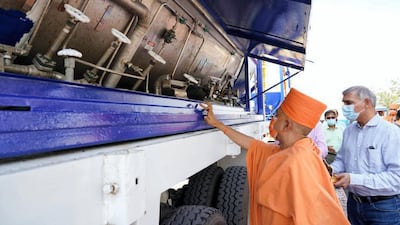
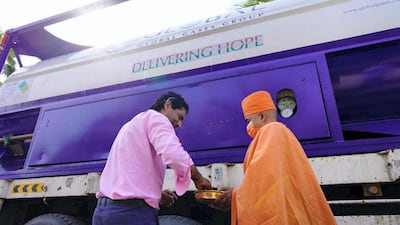
A priest offers a traditional Hindu prayer before a shipment of oxygen tanks and cylinders leaves Dubai for India to support hospitals reeling from oxygen shortages. -
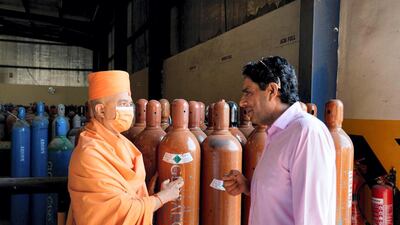
About 600 oxygen cylinders are being shipped to India from Dubai along with two tanks filled with 44 tonnes of liquid oxygen. -
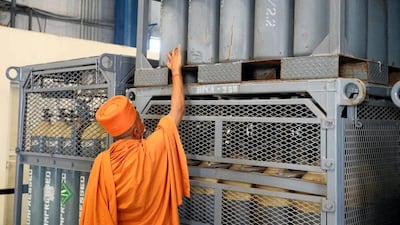
Swami Brahmavihari, a priest with Baps Swaminarayan Sanstha, offers a traditional Hindu prayer before shipping 600 oxygen cylinders to hospitals in India. -
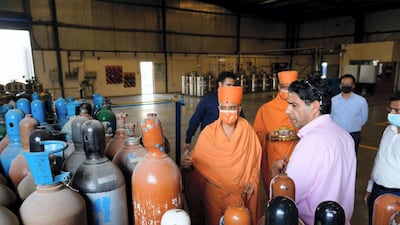
About 600 oxygen cylinders are being shipped to India from Dubai along with two tanks carrying 44 tonnes of liquid oxygen. -
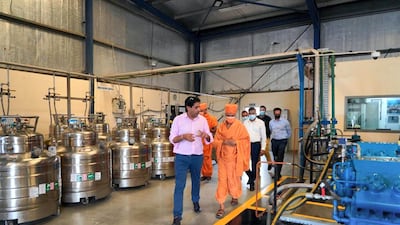
About 600 oxygen cylinders are being shipped to India from Dubai along with two tanks with 44 tonnes of liquid oxygen. -
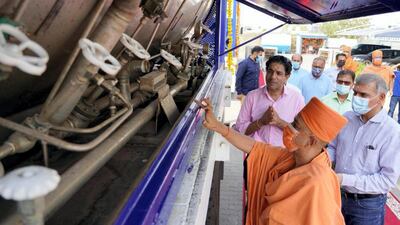
A Hindu priest offers a traditional prayer before shipping oxygen tanks, cylinders and oxygen concentrators to hospitals in India. -
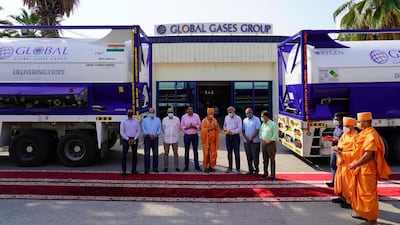
The medical supplies have been organised by the Baps Hindu temple in Abu Dhabi. -
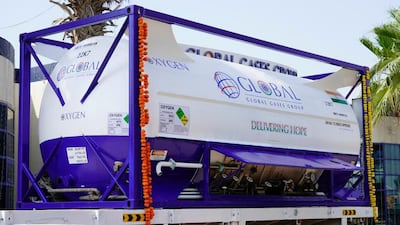
The first shipment is part of a planned monthly supply of 440 tonnes for patients in Indian hospitals. -
Medical grade oxygen is being shipped to Indian hospitals from Dubai.


The retailer initially started with bulk orders between 30 to 200 units. It is now handling online requests for single machines delivered for $999 (Dh3,669) across India.
Procurement has been a challenge as teams in Hong Kong require to pay manufacturers upfront and stay at the factory until the end of the day to ensure the stock is not taken by other companies.
The Indian government has exempted personal use oxygen concentrators from taxes when imported and airlines are giving the shipments priority.
Indian expatriates said the machines could prove critical for timely care of the elderly living alone.
“It’s a stop-gap insurance. We can hopefully buy some time until help can be arranged and we can travel back home,” said Buvana Raman, co-founder of an education technology company in Dubai.
“Our parents don’t have young people around who can quickly help. This could be used by anyone in the community who needs it urgently and not just by our parents.”
Prices range from Dh4,000 to Dh9,000 in the UAE, depending on capacity.
Dr Chaitanya Prabhu, critical care medicine specialist at Aster Hospital in Dubai, said the devices could help tide over a crisis.
“In a pandemic situation when you don’t have access to oxygen, the oxygen concentrator is a good bridge until the time you get to a hospital,” he said.
Typically, when a patient's levels – checked on an oximeter – dipped below 90 per cent, they were rushed to hospital.
But people are receiving supplementary oxygen at home while they wait for admission in hospitals in India.
The National spoke to Dr Prabhu to address questions people have about how to choose the correct machine.

What is an oxygen concentrator?
The device purifies the surrounding air using a filter that removes nitrogen – 79 per cent of atmospheric air – and provides a high concentration of oxygen to a patient.
It needs a continuous supply of electricity. There are machines that run on batteries. It is connected to the patient via plastic tubes, called a nasal cannula or prongs, that channel oxygen to the nose.
When should it be used and who can it help?
It benefits patients who have mild to moderate hypoxia, a condition in which the body is deprived of adequate oxygen supply.
This means their oxygen saturation could be between 86 to 93 per cent. A normal level of oxygen is usually 95 per cent or higher.
It will not aid patients who have a high oxygen requirement. Once their level drops to below 85, they must be taken to hospital.
With limited resources in India, these machines could help until arrangements are made.
Patients whose saturation is between 88 to 92 will get tired easily after some exertion and an oxygen concentrator can help.
People recovering from Covid-19 pneumonia who have been discharged may have a saturation of 90 per cent when they rest.
-

The Indian Air Force transported oxygen containers from Dubai to India for use in hospitals. PTI -

Shipment of oxygen concentrators, ventilators and other medical supplies arrived from Russia to India, Thursday, April 29, 2021. Indian External Affairs Ministry/AP -
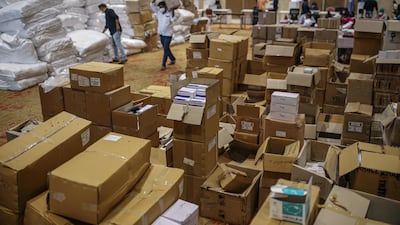
Employees prepare supplies in the control center at the Goregaon NESCO jumbo Covid centre in the Goregaon suburb of Mumbai, India. Bloomberg -
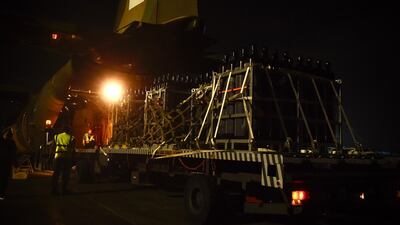
Part of the oxygen cylinder consignment being loaded into a Republic of Singapore Air Force C-130 aircraft to be sent to West Bengal, India to support the country's fight against the COVID-19 pandemic. EPA/Singapore's Ministry of Defence -
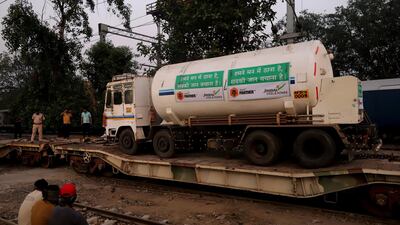
A medical oxygen tanker is delivered via the 'Oxygen Express' train at Delhi Cantt railway station in New Delhi, India, on Tuesday, April 27, 2021. Bloomberg -

A shipment of vital medical supplies from the United Kingdom arrives in New Delhi, India April 27, 2021. REUTERS


They may require an oxygen concentrator for a few months because their oxygen levels could drop when they walk a few metres.
What should I look out for?
The devices concentrate oxygen to a certain level and shows the percentage of oxygen the patient will get.
The machines that show a fixed percentage will at least give 90 per cent oxygen and this will benefit a patient.
If the purity or oxygen percentage sign indicates plus or minus 3 per cent and a variable flow of between 30 to 90 per cent, the amount of oxygen being delivered is uncertain and is not suitable for a Covid-19 patient.
This is because 30 per cent is similar to the air in a room where oxygen is about 21 per cent.
It defeats the purpose of the oxygenator because the aim is for a patient’s oxygen saturation to pick up.
Check if the system has an in-built humidifier. Oxygen can dry up the airways. A humidifier will make breathing easier for the patient.
What does flow rate mean and how do I choose?
This means there is a continuous flow of oxygen to the patient when the concentrator is turned on. Oxygen is delivered at a constant volume of the specified amount of litres per minute.
Not all patients require the high capacity of 10 litres per minute.
In hospitals, patients have improved with two to three litres per minute.
Mild to moderate patients will require between one to five litres per minute at the maximum.
Oxygen concentrators that provide 10 litres per minute can be used in a dual mode for two patients. But it is preferable that one patient uses a machine at a given time.
Higher flow machines are also being bought for homes as India is short of ICU beds.
Anyone who requires more than 10 litres would need an oxygen cylinder and hospital admission.
Oxygen concentrator versus oxygen cylinder – what is the difference?
An oxygen cylinder must be refilled so needs a continuous supply. The oxygen concentrator uses the surrounding air so does not have the same restriction.
At a high flow of 10 or 15 litres per minute, a cylinder is likely to last only four to five hours.
An oxygen concentrator just needs an electricity supply and can be continuously used. Its lifespan is between four to seven years.
Is proning possible while using a concentrator?
Yes, proning – when a person lies on their stomach – helps improve oxygenation and is possible when using a concentrator. It is recommended because it aids oxygenation.
Which brand should I buy?
Look for a reliable company, preferably one that manufactures respiratory products.
Consult your doctor or a pulmonologist before you decide on a product.

