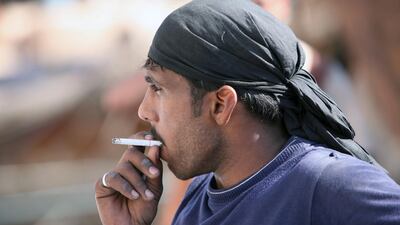
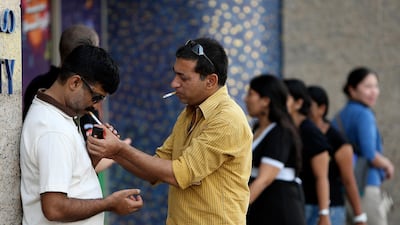
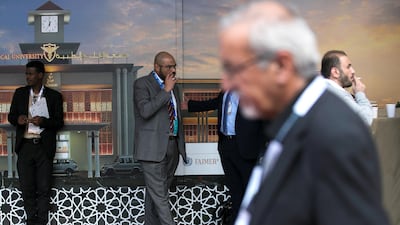
People who use medwakh tobacco pipes are more than three times more likely to be dependent on nicotine than cigarette smokers, new findings in the UAE have revealed.
The new study was conducted by scientists from Gulf Medical University in Ajman, Karnataka Institute of Medical Sciences in India, and New York University.
It is thought to be the first to look at levels of addiction specifically linked to medwakh, which are small pipes filled with tobacco popular in the Emirates.
The researchers behind the work said efforts should be made to make people understand the dangers of becoming dependent on medwakh.
One of the authors of the study, Dr Rizwana Shaikh, of Karnataka Institute of Medical Sciences in India, said the speed at which the tobacco in medwakh pipes was smoked may account for the greater level of dependence.
"Cigarettes are smoked over a period of at least four or five minutes. People take puffs leisurely and it's a kind of social activity," she said.
"When it comes to medwakh, the person is inhaling the nicotine in 30 seconds - it's two deep puffs. It burns up the entire tobacco that's there."
She added that the wide availability and low price of the dokha tobacco used in medwakh made the pipes popular with young people, particularly males, and it is often erroneously seen as less hazardous than cigarettes.
"It has to be brought to the fore that this form of smoking is harmful," said Dr Shaikh, a former associate professor at Gulf Medical University in Ajman.
The study looked at 88 adult smokers in Ajman, 40 of whom used cigarettes and the rest medwakh, and found there was 3.3 times the risk of moderate to high nicotine dependence in the latter group.
While the number of smokers assessed was modest, the results were statistically significant.
“Healthcare practitioners should be aware of the high risk of nicotine dependency among medwakh smokers when recommending smoking cessation strategies,” the authors wrote in the paper titled “Predictors of nicotine dependence among adult male medwakh and cigarette smokers".
The Fagerström test of nicotine addiction
To assess how addicted people were, the study used a modified form of one of the world's best-known measures of nicotine dependence, the Fagerström test.
This asks multiple-choice questions about a person’s smoking habits and gives higher scores to answers suggesting dependence.
Questions in the standard version include, “How soon after you wake up do you have your first cigarette?”, with possible responses being within five minutes, six to 30 minutes after waking, 31 to 60 minutes or more than 60 minutes.
The Fagerström test also asks if smokers find it difficult to refrain from lighting up in places such as the library or cinema, where it is forbidden.
Smokers are also quizzed on, among other things, whether they smoke more during the first hours after they wake up than later in the day, and whether they smoke even if they are so ill they are in bed most of the day.
Another result of the study was that nicotine dependence was almost twice as great among smokers who inhaled deeply, compared to those who did not, although this finding was not statistically significant.
Smoking, which the authors said was associated with an approximately 10-year reduction in life expectancy, remains a major concern in the UAE, with an estimated nine per cent of residents – including 15 per cent of men – using tobacco.
Medwakh is thought to be particularly popular among younger people, with the study quoting previous research indicating that 23.4 per cent of Dubai high school pupils used the pipes at least weekly.
The paper suggested the higher level of dependence linked to medwakh could be because the pipes were filled with dokha, a blend of tobacco and herbs.
Research published in 2018 found that dokha contained more nicotine and tar than cigarettes.
While the new study indicated that medwakh pipes may be particularly addictive, doctors said all forms of smoking were hazardous.
“It’s very commonly associated with risk for CVD [cardiovascular disease] here and all over the Middle East,” said Dr Davinder Pal Singh, a cardiologist at NMC Royal Hospital in Dubai Investments Park.
“All types, even shisha, contain some form of nicotine in varying amounts. All are dangerous … All types of smoking are contributing to CVD. Any type of smoking is not good.”
Another study from 2018, by scientists at New York University Abu Dhabi, found that regular medwakh use was linked to alterations in mouth bacteria associated with a greater risk of CVD.
United States makes moves towards lowering nicotine levels in cigarettes
The%20Killer
%3Cp%3E%3Cstrong%3EDirector%3A%C2%A0%3C%2Fstrong%3EDavid%20Fincher%3C%2Fp%3E%0A%3Cp%3E%3Cstrong%3EStars%3A%C2%A0%3C%2Fstrong%3EMichael%20Fassbender%2C%20Tilda%20Swinton%2C%20Charles%20Parnell%3C%2Fp%3E%0A%3Cp%3E%3Cstrong%3ERating%3A%3C%2Fstrong%3E%204%2F5%C2%A0%3C%2Fp%3E%0A
Joe Root's Test record
Tests: 53; Innings: 98; Not outs: 11; Runs: 4,594; Best score: 254; Average: 52.80; 100s: 11; 50s: 27
RESULTS
5pm Wathba Stallions Cup Maiden (PA) Dh70,000 (Dirt) 1,400m
Winner Munfared, Fernando Jara (jockey), Ahmed Al Mehairbi (trainer)
5.30pm Handicap (PA) Dh70,000 (D) 1,600m
Winner Sawt Assalam, Szczepan Mazur, Ibrahim Al Hadhrami
6pm Maiden (PA) Dh70,000 (D) 1,800m
Winner Dergham Athbah, Pat Dobbs, Mohamed Daggash
6.30pm Handicap (PA) Dh70,000 (D) 1,800m
Winner Rajee, Fernando Jara, Majed Al Jahouri
7pm Conditions (PA) Dh80,000 (D) 1,800m
Winner Kerless Del Roc, Fernando Jara, Ahmed Al Mehairbi
7.30pm Handicap (TB) Dh70,000 (D) 2,000m
Winner Pharoah King, Pat Dobbs, Doug Watson
8pm Conditions (PA) Dh85,000 (D) 2,000m
Winner Sauternes Al Maury, Dane O’Neill, Doug Watson
11 cabbie-recommended restaurants and dishes to try in Abu Dhabi
Iqbal Restaurant behind Wendy’s on Hamdan Street for the chicken karahi (Dh14)
Pathemari in Navy Gate for prawn biryani (from Dh12 to Dh35)
Abu Al Nasar near Abu Dhabi Mall, for biryani (from Dh12 to Dh20)
Bonna Annee at Navy Gate for Ethiopian food (the Bonna Annee special costs Dh42 and comes with a mix of six house stews – key wet, minchet abesh, kekel, meser be sega, tibs fir fir and shiro).
Al Habasha in Tanker Mai for Ethiopian food (tibs, a hearty stew with meat, is a popular dish; here it costs Dh36.75 for lamb and beef versions)
Himalayan Restaurant in Mussaffa for Nepalese (the momos and chowmein noodles are best-selling items, and go for between Dh14 and Dh20)
Makalu in Mussaffa for Nepalese (get the chicken curry or chicken fry for Dh11)
Al Shaheen Cafeteria near Guardian Towers for a quick morning bite, especially the egg sandwich in paratha (Dh3.50)
Pinky Food Restaurant in Tanker Mai for tilapia
Tasty Zone for Nepalese-style noodles (Dh15)
Ibrahimi for Pakistani food (a quarter chicken tikka with roti costs Dh16)
Results
ATP Dubai Championships on Monday (x indicates seed):
First round
Roger Federer (SUI x2) bt Philipp Kohlschreiber (GER) 6-4, 3-6, 6-1
Fernando Verdasco (ESP) bt Thomas Fabbiano (ITA) 3-6, 6-3, 6-2
Marton Fucsovics (HUN) bt Damir Dzumhur (BIH) 6-1, 7-6 (7/5)
Nikoloz Basilashvili (GEO) bt Karen Khachanov (RUS x4) 6-4, 6-1
Jan-Lennard Struff (GER) bt Milos Raonic (CAN x7) 6-4, 5-7, 6-4
UAE squad
Humaira Tasneem (c), Chamani Senevirathne (vc), Subha Srinivasan, NIsha Ali, Udeni Kuruppuarachchi, Chaya Mughal, Roopa Nagraj, Esha Oza, Ishani Senevirathne, Heena Hotchandani, Keveesha Kumari, Judith Cleetus, Chavi Bhatt, Namita D’Souza.
FIXTURES
UAE’s remaining fixtures in World Cup qualification R2
Oct 8: Malaysia (h)
Oct 13: Indonesia (a)
Nov 12: Thailand (h)
Nov 17: Vietnam (h)
Mercer, the investment consulting arm of US services company Marsh & McLennan, expects its wealth division to at least double its assets under management (AUM) in the Middle East as wealth in the region continues to grow despite economic headwinds, a company official said.
Mercer Wealth, which globally has $160 billion in AUM, plans to boost its AUM in the region to $2-$3bn in the next 2-3 years from the present $1bn, said Yasir AbuShaban, a Dubai-based principal with Mercer Wealth.
“Within the next two to three years, we are looking at reaching $2 to $3 billion as a conservative estimate and we do see an opportunity to do so,” said Mr AbuShaban.
Mercer does not directly make investments, but allocates clients’ money they have discretion to, to professional asset managers. They also provide advice to clients.
“We have buying power. We can negotiate on their (client’s) behalf with asset managers to provide them lower fees than they otherwise would have to get on their own,” he added.
Mercer Wealth’s clients include sovereign wealth funds, family offices, and insurance companies among others.
From its office in Dubai, Mercer also looks after Africa, India and Turkey, where they also see opportunity for growth.
Wealth creation in Middle East and Africa (MEA) grew 8.5 per cent to $8.1 trillion last year from $7.5tn in 2015, higher than last year’s global average of 6 per cent and the second-highest growth in a region after Asia-Pacific which grew 9.9 per cent, according to consultancy Boston Consulting Group (BCG). In the region, where wealth grew just 1.9 per cent in 2015 compared with 2014, a pickup in oil prices has helped in wealth generation.
BCG is forecasting MEA wealth will rise to $12tn by 2021, growing at an annual average of 8 per cent.
Drivers of wealth generation in the region will be split evenly between new wealth creation and growth of performance of existing assets, according to BCG.
Another general trend in the region is clients’ looking for a comprehensive approach to investing, according to Mr AbuShaban.
“Institutional investors or some of the families are seeing a slowdown in the available capital they have to invest and in that sense they are looking at optimizing the way they manage their portfolios and making sure they are not investing haphazardly and different parts of their investment are working together,” said Mr AbuShaban.
Some clients also have a higher appetite for risk, given the low interest-rate environment that does not provide enough yield for some institutional investors. These clients are keen to invest in illiquid assets, such as private equity and infrastructure.
“What we have seen is a desire for higher returns in what has been a low-return environment specifically in various fixed income or bonds,” he said.
“In this environment, we have seen a de facto increase in the risk that clients are taking in things like illiquid investments, private equity investments, infrastructure and private debt, those kind of investments were higher illiquidity results in incrementally higher returns.”
The Abu Dhabi Investment Authority, one of the largest sovereign wealth funds, said in its 2016 report that has gradually increased its exposure in direct private equity and private credit transactions, mainly in Asian markets and especially in China and India. The authority’s private equity department focused on structured equities owing to “their defensive characteristics.”
Zayed Sustainability Prize
COMPANY%20PROFILE%20
%3Cp%3EName%3A%20DarDoc%3Cbr%3EBased%3A%20Abu%20Dhabi%3Cbr%3EFounders%3A%20Samer%20Masri%2C%20Keswin%20Suresh%3Cbr%3ESector%3A%20HealthTech%3Cbr%3ETotal%20funding%3A%20%24800%2C000%3Cbr%3EInvestors%3A%20Flat6Labs%2C%20angel%20investors%20%2B%20Incubated%20by%20Hub71%2C%20Abu%20Dhabi's%20Department%20of%20Health%3Cbr%3ENumber%20of%20employees%3A%2010%3C%2Fp%3E%0A