

Johnson & Johnson’s single dose Covid-19 vaccine was given conditional approval by the EU's drugs regulator on Thursday.
It will help to bolster Europe’s stuttering inoculation campaign and boost its supplies of vaccines.
Announcing its decision, the EU medicines regulator said it was recommending the vaccine be authorised "after a thorough evaluation" of J&J data found it met the criteria for efficacy, safety and quality.
“With this latest positive opinion, authorities across the European Union will have another option to combat the pandemic and protect the lives and health of their citizens,” said Emer Cooke, executive director of the European Medicines Agency.
"This is the first vaccine that can be used as a single dose."
The Covid-19 shot, which the EMA said was about 67 per cent effective, is the fourth to be endorsed for use in the EU after vaccines from Pfizer-BioNTech, AstraZeneca-Oxford University and Moderna, and is recommended for those over 18 years of age, the EMA said.
The US, Canada and Bahrain also approved the shot. South Africa is carrying out an expedited review.
EU conditional marketing authorisation allows a treatment to be sold for a year without full data on its efficacy and side effects being available.
The region is having difficulty controlling a surge in cases driven by more contagious variants of the coronavirus, with countries including Italy and France imposing new lockdowns.
The EU struggled to quickly distribute doses and immunise its most vulnerable citizens. It ranks far behind countries such as Israel, Britain, Chile and the US.
The Johnson & Johnson decision came on the day health authorities in Denmark and Norway temporarily suspended the use of AstraZeneca's Covid-19 vaccine shots after reports of the formation of blood clots in some who had been vaccinated.
Austria stopped using a batch of AstraZeneca shots while investigating a death from coagulation disorders and an illness from a pulmonary embolism.
Danish health authorities said the country's decision to suspend the shots for two weeks came after a 60-year-old woman in Denmark, who was given an AstraZeneca shot from the same batch that was used in Austria, suffered a blood clot and died.
-
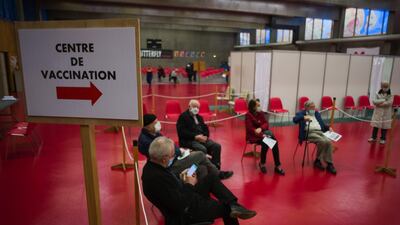
Elderly visitors wait to receive a dose of the Covid-19 vaccine at the vaccination center in the Jean Pierre Rives sports stadium in Paris, France. Bloomberg -

Musician Samuel Palomino plays the viola during a Mozart mini-concert for Covid-19 patients at the Nurse Isabel Zendal Hospital in Madrid, Spain. AP Photo -

An employee helps customers at a Saturn electronic store as the coronavirus lockdown measures are eased in Berlin, Germany. Reuters -
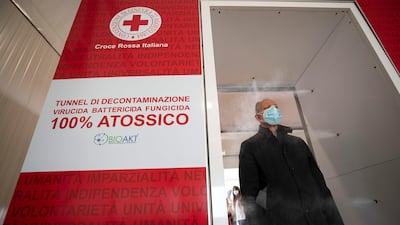
A man is disinfected as he enters an Italian Red Cross vaccination centre set up at Piazza dei Cinquecento, in Rome, Italy. EPA -

Students gather to protest against isolation in Brussels, Belgium. EPA -
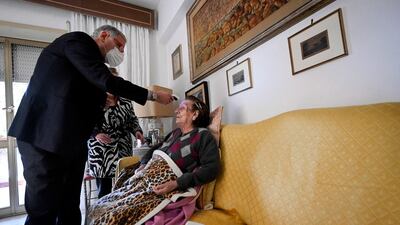
A family doctor administers a vaccine to his 100 year old patient named Amelia in Rome, Italy. EPA -
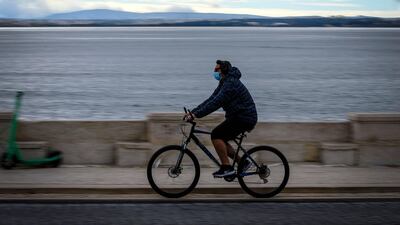
A man rides a bicycle in a quiet Lisbon, Portugal. Portugal will start to ease restrictions due to a decrease in coronavirus cases. AFP -
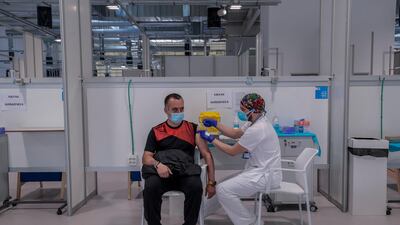
A man receives the AstraZeneca vaccine at the Nurse Isabel Zendal Hospital in Madrid, Spain. AP Photo


Danish authorities said they had responded "to reports of possible serious side effects, both from Denmark and other European countries".
"It is currently not possible to conclude whether there is a link. We are acting early, it needs to be thoroughly investigated," Health Minister Magnus Heunicke said on Twitter.
"This is a cautionary decision," said Geir Bukholm, director of infection prevention and control at the Norwegian Institute of Public Health (FHI).
Norway's FHI did not say how long the suspension would last.
Also on Thursday, Italy said it would suspend use of the AstraZeneca batch that was used in Austria.
Some health experts said there was little evidence to suggest the AstraZeneca vaccine should not be administered and that the cases of blood clots corresponded with the rate of such cases in the general population.
"This is a super-cautious approach based on some isolated reports in Europe," said Stephen Evans, professor of pharmacoepidemiology at the London School of Hygiene & Tropical Medicine.
Europe recorded a million new Covid-19 cases last week, an increase of 9 per cent 9from the previous week and a reversal that ended a six-week decline in new infections.

