Norway, Denmark and Iceland suspended use of the Covid-19 vaccine made by AstraZeneca on Thursday after several cases of blood clots among people inoculated with the shot were reported.
The move comes after one person in Denmark who was given the AstraZeneca shot suffered a blood clot and died.
The concerns stemmed from a particular batch of AstraZeneca vaccines that went to 17 European Union countries.
Austria on Tuesday stopped using doses from the batch while investigating a death from a pulmonary embolism, an acute lung disease caused by a dislodged blood clot.
Italy, Estonia, Lithuania, Luxembourg and Latvia were among the other European nations to ban the batch, which contained one million doses.
Danish authorities said they were acting cautiously after a 60-year-old woman who died from a blood clot two weeks ago was given an AstraZeneca shot from the same batch used in Austria.
Health Minister Magnus Heunicke said it was too early to conclude whether the deaths were linked to the vaccine.
"We are acting early. It needs to be thoroughly investigated," he said.
Hours after Denmark’s move, Norway and Iceland also said they would halt the delivery of AstraZeneca's Covid-19 vaccine.
"This is a precautionary decision," said Geir Bukholm, the director of infection prevention and control at the Norwegian Institute of Public Health.
The European Medicines Agency said European countries can keep using AstraZeneca's coronavirus vaccine while an investigation into the blood clots takes place.
The regulator said there have been 30 cases of "thromboembolic events" among five million people who've had the shot so far in Europe.
"The vaccine's benefits continue to outweigh its risks and the vaccine can continue to be administered while investigation of cases of thromboembolic events is ongoing," it said.
"There is currently no indication that vaccination has caused these conditions, which are not listed as side effects with this vaccine."
The UK medicines regulator also moved to reassure the public that the vaccine was safe.
Dr Phil Bryan, safety lead at the Medicines and Healthcare Products Regulatory Agency, said there was little evidence the AstraZeneca vaccine should not be administered.
“The Danish authorities’ action to temporarily suspend use of the vaccine is precautionary whilst they investigate,” he said.
“The safety of the public will always come first. We are keeping this issue under close review but available evidence does not confirm that the vaccine is the cause."
-
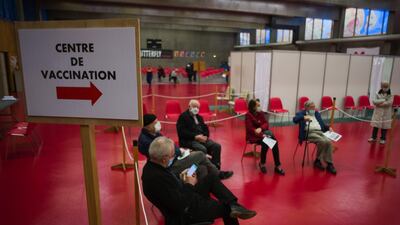
Elderly visitors wait to receive a dose of the Covid-19 vaccine at the vaccination center in the Jean Pierre Rives sports stadium in Paris, France. Bloomberg -

Musician Samuel Palomino plays the viola during a Mozart mini-concert for Covid-19 patients at the Nurse Isabel Zendal Hospital in Madrid, Spain. AP Photo -

An employee helps customers at a Saturn electronic store as the coronavirus lockdown measures are eased in Berlin, Germany. Reuters -

A man is disinfected as he enters an Italian Red Cross vaccination centre set up at Piazza dei Cinquecento, in Rome, Italy. EPA -

Students gather to protest against isolation in Brussels, Belgium. EPA -
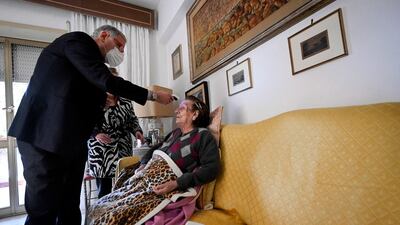
A family doctor administers a vaccine to his 100 year old patient named Amelia in Rome, Italy. EPA -

A man rides a bicycle in a quiet Lisbon, Portugal. Portugal will start to ease restrictions due to a decrease in coronavirus cases. AFP -
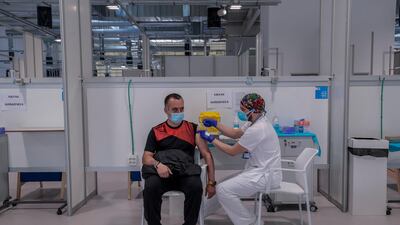
A man receives the AstraZeneca vaccine at the Nurse Isabel Zendal Hospital in Madrid, Spain. AP Photo


Prof Stephen Evans, from the London School of Hygiene and Tropical Medicine, said some European countries were taking a “super-cautious approach based on some isolated reports”.
"The problem with spontaneous reports of suspected adverse reactions to a vaccine is the enormous difficulty of distinguishing a causal effect from a coincidence," he said.
Prof Anthony Harnden, from Oxford University, noted that Covid-19 was strongly associated with blood clots.
“People ought to be absolutely reassured we are seeing no major safety signals in the UK at the moment,” he told Sky News.
“There will always be cases of serious illness around the time of vaccination, but that’s very different from vaccines causing it.”
Swedish authorities said they had not found sufficient evidence to stop using AstraZeneca's vaccine.
Sweden has found two cases of "thromboembolic events" in connection with AstraZeneca's vaccine and about 10 with the Pfizer-BioNTech vaccine.
"We see no reason to revise our recommendation," said Veronica Arthurson, head of Swedish Medical Products Agency.
"There is nothing to indicate that the vaccine causes this type of blood clot."
Spain on Thursday said it had not registered any cases of blood clots related to AstraZeneca's vaccine so far and would continue administering the shots.
Authorities said blood clotting was not among the known side effects of the vaccine.
According to clinical and real-world data, some patients experience only mild to moderate side effects, including headaches, fatigue and pain at the site of injection.
The vaccine, developed in partnership with Oxford University, is one of four Covid-19 drugs approved in the European Union. The others are made by Pfizer-BioNTech, Moderna and Johnson & Johnson, which was approved on Thursday.
But officials are struggling to generate public support for the AstraZeneca vaccine after it was described as "quasi-ineffective" by French President Emmanuel Macron.
The German medicines regulator also cast doubt on its effectiveness after it said it did not recommend the shot for older people, citing a lack of data.
The country backtracked last week after its independent vaccine panel reversed its former advice and ruled the shot was safe for over-65s.
France announced a similar move just days before Germany changed its advice.
Real-world data released by British health authorities showed the shot was "highly effective" in preventing serious illness in older people, with a more than 80 per cent reduction in hospital admissions.
UK Health Secretary Matt Hancock said the data was "slightly better for the Oxford jab than for Pfizer".
The Public Health England study showed that in people over the age of 80, a single dose of either the Pfizer-BioNTech or Oxford-AstraZeneca vaccine was more than 80 per cent effective in preventing hospital admission about three to four weeks after vaccination.

