

On March 11, more than three months after it officially began, the World Health Organisation declared the outbreak of Covid-19 a pandemic.
The virus, which originated in Wuhan in December 2019, has spread to over 124 countries.
There are now more than 126,500 cases, with 4,600 deaths.
More than 68,300 patients have recovered so far.
“WHO has been assessing this outbreak around the clock and we’re deeply concerned both by the alarming levels of spread and severity and the alarming levels of inaction. We have therefore made the assessment that Covid-19 can be characterised as pandemic,” said the body’s director general, Tedros Adhanom Ghebreyesus.
But countries can change the course of the pandemic by detecting, testing, treating, isolating and tracing contacts to prevent community transmission, he said.
The WHO has praised strategies like the lockdown of Wuhan, the epicentre of the outbreak, to stem the spread of the virus.
“This is the first one in history we can control,” said Dr Fadi Baladi, medical director, Bujeel Day Surgery Centre, Reem Island.
“Countries are taking extreme measures and are learning from each other, which is the right thing to do. Unfortunately it took a catastrophe for people to start working together.”
Why declare a pandemic now?
Experts said the outbreak of Covid-19 meets the definition of a pandemic as the pathogen spreads across countries and continents.
With 126,500 cases in 124 countries, the outbreak now ticks all boxes to be declared a pandemic.
How do past pandemics compare to this one?
The last pandemic occurred in 2009 during the swine flu outbreak.
Estimates suggested one in five people were infected in the first year of the outbreak but it was a mild illness, with a mortality rate of just 0.02 per cent – around five times lower than the seasonal flu.
About 575,000 people died but medical systems were not overwhelmed like parts of Italy and China in the current outbreak.
The Spanish flu of 1918 was the last pandemic, killing up to 50 million people, or 2.5 per cent of the people it infected.
Current estimates suggest Covid-19 is significantly deadlier, with a current mortality rate of around 3.4 per cent, according to the WHO.
That could vary if more mild cases are discovered via widespread testing, or rise as more succumb to the virus.
-

A fence secured with a lock and chain is seen at the entrance to the New Rochelle High School in New Rochelle, New York, USA. Bloomberg -

A worker staffs a security checkpoint in the international terminal at O'Hare Airport in Chicago, Illinois. AFP -
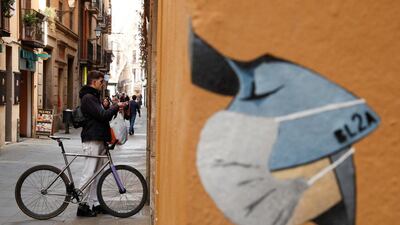
A man stops with a bicycle near a drawing of a person wearing a mask in a wall, in central Barcelona, Spain. Reuters -

A man washes his hands at the University Medical Center in Groningen, The Netherlands. EPA -

A man walks past the closed Air France counters at the Terminal 1 section at John F. Kennedy International Airport in New York City. AFP -
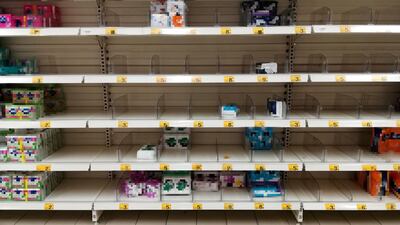
Empty shelves are seen at a supermaket in Lublin, eastern Poland. EPA -
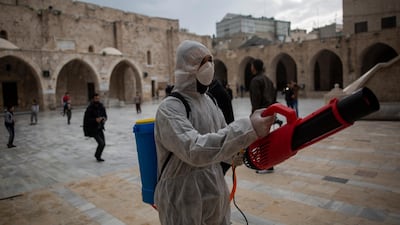
Health workers spray disinfectant as a precaution against the coronavirus in the Al-omari Mosque in Gaza City. AP Photo -

A father puts a protective face mask on his son face, before entering a makeshift coronavirus testing centre at the Mishref Fair Grounds in Kuwait city, Kuwait. Reuters -
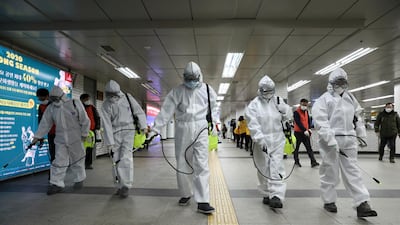
Workers disinfect as a precaution against coronavirus at a subway station in Seoul, South Korea, Wednesday, March 11, 2020. AP -

US President Donald Trump delivers remarks to the media during a meeting with bankers on the coronavirus response at the White House, March 11, 2020. Reuters -

US actor Tom Hanks and his wife, US actress Rita Wilson, arrive at the European premiere of their movie 'The Post' in London, Britain, 10 January 2018. They have both tested positive for coronavirus. EPA -
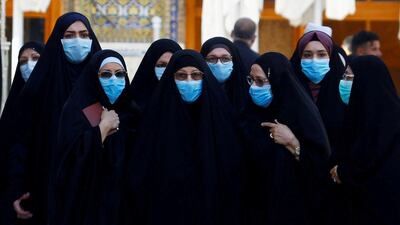
Women wear protective face masks at Imam Ali Shrine in the holy city of Najaf, Iraq March 11, 2020. Reuters -
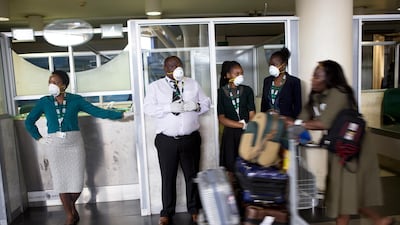
Travellers and airport staff walk through Robert Mugabe International airport in Harare, Wednesday, March, 11, 2020. AP Photo -

Workers in protective suits disinfect Dolmabahce Palace due to coronavirus concerns in Istanbul, Turkey March 11, 2020. Reuters -
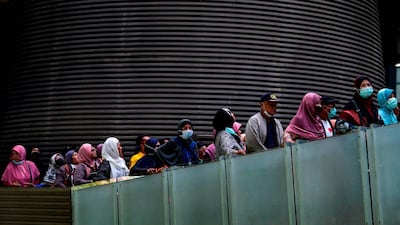
Visitors wearing protective face masks visit the tsunami museum in Banda Aceh on March 11, 2020. AFP -
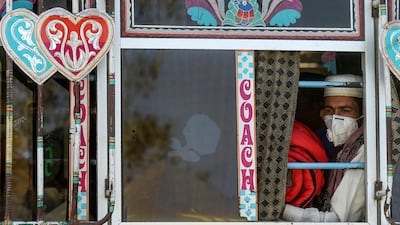
A passenger sits in a bus in Karachi on March 11, 2020. AFP -

A police officer stands guard at the Vatican's Saint Peter's Square and its main basilica on March 11, 2020. AFP -
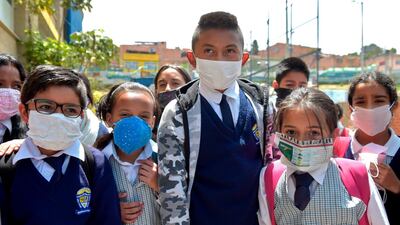
Colombian students pose for a picture wearing face masks made of recyclable and biodegradable materials, as a form of protest against the shortage of face masks in pharmacies, at Julio Cesar Turbay school, in Soacha, Colombia, on March 11, 2020. AFP -
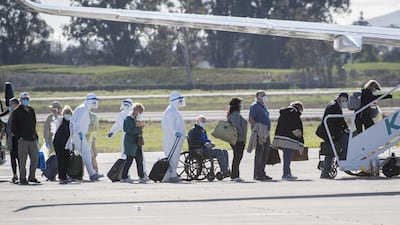
Passengers who were on the Carnaval Corp. Grand Princess cruise ship board a chartered plane at the Oakland International Airport in Oakland, California, US, on Wednesday, March 11, 2020. Bloomberg -
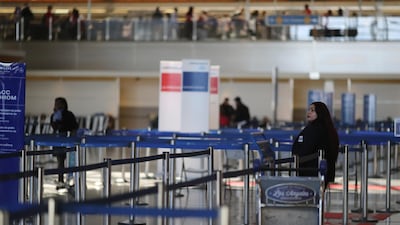
An airline worker stands in the empty international terminal at LAX airport in Los Angeles, California, US, March 11, 2020. Reuters -
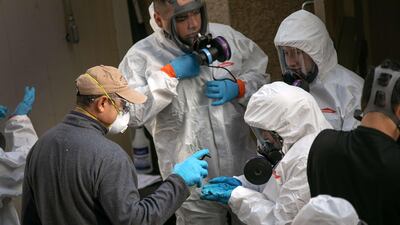
A cleaning crew disinfects and removes protective clothing after exiting the Life Care Center on March 11, 2020 in Kirkland, Washington. Getty Images/AFP -

A general view before the 69th NBA All-Star Game at the United Center on February 16, 2020 in Chicago, Illinois. The NBA will suspend play starting on March 12, 2020 after a Utah Jazz player preliminarily tested positive for the new coronavirus, the league said Wednesday. AFP -

Passengers from the Grand Princess cruise ship are assisted boarding a charter plane at the Oakland International Airport in Oakland, California, USA, 11 March 2020. EPA


How big could the outbreak get?
Many experts predict the majority of the world – possibly as many as 70 per cent of people – will become infected with Covid-19.
A Harvard epidemiologist, Marc Lipsitch, who is the director of the Centre for Communicable Disease Dynamics at the Harvard T.H. Chan School of Public Health, first predicted the severity of the virus in mid-February, when there were fewer cases outside China.
He warned the virus would “likely” become a pandemic, affecting 40 to 70 per cent of the world’s population this year.
Prof Gabriel Leung, the chair of public health medicine at Hong Kong University, said the virus’ attack rate would affect 60 to 80 per cent of the world’s population, based on a transmission estimate of 2.5 people for each infected person.
The opinion is now shared by world leaders.
German Chancellor Angela Merkel warned on Wednesday that up to 70 per cent of her country's population could contract the virus.
Why is it predicted to infect so many people?
Low immunity levels to the novel virus and a higher rate of infection increases the risk of more people contracting it.
Studies use a value called R-nought (R0) to rate a disease’s infectiousness, which suggests how many people one patient will go on to infect.
A study published in the New England Journal of Medicine in late January suggested the R0 value of the new coronavirus to be 2.2.
By comparison, seasonal flu’s R0 value is estimated to be just 1.3.
What's the way forward?
Governments will need to mobilise their entire health system, distribute personal protective equipment, antivirals, and medical supplies and test more people as part of their mitigation plans.
“The moment you declare a pandemic, it is imperative that all countries are ready and test for the presence of this bug in their community,” Dr Ravi Arora, a specialist in internal medicine at NMC Speciality Hospital in Abu Dhabi said.
“Anyone with symptoms, especially where local transmission has been documented, they could or should be tested. But then that’s going to be a drain on resources. Imagine the number of kits that will be required on a daily basis the world over. You are talking of a million tests a day, or even more.”

