


While Covid-19 is typically less common in children, the pandemic has greatly affected opportunities for growth and development for many in their early years.
With nurseries and day care facilities closed during most of last year, society's youngest members missed out on getting the crucial social stimulation they would normally have.
Lockdowns and social distancing rules meant many children were restricted to only seeing immediate family members and spending less time outdoors.
The past year has been confusing for youngsters, said many parents.
There were outbursts due to a lack of routine and behavioural issues caused by limited social interaction, said Laetitia Tregoning, 43, a British mother of two boys.
“My son Eddie was just shy of his second birthday when his nursery closed temporarily due to the first lockdown. That was almost one year ago,” she said.
“Within a few days he was lost. He went from having structure to almost no structure at all.
“Quite quickly we saw a change in his behaviour because he missed being in that nursery setting.”
As the self-employed parents of Eddie and his five-year-old brother, Ms Tregoning said she and her husband, Harry, found it tough juggling work, home schooling and early years learning.
“In a sense, now I look back, Eddie got left behind a little bit,” she said.
“I guess trying to navigate things like Arabic and Maths for our older child soon took a front seat.
“After a while, Eddie started to become difficult at bedtime and would make himself physically sick to get our attention.
"His behaviour spiralled, he spent more time on the screen for home learning – which given the circumstances was unavoidable – and he became a bit fussy with food," Ms Tregoning said.

“When you look back, a lot of those issues could be age related but I feel like it all started from a lack of structure that he usually got when in the nursery.
"He returned in October when it reopened, and we've got our Eddie back. But it was a really horrible and confusing time for him and us."
Dr Amy Bailey, clinical psychologist at KidsFirst Medical Centre in Dubai, said children use person-to-person interactions to pick up social cues from peers, build attachments and establish routines.
But due to the pandemic, a lot of parents worried about how reduced interactions would affect their children socially, emotionally and in their development.
“Social learning theory states that children learn through observing others; the lack of interaction with others can therefore prohibit them from having the opportunities to learn appropriate prosocial behaviours,” she said.
“This may include learning co-operation, negotiation and understanding how others feel.
“The wearing of masks means that children have less opportunities to understand and learn how to respond to facial expressions, as well as reduced opportunities to see how their responses and reactions may impact others.”
Ms Bailey said a lack of interaction with others could also have a direct impact on a child's language development and their "overall development and functioning in later life".
This includes their ability to communicate effectively, build self-esteem and manage conflict.
While many children would have benefited from more one-on-one attention from parents, Tanya Dharamshi, clinical director at Priory Wellbeing Centre in Dubai, said that could have created a number of other issues.
“The time spent in isolation with parents and family members may cause attachment issues and, in some case, separation anxiety,” she said.
“Many children must have missed out on nursery, school, playdates and close and regular contact with friends," Ms Dharamshi said.
“Through this contact with friends, children learn how to socialise, read body cues and decipher tone.
“Without this, children may be affected in their desire to return to their previous routine. They may find new environments and mixing with people again overwhelming and very unsettling at first,” she said.
Experts said parents can look at other ways to boost a child's social learning experiences.
This can be through increased family time or looking at non-direct ways of interaction, such as teleconferencing.
Play can also be used to act out different social scenarios and parents can use books and films to discuss social situations.
Adults can ask the child about how a book character reacted and what they would do in a similar situation.
One mother-of-three said she had seen some change in young children who attended a structured nursery.
“I’d say the FS1 children are noticeably a bit behind on things like lining up and certain discipline practices at school,” she said.
"Teachers have noticed it as well. These children missed out on six months of nursery at quite an important time in their lives.
"Personally, having three children very close in age meant lockdown didn't actually affect mine all that much, socially, but I imagine children with no siblings must have suffered," she said.
"It made me realise my boys started nursery too young. They were both under the age of one, but my daughter started at the perfect time – almost two – and is much more settled."
Sanitisation work being carried out in nurseries before reopening in October 2020 - in pictures
-

British Orchard Nursery staff sterilise toys regularly. All photo by Reem Mohammed/The National -
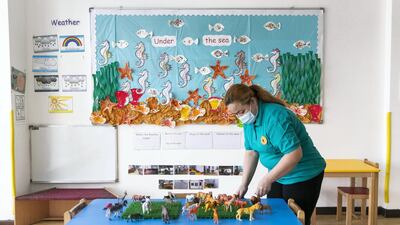
British Orchard Nursery staff arrange sanitised toys on the table -
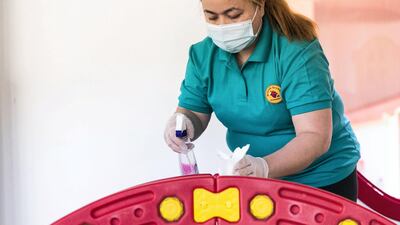
Safety is paramount for British Orchard Nursery as the group prepares to reopen its 23 centres in the emirate -
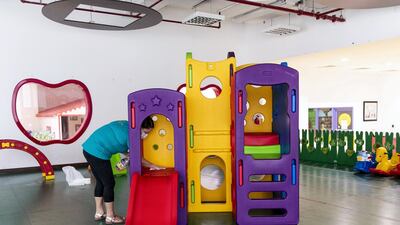
Extensive preparations have been made ahead of a planned reopening -
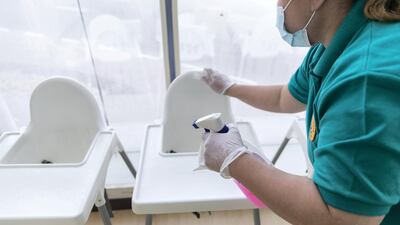
Nurseries will operate at 50 per cent capacity if given the green-light to resume operations -
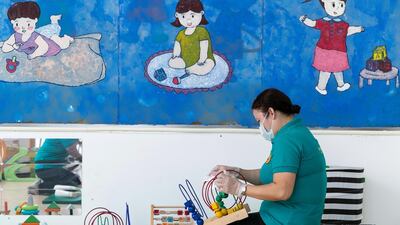
British Orchard Nursery was one of the many places of learning to close in March to restrict the spread of Covid-19 -
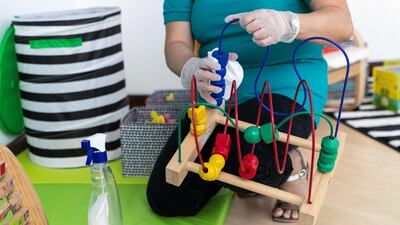
British Orchard Nursery is awaiting government approval to reopen its doors -
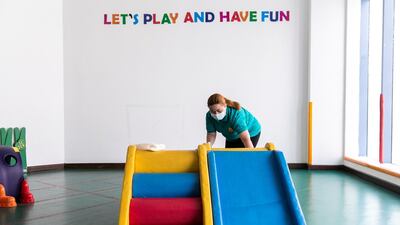
British Orchard Nursery staff are looking forward to welcoming back children for the first time in seven months -
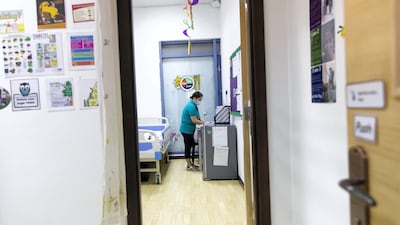
The clinic at British Orchard Nursery in Dubai Silicon Oasis -
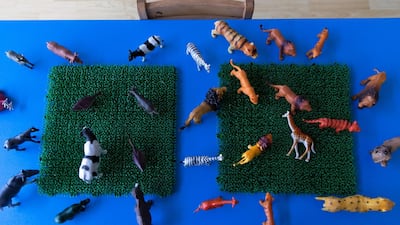
British Orchard Nursery in Dubai Silicon Oasis -
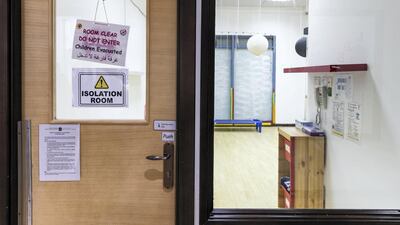
An isolation room at the British Orchard Nursery in Dubai Silicon Oasis -
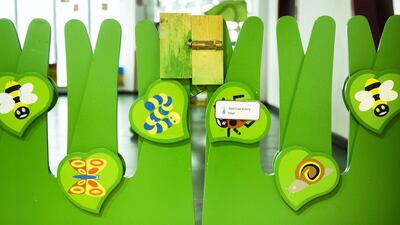
“Sanitise Every Hour” signs are placed around British Orchard Nursery in Dubai Silicon Oasis -
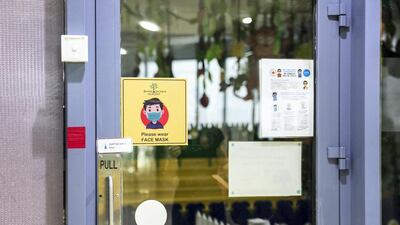
A “Please wear a face mask” sign at the entrance of British Orchard Nursery in Dubai Silicon Oasis



