
Latest: Dubai health officials warn public over flouting mask and distancing rules
The UAE's Health Minister said the country was already drawing up plans to battle future viral outbreaks, as it continues to tackle the effects of coronavirus.
Abdulrahman Al Owais said a national strategy for managing future diseases, known as "Disease X', would be developed from lessons learnt with this pandemic.
Mr Al Owais was speaking on the final day of an online government meeting to assess the country's post-Covid-19 action plan.
He said the ministry would improve the efficiency of health services by embracing advances in technology and investing more resources.
“The ministry will endeavour to develop the healthcare sector by creating innovative ways to deliver healthcare services such as telemedicine and digital medicine,” Mr Al Owais said.
He spoke of ways to bolster the health sector, which included raising its government budget, continuing to increase testing for the virus and work on vaccine research, and promoting healthy lifestyles so residents are in a better position to stave off disease.
Mr Al Owais said the UAE had conducted more than 1.5 million Covid-19 tests since the outbreak.
“The UAE intensified prevention efforts to contain the pandemic by organising a nationwide sterilisation campaign, launching the ‘Weqaya’ virtual platform and intensifying awareness campaigns about hygiene and social physical distancing, not to mention its ‘Don’t Worry’ campaign to promote mental health,” he said.
“Other measures include isolation and quarantine programmes for people returning to the UAE from foreign destinations, as well as the drive-through Covid-19 testing centres."
-
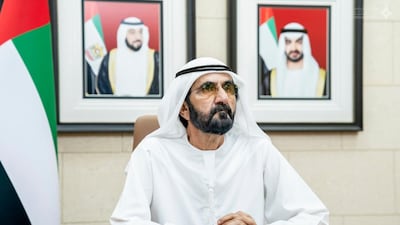
Sheikh Mohammed bin Rashid, Prime Minister and Ruler of Dubai, leads a UAE Government meeting to address the country's national priorities post-coronavirus. Courtesy: Dubai Media Office Twitter -
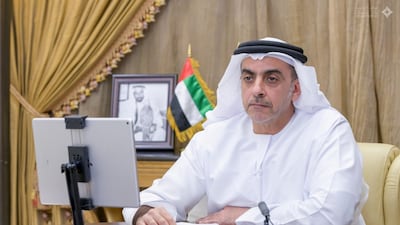
Sheikh Saif bin Zayed, Deputy Prime Minister and Minister of Interior, attends a remote government meeting to discuss the UAE's post-coronavirus future. Courtesy: Dubai Media Office Twitter -
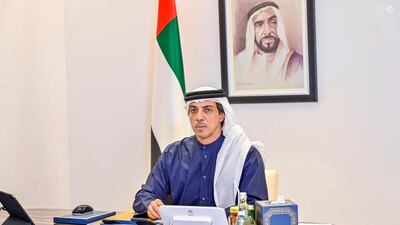
Sheikh Mansour bin Zayed, Deputy Prime Minister and Minister of Presidential Affairs, attends a remote government meeting to discuss the UAE's post-coronavirus future. Courtesy: Dubai Media Office Twitter -

Sheikh Mohammed bin Rashid, Prime Minister and Ruler of Dubai, during a remote government meeting to discuss the UAE's post-coronavirus future. Courtesy: Dubai Media Office Twitter -
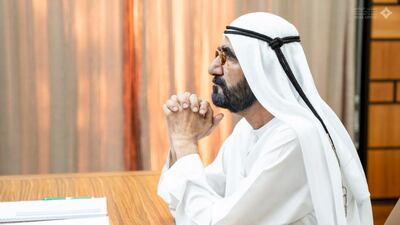
Sheikh Mohammed bin Rashid, Prime Minister and Ruler of Dubai, during a remote government meeting to discuss the UAE's post-coronavirus future. Courtesy: Dubai Media Office Twitter


Mr Al Owais said the UAE faced its sternest challenge last month when its Covid-19 curve began to climb.
"As a precautionary measure, the UAE intensified its efforts to contain the outbreak by enforcing mandatory self-quarantine and confinement measures, even for asymptomatic persons, during recovery for 15 to 25 days and up to 35 days," he said.
"However, it takes up to one month to confirm total recovery.
“The UAE acted proactively with extreme transparency since the early days of the outbreak and managed to respond quickly to the virus.
"It was the first country in the Middle East to report a confirmed case, one of the first countries to begin coronavirus testing and early detection, and among the few countries that are still performing strict testing.
“There are no custom-made, clear experiences on how to handle the crisis and no one can predict what will happen.
"However, the UAE is committed to adopting new ideas and availing of similar experiences to establish their own response strategy, based on accumulated lessons and information, and will hopefully overcome this crisis with greater strength and determination.”
Mr Al Owais said the UAE's multicultural make-up meant it had to devise a unique response to the public health crisis.
“The UAE has shown exceptional management of the crisis, while leveraging other countries’ experiences," he said.
"However, the level of response was different, given the demographic composition in the country, which is home to more than 200 nationalities, and its distinct resources, readiness and experiences in many sectors.
"This explains the discrepancy in world countries’ response to the coronavirus pandemic and the disparate impact on the economic, health, psychological and social levels."
The six main areas of focus for the Covid-19 meeting are health, education, the economy, food security, society and government.
-

A medical worker wearing personal protective equipment attends to a newborn child of a woman with Covid-19 at the Sancaktepe Martyr Prof Dr Ilhan Varank Training and Research Hospital in Istanbul, Turkey, EPA -

About 60,000 people have approached Sancaktepe hospital complaining of Covid-19 symptoms. As many as 12,000 were tested and 2,500 treated. The mortality rate at the hospital is below 1 per cent. EPA -

People wearing protective face masks and gloves shop at a supermarket in Riyadh, Saudi Arabia. Reuters -

A Saudi man wearing protective gloves buys vegetables at a supermarket in Riyadh, Saudi Arabia. Reuters -

Dr Wael Abd Elaziz wearing a protective mask places his order at Dawa Pharmacy, the first Egyptian pharmacy using a robotic device that handles prescriptions, in Cairo, Egypt. Reuters -

An employee checks customers' temperature upon their arrival at LC Wakiki store in Tunis, Tunisia. EPA -

A Palestinian hairdresser wearing protective mask works during a free hair-cutting campaign for Palestinians in the occupied West Bank city of Hebron. EPA -

Measures taken by the Palestinian Authority amid concerns over the spread of coronavirus prevent hairdressers from opening their barbershops. EPA -

An Iraqi man wearing a protective face mask stands next to a sign reading in Arabic 'Together against Coronavirus, don't kiss, don't shake hands, your smile makes me happy' during the month of Ramadan, in Baghdad, Iraq. EPA -

Customers wearing protective face masks queue outside a Zara store before reopening on the Habib Bourguiba avenue in Tunis, Tunisia. EPA -

A waiter takes an order at an outdoor terrace of a restaurant as Lebanon eases its coronavirus lockdown, and its restaurants struggle to choose between opening with reduced capacity or staying shut, amid an unprecedented economic crisis that has slashed profit and raised cost, in Beirut. Reuters -

Fishermen dangle their lines to catch fish at Beirut's seaside Corniche, as Lebanese authorities warned of a new wave of the coronavirus. Reuters -

A poster of Kuwait's emir Sheikh Sabah Al Ahmad Al Sabah is seen hanging above a closed entrance of the Mubarakiya market in Kuwait City during the 20-day nationwide lockdown. AFP -

A view of a deserted playground near Kuwait Towers during the lockdown in Kuwait city. AFP


Ministers and officials have been discussing and taking part in interactive sessions.
The aim is to produce business plans, policies and means to ensure the short, medium and long-term development of the UAE’s government work, and enable the country to tackle economic and social challenges.
As of Tuesday, the UAE had recorded 19,661 Covid-19 cases, of which 6,012 patients have recovered and 203 have died.

