The battle back to fitness appeared well under way in Dubai on Wednesday, as gyms opened their doors for the first time since March.
Following weeks of coronavirus restrictions, exercise fanatics returned to their workout routines in their droves.
An estimated 750 people clad in mandatory face-masks arrived at GymNation in Al Quoz over the course of the opening day.
It was a similar story elsewhere across the city, with exercise classes booked up and thousands eager to hit the running machines and free weights.
“We introduced a capacity limit of no more than 15 people per visit to align with the government measures to protect staff and customers,” said Jithu Jacob, who owns Al Quoz Gym in the city.
“Usually we have three trainers in the gym at any one time but we have reduced employee numbers to avoid overcrowding."
With one trainer and one cleaner on duty, Mr Jacob said workouts were limited to “40 minutes per session” between 6am and 10pm.
Hundreds of gyms across Dubai were ordered to close on March 16 as part of government measures to help prevent the spread of Covid-19.
The policy was among numerous restrictions placed on normal business operations that included the closure of restaurants and malls.
Now, as the UAE and the rest of the world considers a controlled reopening, government regulations in the UAE are easing.
Some businesses are being allowed to return to regular hours, albeit with specific conditions attached.
In the case of Dubai gyms, users must still be kept two metres apart, personal trainers must keep to two clients per session, masks must be worn at all times and all shared equipment must be regularly sanitised.
Speaking to The National, Loren Holland, the founder of GymNation, said more than 1,500 new clients had signed up for membership during gym closures.
He said now they were reopening, some class times had been reduced to allow for additional cleaning and changing rooms would remain closed.

"We’ve got seven classes scheduled today ranging from body combat to spinning and they are all fully booked, meaning we should have more than 150 class participants on the first day back," he said.
“It’s very encouraging that members have the confidence to return to the facility and are eager to re-engage with health and fitness at a safe distance.”
“In preparation for the opening we have ensured that all our equipment is spread out.”
For Egyptian Ahmed Tony, Wednesday’s reopening of GymNation in Al Quoz, which offers more than 500 workout machines, could not have come soon enough.
“I could hardly sleep last night because I was so looking forward to getting back to my gym routine,” said the 30-year-old.
“I’ve been trying to train at home, running and things, but I’ve lost 5kg of muscle mass and gained 2kg of fat because I’ve not been able to train with weights.”
Paediatric nurse Francesca Fattoruso, 29, also said she was anxious to hit the gym again after a long hospital shift on the coronavirus frontline.
“It is odd being here during a pandemic and seeing people in face masks, but I’m used to it because of my day job,” she said.
“Working up a sweat in a face mask is not easy but it’s just something I’ll get used to.”
-
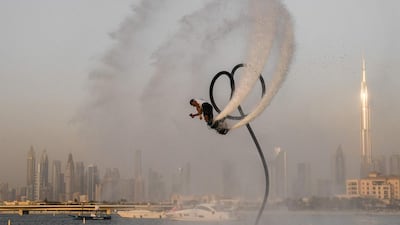
An athlete performs stunts with a water jet pack on the first day of the Dubai watersport festival, organised by the Dubai International Marine Club (DIMC), in the Gulf emirate on June 25, 2020. / AFP / KARIM SAHIB -
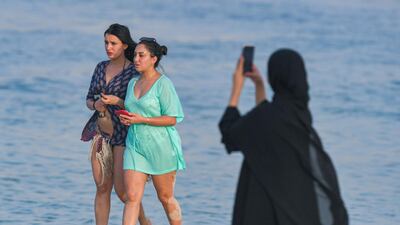
An Emirati woman uses her phone to take a picture as women in bathing suits walk past along a beach in the Gulf Emirate of Dubai on June 25, 2020. / AFP / KARIM SAHIB -
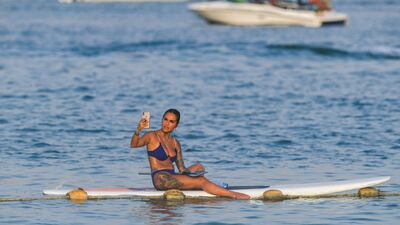
A woman athlete uses a phone as she sits on a surfboard during the Dubai watersport festival, organised by the Dubai International Marine Club (DIMC), near the Burj Khalifa skyscraper in the Gulf emirate on June 25, 2020. / AFP / KARIM SAHIB -
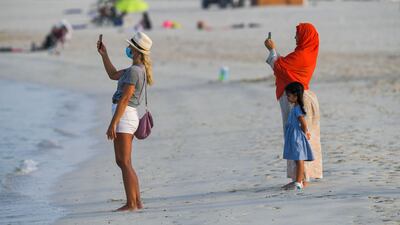
An Emirati woman and a foreign resident, clad in mask due to the COVID-19 coronavirus pandemic, use their phones to take a picture as they stand along a beach in the Gulf Emirate of Dubai on June 25, 2020. / AFP / KARIM SAHIB -
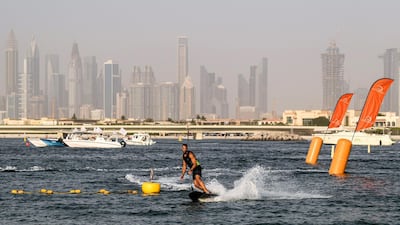
An athlete rides a jet-powered surfboard on the first day of the Dubai watersport festival, organised by the Dubai International Marine Club (DIMC), near the Burj Khalifa skyscraper in the Gulf emirate on June 25, 2020. / AFP / KARIM SAHIB -
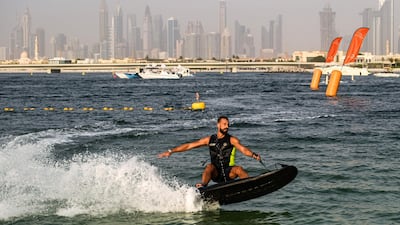
An athlete rides a jet-powered surfboard on the first day of the Dubai watersport festival, organised by the Dubai International Marine Club (DIMC), near the Burj Khalifa skyscraper in the Gulf emirate on June 25, 2020. / AFP / KARIM SAHIB -
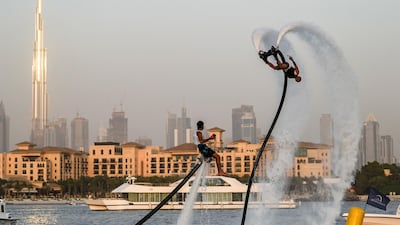
Athletes perform stunts with water jet packs on the first day of the Dubai watersport festival, organised by the Dubai International Marine Club (DIMC), near the Burj Khalifa skyscraper in the Gulf emirate on June 25, 2020. / AFP / KARIM SAHIB -
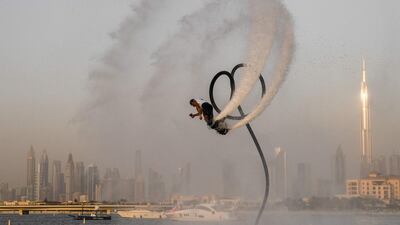
TOPSHOT - An athlete performs stunts with a water jet pack on the first day of the Dubai watersport festival, organised by the Dubai International Marine Club (DIMC), near the Burj Khalifa skyscraper in the Gulf emirate on June 25, 2020. / AFP / KARIM SAHIB -
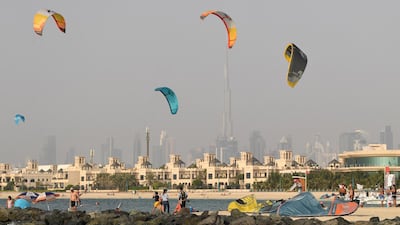
People kite-surf during the Dubai watersport festival, organised by the Dubai International Marine Club (DIMC), in the Gulf emirate on June 26, 2020. / AFP / KARIM SAHIB -
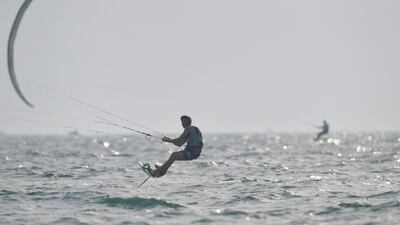
An athlete kite-surfs during the Dubai watersport festival, organised by the Dubai International Marine Club (DIMC), in the Gulf emirate on June 26, 2020. / AFP / KARIM SAHIB -
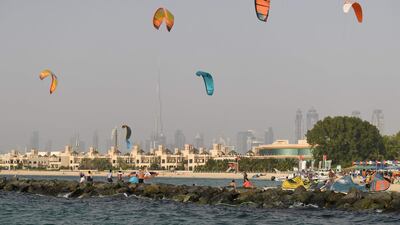
People kite-surf during the Dubai watersport festival, organised by the Dubai International Marine Club (DIMC), in the Gulf emirate on June 26, 2020. / AFP / KARIM SAHIB -
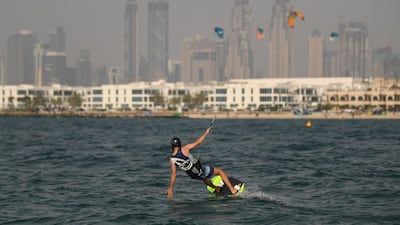
An athlete kite-surfs during the Dubai watersport festival, organised by the Dubai International Marine Club (DIMC), in the Gulf emirate on June 26, 2020. / AFP / KARIM SAHIB


Egyptian Ahmed Ali, 32, was another keen fitness fanatic glad to be back in the gym.
“It is not easy remembering to keep a distance from people and working out in a mask, but it’s better than nothing,” he said.
“We just have to remember we are still in a pandemic and we need to respect the new rules.”
At Fitness First, gym members must book an exercise slot to prevent overcrowding.
Facilities can only operate at 50 per cent capacity and new partitions separate static equipment.
As Egyptian Nancy Moh prepared to return to work, she said she was shocked to discover some of her clothes no longer fitted and she weighed an extra 8kg.
“I lost 21 kilos two years ago by making changes to my diet and eating well,” said Ms Moh, an operations manager who used to weigh 111kg.
“It was not an extreme regime, just cooking without oil and eating fresh vegetables, brown rice and bread.
“It became a lifestyle so I was able to keep the weight off. When the lockdown came I lost my daily routine and was no longer walking around my workplace so the weight came back.”
Ms Moh said she now hoped to lose the so-called “corona-stone” by changing her diet, taking on nutrition advice from online business Good Habits.
Founder Carole Holditch has helped scores of people lose weight by offering heathy living advice and meal recipes.

“Nancy’s story is not uncommon, she knows how good it felt to lose weight and has since put it back on again after the lockdown period,” said Ms Holditch.
“People have not been able to exercise or go to the gym, so they may have kept their calorie intake up but without burning it off, have put on weight.”
Prior to the restrictions on public gatherings, Good Habits hosted groups of up to 20 people to share insights into healthy living.
Today, like many businesses, those meetings have moved online.
“I started with 14 people ready to do an online Zoom class, now we have more than 50,” said Ms Holditch.
“One of the biggest triggers for overeating has been boredom.”

