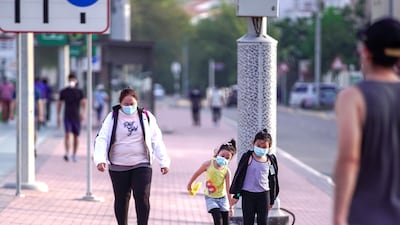

It has been more than 100 days since the UAE announced its first cases of Covid-19: a family of four, from Wuhan, China.
Since then, what has gone from an unknown virus, understood to have originated from a wet market, to a full-blown pandemic responsible for the deaths of hundreds of thousands of people.
And the path ahead is yet uncertain with experts saying Covid-19 could continue to stalk for the world for the foreseeable future, unless a way is found to eradicate it.
A vaccine is likely the best hope in doing this but that could be more than a year away, if not longer. And it would take time to roll that out to enough people to achieve herd immunity.
So what could life be like going forward?
Researchers at Harvard University have said some form of social distancing could be required until 2022.
This is because, despite restrictions taming outbreaks in some countries, any significant relaxation would lead to a surge in new cases that could overwhelm healthcare systems.
“We are trying to flatten the curve. That doesn’t mean we are getting rid of the pandemic,” said Dr Ravi Arora, a specialist in internal medicine at NMC Speciality Hospital Abu Dhabi.
“It means it will be distributed over time, rather than being clustered over a very short period. This is something which is paramount for people to understand.”
Governments walk a tightrope between relaxing restrictions to restart their economies with the effect that would have on the number of infections.
Strict measures on movement aim to keep the number of infections below 1 to 1 in the hopes that, eventually, cases will peter out. To do this, social distancing will likely need to continue for a while.
Wuhan was a case in point. When the city was released from lockdown recently, life did not return to how it was. It reverted to a “new normal”. This included frequent temperature testing of staff in offices and physical distancing measures such as partitions between tables.
Even schools, which returned last week, have changed. Children in Wuhan are required to wear masks and walk in single file past thermal scanners.
It is not clear how schools would change in the UAE, if at all, when pupils return to hallways, but the reopening of malls, offices and restaurants offered a clue on how some aspects of life could be for the foreseeable future.
-
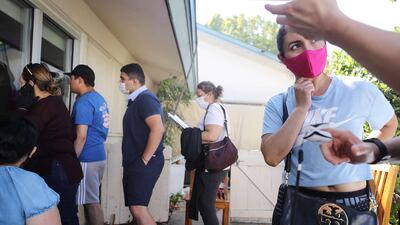
Family members and visitors gather outside patient Isaias Perez Yanez's room at Sharp Coronado Hospital, California. Covid-19 patients are not allowed to have visitors for safety reasons but family members and visitors are able to view and communicate with Yanez from outside the window. Getty Images/AFP -
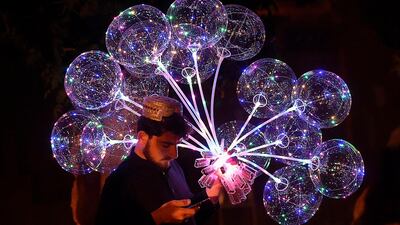
A vendor checks his mobile phone as he sells balloons along a street during a government-imposed nationwide lockdown in Quetta, Pakistan. AFP -
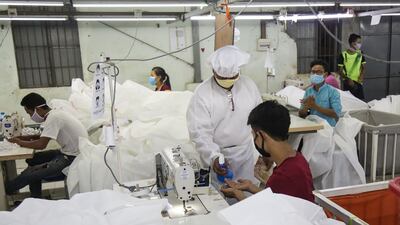
Workers sew disposable surgical gowns for health workers at a garment factory in Yangon. The factory produces 1,000 medical gowns per day to address the shortage of protective personal equipment as Myanmar battles the coronavirus pandemic. AFP -

Indian citizens arriving from Dubai by an Air India flight, arrive at the Anna International Airport as part of a massive repatriation effort, in Chennai on May 9, 2020. AFP -
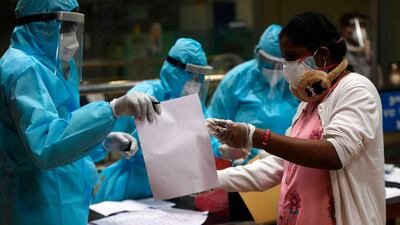
Indian citizens evacuated from Dubai by Air India flight, arrive at the Anna International Airport as part of a massive repatriation effort, in Chennai on May 9, 2020. AFP -
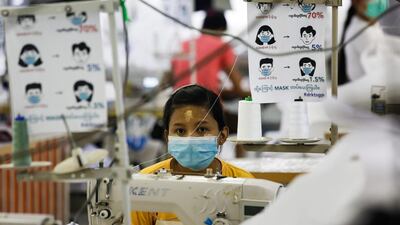
A worker sews disposable surgical gowns for health workers at a garment factory in Yangon. AFP -
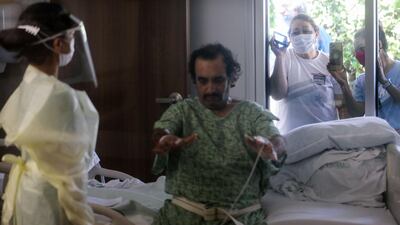
Family members watch from outside COVID-19 patient Isaias Perez Yanez's room, as he is assessed by occupational therapist Jaclyn Lien in the Progressive Care Unit (PCU) at Sharp Coronado Hospital, California. Getty Images/AFP -

Malian migrant worker Tidjane attends a teleconsultation at a special medical unit set up outside a building housing migrant workers as part of a private initiative supported by the Paris city hall, in Paris. AFP -
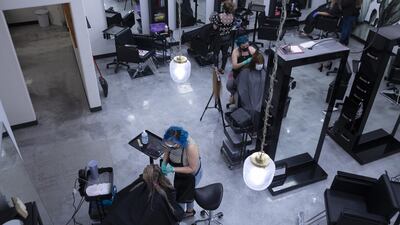
Stylists wear protective masks and gloves while working on customer's hair at a Belazza salon in Tucson, Arizona, US. Bloomberg -
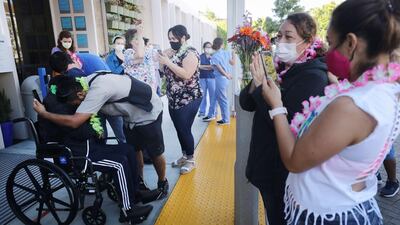
Isaias Perez Yanez, 59, in wheelchair, is hugged and applauded by family and hospital staff as he is released from Sharp Coronado Hospital in Coronado, California. Getty Images/AFP -
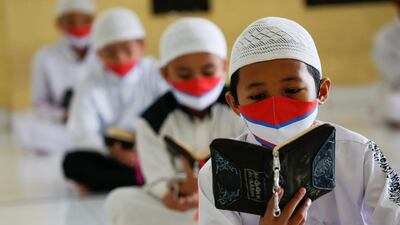
Muslim students wearing face masks practice social distancing while reading Quran at Daarul Qur'an Al Kautsar boarding school mosque in Bogor, West Java province, Indonesia. Reuters -
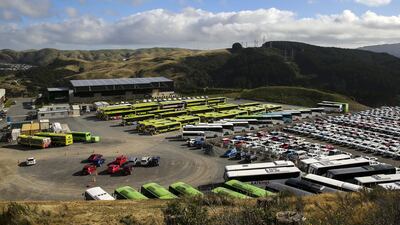
A general view of Tranzit Bus Depot in Wellington, New Zealand. Getty Images -
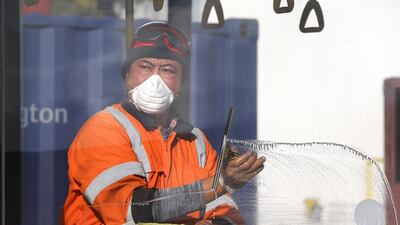
Senior Yard Supervisor Lipi Vitolio the windows of a bus at Tranzit Bus Depot in Wellington, New Zealand. The New Zealand government will decide whether to move to Covid-19 Alert Level 2 and ease further restrictions on Monday, 11 May. Getty Images -

An aerial photo made with a drone shows a sold out McHenry Outdoor Theater as a movie starts in McHenry, Illinois, USA. EPA -

Members of the Mothers of False Positives (Mafapo) civil organization wear face masks reading “Who gave the order?” against the spread of the novel coronavirus in Soacha, Colombia. Thousands of extrajudicial executions known as "false positives" were carried out in the biggest scandal of the Colombian military forces in their struggle of more than half a century against rebel groups. The mothers of the victims found in the making of face masks a way to make their cause visible. AFP -
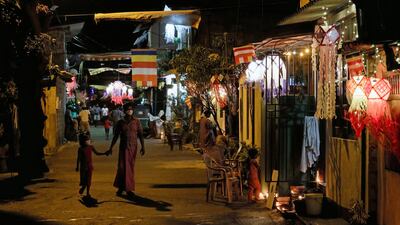
People walk on a road decorated with lights and lanterns on the Vesak Day, which is celebrated in Sri Lanka on May 7th and 8th to commemorate the birth, enlightenment and death of Buddha, in Colombo, Sri Lanka. Reuters -
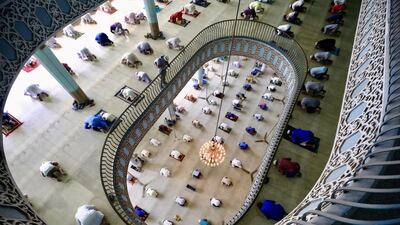
Muslims attend Friday prayer at the Baitul Mokarram National Mosque after the government eased the restrictions amid concerns over the coronavirus outbreak in Dhaka, Bangladesh. Reuters -
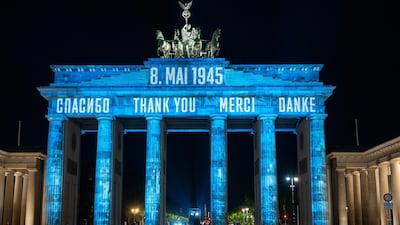
In Russian, from left, English, French and German, the Brandenburg Gate is illuminated with the word "Thank you," in Berlin, Germany. May 8th marked the 75th anniversary of the end of World War II in Europe. AP


Shop and restaurant capacities have been capped at 30 per cent to ensure there is enough room to practice social distancing.
Whether that could change going forward would likely depend on the number of cases, said Dr Arora.
“I think the limitations should improve over time but it’s very hard to predict – 30 per cent is a number that at the moment seems right,” said Dr Arora.
“We may go down to 10 per cent or go up to 50 per cent, depending on the numbers."

Another feature that could be here to stay are disinfection gates at entrances to public areas, including malls, bus stations and other buildings.
They were used widely in Wuhan to stem the spread of the virus and one entrepreneur in the UAE has banked on them becoming ubiquitous here, too.
“After 9/11 metal detectors became the norm. They were in hotels,” said Husam Zammar, who owns Guard ME.
“In the near future, these gates will also be everywhere. And shoppers will choose stores with them.”
He said his factory was now making 20 gates a day. And it is just one of a number of similar companies working in the space in the UAE.
“We discovered the market was really thirsty for this kind of product, so we increased our capacity from three every day, to five, then to 10 and to 20,” said the Syrian entrepreneur.
Dubai Future Foundation is also working on producing technologies that may become part of daily life.
“Dubai Future Labs is working on testing and manufacturing medical appliances such as face masks using 3D printing technologies, prototyping ventilators, and artificial intelligence to support the efforts of health authorities,” said Khalfan Belhoul, the foundation’s chief executive.
Many measures in place across the UAE, such as the nightly disinfection drive, requirement to wear masks and observe social distancing, are expected to continue until further notice.
But one day, in the not too distant future, the UAE could open its borders again, having shut them to all but Emiratis wishing to return home, in March. Already, flights carrying UAE residents who were stranded abroad when planes were grounded have begun operating.
It is not known when the country’s borders will reopen for commercial flights but the experience of flying will likely be different going forward.

Last week, The International Air Transport Association, the body representing global airlines said it supported passengers wearing masks onboard to protect them against the virus.
Iata's medical advisor, David Powell, said face coverings would be part of a range of measures including screening passengers before flying to make sure they did not have a fever, plus enhanced cleaning procedures that would allow flying to restart safely.
However, it did not support a plan to leave the middle seat empty, after its chief economist said most airlines will not be able to make money this year if a third of the seats are removed.
Nevertheless, doctors said the use of masks generally could control transmission of the virus.
“There are good statistics on that. If there is a patient who is spreading the virus and wearing a plain mask, and the people around them are wearing a mask, you can reduce transmission from 80 per cent to 90 per cent, which is pretty good actually,” said Dr Arora.
If you add in two metre social distancing as well, protection rose to around 95 per cent.
“We will have to wear masks and we will probably have to wear gloves and avoid large gatherings. We are going to have virtual concerts to virtual meet-ups,” said Dr Arora.
“This will be our life for the foreseeable future, even for the next couple of years, perhaps."

