Hospitals in Abu Dhabi are working to protect their staff after hundreds were believed to have contracted Covid-19 from each other.
Medical staff around the world wear personal protection equipment to shield themselves from being infected by patients but the masks, gowns and gloves also keep them safe from contracting the virus from each other.
Globally, staff are at greatest risk of contracting the virus. At the height of Italy's outbreak, thousands of medical staff became infected with Covid-19 while more than 100 of the 31,000 people who died in the country were healthcare workers. In the UK, testing has suggested that up to 3 per cent of all National Health Service hospital staff may be unknowingly infected with coronavirus.
The rate of coronavirus infection among the 18,000 staff working at all hospitals managed by Abu Dhabi Healthcare Services (Seha) is between two to four per cent, Anwar Salam, Seha's chief operating officer told The National.
He said this was lower than the international rate of infection within staff – about 10 per cent – but that safety measures have been introduced at Seha facilities to bring it down further.
These precautionary measures include changing scrubs as soon as staff enter and leave the hospital; frequently changing PPE, which is worn over the scrubs; and wearing masks at all times while at work.
“Body temperatures are taken twice a day. Staff are always in surgical masks even when speaking to each other and we maintain social distancing,” said Dr Mohamed Ismail, chair of the Medical Institute at one of Seha's hospitals.
“All desks, computers and chairs are wiped down with antibacterial solution before use and we maintain the highest standards of personal hygiene with staff sanitising their hands before they use anything or have any contact with someone else,” he said.
These measures apply to all staff who not dealing directly with patients. Those who do, have more intensive precautions in place including increased layers of PPE such as a face shield and hazmat suit.
“It resembles a space suit with complete gear that isolates you completely from the environment,” said Dr Ismail. The majority of staff who do not treat Covid-19 patients, including administrative staff and cleaners, must wear N95 masks, face shields or goggles and gloves at all times. “Our rates are lower than the rest of world because we have had all this protective gear made available to us," said Dr Ismail.
One nurse, who contracted Covid-19 from a colleague, said it was vital that medical staff are protecting themselves from each other too.
Biji Beji, 42, who works at a Seha hospital became infected with the virus on April 2. She went on to pass the coronavirus to her husband and one of her two children. "I got it from a colleague and not from the patients," she told The National.
Her colleague had tested positive for the virus a day before she was tested.
“I am protected around [the patients] and wear protective equipment but I was not protected around my colleague,” she said. Ms Beji, her husband and daughter, from India, were placed in quarantine in a government hospital to avoid spreading the virus to her 13-year-old son.
“I was very upset that day. I was shocked for some time,” she said.
-
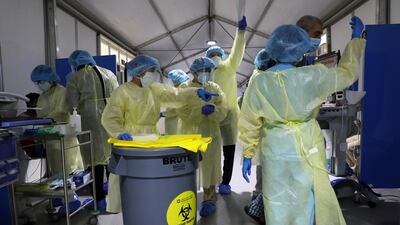
Medical staff inside a Covid-19 screening centre at Cleveland Clinic Abu Dhabi. Reuters -
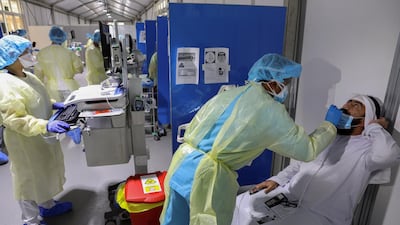
A healthcare worker tests a man for Covid-19 at Cleveland Clinic Abu Dhabi. Reuters -
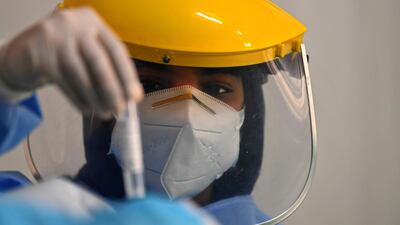
A health worker examines a sample taken from a labourer in the Al Quoz district of Dubai. The UAE has significantly increased testing for the coronavirus that causes Covid-19. AFP -
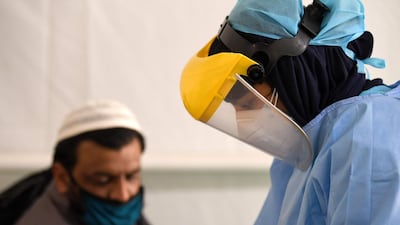
A medic takes samples from a worker at a testing centre in Al Quoz. AFP -
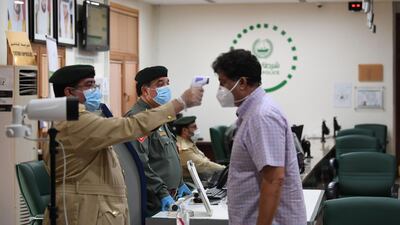
A man wearing a protective mask has his body temperature reading taken upon arriving at the police station in Naif. AFP -
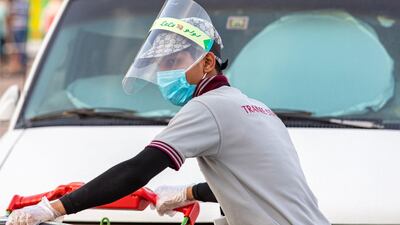
An employee wears a protective face mask and shield while collecting carts outside a Lulu hypermarket in Dubai. Bloomberg -
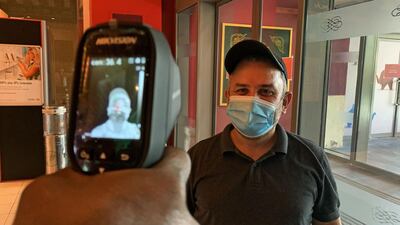
A man, wearing a protective mask to prevent the spread of the coronavirus, has his temperature taken at the Ibn Battuta centre in Dubai. AFP -
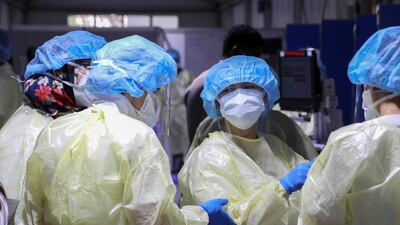
Frontline workers, such as medics leading the fight against Covid-19, are being recognised in the UAE. Reuters


The family were fortunate not to have any major symptoms. Her husband and daughter were completely asymptomatic while Ms Beji only temporarily lost her sense of taste and smell. They were kept together in a family room for 20 days until they each received two consecutive negative tests and could be released.
“We were relaxed because we were all in the same room.
“Suddenly I felt that Jesus helped me and the hospital supported me," she said. They returned home in the last week of April and Ms Beji has since returned to work.
Medical and nursing staff at government hospitals use personal protective gear according to guidelines issued by Department of Health and Seha, which match up with international recommendations.

