Patients meet with Millie the Pug during the arts and crafts session at Al Jalila Children's Speciality Hospital in Dubai on 10 October, 2021. Pawan Singh / The National

Hi-tech genetic sequencing at Dubai children's hospital aims to improve patient care


Daniel Bardsley
  • English
  • Arabic

A children’s hospital in Dubai sequenced the genetic material of some of its young patients to diagnose their illnesses and accelerate treatment plans.

The work at Al Jalila Children’s Specialty Hospital is thought to be the first such use of rapid whole genome sequencing (rWGS) in the Middle East, according to officials.

Scientists hope to use the technology more widely and to build up a database that could improve diagnoses for people from the Arab world and other regions traditionally under-represented in genetic studies.

Reported in the journal Genome Medicine, the work involved sequencing the genome, or all of the genetic material, of five newborns and infants at the 200-bed facility, described as the UAE’s only paediatric hospital.

Boosting patient care

Former Manchester United footballer Paul Pogba on a surprise visit to Al Jalila Children’s Specialty Hospital in November. Photo: Al Jalila Children’s Specialty Hospital

One patient was found to have a harmful variant of a gene known as Lipa, which provides instructions for the production of an enzyme. This patient was given enzyme replacement therapy.

Another patient was found to have Pallister-Killian syndrome, a chromosomal disorder characterised by distinct facial features, weak muscle tone and other abnormalities.

Dr Ahmad Abou Tayoun, director of the hospital’s genomics centre, said rWGS provided results within two days, compared with several weeks for some other diagnostic methods.

It has become possible to use whole genome sequencing in a clinical setting because the cost of the sequencing has fallen to less than $1,000 per patient, while the computing power required to interpret the vast amounts of data generated has advanced.

“The concept of next-generation sequencing has been discussed for more than 10 years, but the cost has been prohibitive,” Dr Abou Tayoun said. “The sequencing cost has been coming down to the point where it’s doable.”

Having carried out the feasibility study with five children, the hospital hopes to undertake sequencing with much larger numbers of patients.

“We want to generate evidence that it’s the way to go, it generates answers for Middle East patients, where the genetic burden is high,” Dr Abou Tayoun said. “We want to generate a body of evidence, so we want to expand the study.”

It is acknowledged that the high rates of consanguineous marriages in the UAE, often between cousins, can mean that certain genetic disorders are more prevalent. Yet there is often less access to advanced genetic diagnosis in the region.

Genetic databases are often heavily skewed towards white people, with one of the largest available having about 80 per cent of its data from people of white European descent.

Finding medical solutions

An image from the National Human Genome Research Institute shows the output from a DNA sequencer. AP

Sequencing of the kind carried out by the hospital could increase the amount of information from people from other racial backgrounds. The latest study involved children from the UAE, Pakistan, Jordan, Kenya and the Philippines.

The work was done using technology provided by a California company, Illumina, whose vice president of scientific research and medical genomics research, Dr Ryan Taft, said obtaining information from a more diverse cohort of patients was “hugely important”.

He said rWGS offered the “greatest number of possible options for finding that rare diagnosis”, which in some cases may involve identifying a single novel genetic mutation or a genetic variant inherited from both parents.

This precise genetic information may help researchers to understand the biological processes that cause the conditions, potentially leading to new treatments.

The technology can be used, Dr Taft said, with newborn babies admitted to intensive-care units, and with infants aged two or three who may be missing developmental milestones or who show unusual physical characteristics.

A prompt diagnosis allows treatment to be started earlier, offering the chance of a better outcome, and saving significant amounts of money because the child will not have to be taken from one specialist to another to determine what condition he or she has.

“We have a very solid evidence base to strongly say the best possible pathway for care for these patients is to ensure they get access to whole genome sequencing,” he said.

He described the use of rWGS in clinics as “really still in its infancy”, with only a modest number of facilities, often in the US, UK or Germany, using the technology.

“It’s not widely adopted at this point. We’re at the beginning of this big adoption curve,” he said.

Emirati Genome Project - in pictures

  • Emiratis in the UAE have been urged to voluntarily give an anonymous blood sample to help expand the data collection for the Emirati Genome Project. All photos by Khushnum Bhandari / The National
    Emiratis in the UAE have been urged to voluntarily give an anonymous blood sample to help expand the data collection for the Emirati Genome Project. All photos by Khushnum Bhandari / The National
  • The programme, which officially launched two years ago, has so far collected blood samples and buccal swabs from tens of thousands of people.
    The programme, which officially launched two years ago, has so far collected blood samples and buccal swabs from tens of thousands of people.
  • Dr Walid Zaher is the chief research officer for G42 Healthcare and one of the lead researchers for the Emirati Genome Programme
    Dr Walid Zaher is the chief research officer for G42 Healthcare and one of the lead researchers for the Emirati Genome Programme
  • Using the data, experts say they can predict, and in some cases prevent, diseases before they happen
    Using the data, experts say they can predict, and in some cases prevent, diseases before they happen
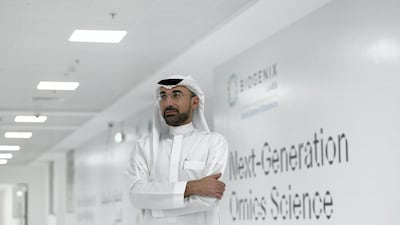
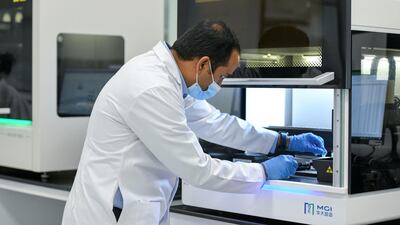
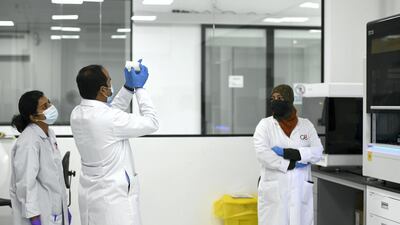
  • Researchers for the Emirati Genome Programme analyse sample data in the Omics laboratory
    Researchers for the Emirati Genome Programme analyse sample data in the Omics laboratory
  • Researchers said the end goal is to collect samples from 100 per cent of the population
    Researchers said the end goal is to collect samples from 100 per cent of the population
  • The risk of inheriting a gene mutation increases sharply when closely related individuals marry
    The risk of inheriting a gene mutation increases sharply when closely related individuals marry
  • Teams working as part of the programme have already created the first reference genome from more than 1,000 volunteers
    Teams working as part of the programme have already created the first reference genome from more than 1,000 volunteers
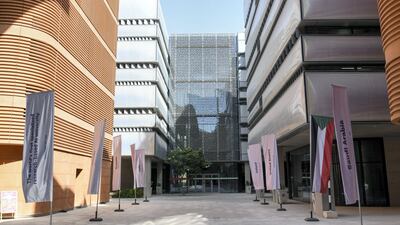
  • The Omics Centre of Excellence run by G42 Healthcare in Masdar City, Abu Dhabi
    The Omics Centre of Excellence run by G42 Healthcare in Masdar City, Abu Dhabi
  • Using biotechnology and Artificial Intelligence, researchers can characterise things like genetic variation and understand how they relate to different diseases
    Using biotechnology and Artificial Intelligence, researchers can characterise things like genetic variation and understand how they relate to different diseases
  • Volunteers can now submit DNA samples at a number of centres across Abu Dhabi including NMC Royal Hospital in Khalifa City, Bareen International Hospital, and NMC Specialty Hospital, Al Ain
    Volunteers can now submit DNA samples at a number of centres across Abu Dhabi including NMC Royal Hospital in Khalifa City, Bareen International Hospital, and NMC Specialty Hospital, Al Ain

Mercer, the investment consulting arm of US services company Marsh & McLennan, expects its wealth division to at least double its assets under management (AUM) in the Middle East as wealth in the region continues to grow despite economic headwinds, a company official said.

Mercer Wealth, which globally has $160 billion in AUM, plans to boost its AUM in the region to $2-$3bn in the next 2-3 years from the present $1bn, said Yasir AbuShaban, a Dubai-based principal with Mercer Wealth.

Within the next two to three years, we are looking at reaching $2 to $3 billion as a conservative estimate and we do see an opportunity to do so,” said Mr AbuShaban.

Mercer does not directly make investments, but allocates clients’ money they have discretion to, to professional asset managers. They also provide advice to clients.

“We have buying power. We can negotiate on their (client’s) behalf with asset managers to provide them lower fees than they otherwise would have to get on their own,” he added.

Mercer Wealth’s clients include sovereign wealth funds, family offices, and insurance companies among others.

From its office in Dubai, Mercer also looks after Africa, India and Turkey, where they also see opportunity for growth.

Wealth creation in Middle East and Africa (MEA) grew 8.5 per cent to $8.1 trillion last year from $7.5tn in 2015, higher than last year’s global average of 6 per cent and the second-highest growth in a region after Asia-Pacific which grew 9.9 per cent, according to consultancy Boston Consulting Group (BCG). In the region, where wealth grew just 1.9 per cent in 2015 compared with 2014, a pickup in oil prices has helped in wealth generation.

BCG is forecasting MEA wealth will rise to $12tn by 2021, growing at an annual average of 8 per cent.

Drivers of wealth generation in the region will be split evenly between new wealth creation and growth of performance of existing assets, according to BCG.

Another general trend in the region is clients’ looking for a comprehensive approach to investing, according to Mr AbuShaban.

“Institutional investors or some of the families are seeing a slowdown in the available capital they have to invest and in that sense they are looking at optimizing the way they manage their portfolios and making sure they are not investing haphazardly and different parts of their investment are working together,” said Mr AbuShaban.

Some clients also have a higher appetite for risk, given the low interest-rate environment that does not provide enough yield for some institutional investors. These clients are keen to invest in illiquid assets, such as private equity and infrastructure.

“What we have seen is a desire for higher returns in what has been a low-return environment specifically in various fixed income or bonds,” he said.

“In this environment, we have seen a de facto increase in the risk that clients are taking in things like illiquid investments, private equity investments, infrastructure and private debt, those kind of investments were higher illiquidity results in incrementally higher returns.”

The Abu Dhabi Investment Authority, one of the largest sovereign wealth funds, said in its 2016 report that has gradually increased its exposure in direct private equity and private credit transactions, mainly in Asian markets and especially in China and India. The authority’s private equity department focused on structured equities owing to “their defensive characteristics.”

England's all-time record goalscorers:
Wayne Rooney 53
Bobby Charlton 49
Gary Lineker 48
Jimmy Greaves 44
Michael Owen 40
Tom Finney 30
Nat Lofthouse 30
Alan Shearer 30
Viv Woodward 29
Frank Lampard 29

Ten tax points to be aware of in 2026

1. Domestic VAT refund amendments: request your refund within five years

If a business does not apply for the refund on time, they lose their credit.

2. E-invoicing in the UAE

Businesses should continue preparing for the implementation of e-invoicing in the UAE, with 2026 a preparation and transition period ahead of phased mandatory adoption. 

3. More tax audits

Tax authorities are increasingly using data already available across multiple filings to identify audit risks. 

4. More beneficial VAT and excise tax penalty regime

Tax disputes are expected to become more frequent and more structured, with clearer administrative objection and appeal processes. The UAE has adopted a new penalty regime for VAT and excise disputes, which now mirrors the penalty regime for corporate tax.

5. Greater emphasis on statutory audit

There is a greater need for the accuracy of financial statements. The International Financial Reporting Standards standards need to be strictly adhered to and, as a result, the quality of the audits will need to increase.

6. Further transfer pricing enforcement

Transfer pricing enforcement, which refers to the practice of establishing prices for internal transactions between related entities, is expected to broaden in scope. The UAE will shortly open the possibility to negotiate advance pricing agreements, or essentially rulings for transfer pricing purposes. 

7. Limited time periods for audits

Recent amendments also introduce a default five-year limitation period for tax audits and assessments, subject to specific statutory exceptions. While the standard audit and assessment period is five years, this may be extended to up to 15 years in cases involving fraud or tax evasion. 

8. Pillar 2 implementation 

Many multinational groups will begin to feel the practical effect of the Domestic Minimum Top-Up Tax (DMTT), the UAE's implementation of the OECD’s global minimum tax under Pillar 2. While the rules apply for financial years starting on or after January 1, 2025, it is 2026 that marks the transition to an operational phase.

9. Reduced compliance obligations for imported goods and services

Businesses that apply the reverse-charge mechanism for VAT purposes in the UAE may benefit from reduced compliance obligations. 

10. Substance and CbC reporting focus

Tax authorities are expected to continue strengthening the enforcement of economic substance and Country-by-Country (CbC) reporting frameworks. In the UAE, these regimes are increasingly being used as risk-assessment tools, providing tax authorities with a comprehensive view of multinational groups’ global footprints and enabling them to assess whether profits are aligned with real economic activity. 

Contributed by Thomas Vanhee and Hend Rashwan, Aurifer

Red flags
  • Promises of high, fixed or 'guaranteed' returns.
  • Unregulated structured products or complex investments often used to bypass traditional safeguards.
  • Lack of clear information, vague language, no access to audited financials.
  • Overseas companies targeting investors in other jurisdictions - this can make legal recovery difficult.
  • Hard-selling tactics - creating urgency, offering 'exclusive' deals.

Courtesy: Carol Glynn, founder of Conscious Finance Coaching

Brief scoreline:

Liverpool 2

Mane 51', Salah 53'

Chelsea 0

Man of the Match: Mohamed Salah (Liverpool)

Indoor Cricket World Cup Dubai 2017

Venue Insportz, Dubai; Admission Free

Fixtures - Open Men 2pm: India v New Zealand, Malaysia v UAE, Singapore v South Africa, Sri Lanka v England; 8pm: Australia v Singapore, India v Sri Lanka, England v Malaysia, New Zealand v South Africa

Fixtures - Open Women Noon: New Zealand v England, UAE v Australia; 6pm: England v South Africa, New Zealand v Australia

UAE Rugby finals day

Games being played at The Sevens, Dubai

2pm, UAE Conference final

Dubai Tigers v Al Ain Amblers

4pm, UAE Premiership final

Abu Dhabi Harlequins v Jebel Ali Dragons

AGUERO'S PREMIER LEAGUE RECORD

Apps: 186
Goals: 127
Assists: 31
Wins: 117
Losses: 33

The specs

Engine: 2.0-litre 4cyl turbo

Power: 261hp at 5,500rpm

Torque: 405Nm at 1,750-3,500rpm

Transmission: 9-speed auto

Fuel consumption: 6.9L/100km

On sale: Now

Price: From Dh117,059

%3Cp%3E%3Cstrong%3EDirector%3A%3C%2Fstrong%3E%20Nag%20Ashwin%3C%2Fp%3E%0A%3Cp%3E%3Cstrong%3EStarring%3A%20%3C%2Fstrong%3EPrabhas%2C%20Saswata%20Chatterjee%2C%20Deepika%20Padukone%2C%20Amitabh%20Bachchan%2C%20Shobhana%3C%2Fp%3E%0A%3Cp%3E%3Cstrong%3ERating%3A%20%3C%2Fstrong%3E%E2%98%85%E2%98%85%E2%98%85%E2%98%85%3C%2Fp%3E%0A
Updated: July 27, 2022, 9:00 AM