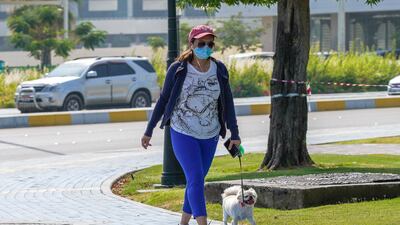
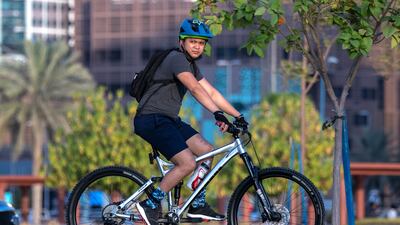
The UAE’s warm weather is perfect for sun worshippers, but for residents keen to keep fit by exercising outdoors, it is not always ideal, especially during the summer.
In very hot weather, there can be risks associated with being too active, including of heat exhaustion, which can cause nausea, dizziness, increased sweating and a raised body temperature.
Even more serious is heat stroke, a potentially fatal condition in which the body becomes unable to control its own temperature. Often involving slurred speech, confusion and loss of consciousness, it requires emergency medical treatment.
But with a few precautions, it should be possible for most people to safely run, cycle or play sports outside, even during the hottest months of the year.
Exercising for several hours in a 40ºC environment without drinking can push the body to limits and the person has a high risk of heat exhaustion or heat stroke
Prof Gonzalez-Alonso
Here we speak to experts and outline strategies to ensure that outdoor summertime exercise remains low risk and enjoyable.
Prepare carefully
Before pulling on a pair of running shoes or setting off on a racing bike, it is worth checking with a medical practitioner, said Prof Stefan Schneider, a professor of neuroexercise at the German Sport University Cologne.
“The first thing to do, whether in a hot or cold country, is go to see your doctor,” he said.
“Everyone who wants to start exercising should see his or her doctor for a medical check-up, especially to check on the cardiovascular system if you’re exercising in the heat.
“Heat is an additional stress, probably especially on the cardiovascular system. Very often people underestimate the heat.”
People with medical conditions such as diabetes or heart disease should be particularly careful, as should children and older people, as their bodies may find it harder to regulate temperature. Anyone who has been ill should be cautious about getting back into exercise.
The right clothing is important. Lighter coloured garments reflect heat, as does a hat, while cotton may be less suitable than fabrics that wick sweat away from the body. Sunscreen is recommended if exercising in direct sunlight.
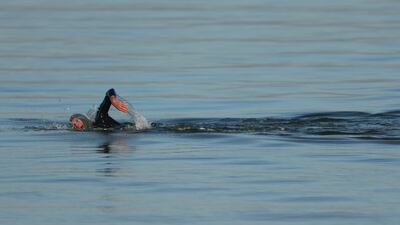
Some forms of exercise are better suited to hot environments. While running and cycling can be carried out safely in hot weather, swimming and yoga are sometimes seen as more heat-friendly.
Another issue is time of day: the late morning and the afternoon have the hottest weather, so are best avoided.
“It’s probably advisable to go for exercise in the [early] morning or evening,” said Prof Schneider. “Probably the morning is cooler than the evening. Everyone should avoid the heat peaks that come in the middle of the day.”
Drink plenty of water
It is important to gradually build up the amount of time that you spend exercising, said Prof Jose Gonzalez-Alonso, a professor of exercise and cardiovascular physiology at Brunel University in the UK.
So on your first day, it might be advisable to stop after about 30 minutes, but the day after five minutes can be added, and so on.
It is also a good idea to carry out a larger number of short exercise sessions, rather than a few long ones.
As water loss is a probable result of exercising in the heat, Prof Gonzalez-Alonso says that ensuring the body is well hydrated before starting is important.
“If you start already dehydrated, you will be more likely to stress the body. You want to prevent that,” he said.
Drinking about 250 to 300ml of fluid before a vigorous exercise session is sometimes advised, although it is not recommended to eat immediately before — or after — exercising.
During 30 minutes of exercise, a person may lose between half a litre and a litre of water and so it is recommended to drink this much afterwards to make up for what has been lost.
For an hour-long exercise session, a person should ensure they drink at least 200 to 300ml of water during the exercise itself, as this can ensure that weight loss is kept to within 1 per cent of their body weight.
Anything beyond this and it is advisable to drink a sports drink to help replenish electrolytes, the charged particles in cells and blood.
Don’t be put off
While exercising in hot weather does require precautions, Prof Schneider said that living in a hot climate should not put people off physical activity.
“I think the biggest risk is not to exercise at all; that really stresses the cardiovascular system. If you need to exercise and the climate is hot, take several precautions and go for it,” he said.
Prof Gonzalez-Alonso said that exercise in a hot environment may be particularly beneficial for the body, as long as precautions are taken to ensure it is safe.
“Exercising for several hours in a 40ºC environment without drinking can push the body to limits and the person has a high risk of heat exhaustion or heat stroke. But if you are well acclimatised and well hydrated, you can still maintain physiological function,” he said.
He said the fact that ultramarathons are held in extreme environments — a notable one is the Marathon des Sables, which covers 251km of the Sahara in southern Morocco — show that the human body can, with adequate precautions, deal with hot weather.
“When people prepare properly through heat acclimatisation and carry fluids and eat properly, they can do very well in hot environments,” he said.
Exercises to control high blood pressure - in pictures
Countries offering golden visas
UK
Innovator Founder Visa is aimed at those who can demonstrate relevant experience in business and sufficient investment funds to set up and scale up a new business in the UK. It offers permanent residence after three years.
Germany
Investing or establishing a business in Germany offers you a residence permit, which eventually leads to citizenship. The investment must meet an economic need and you have to have lived in Germany for five years to become a citizen.
Italy
The scheme is designed for foreign investors committed to making a significant contribution to the economy. Requires a minimum investment of €250,000 which can rise to €2 million.
Switzerland
Residence Programme offers residence to applicants and their families through economic contributions. The applicant must agree to pay an annual lump sum in tax.
Canada
Start-Up Visa Programme allows foreign entrepreneurs the opportunity to create a business in Canada and apply for permanent residence.
Mercer, the investment consulting arm of US services company Marsh & McLennan, expects its wealth division to at least double its assets under management (AUM) in the Middle East as wealth in the region continues to grow despite economic headwinds, a company official said.
Mercer Wealth, which globally has $160 billion in AUM, plans to boost its AUM in the region to $2-$3bn in the next 2-3 years from the present $1bn, said Yasir AbuShaban, a Dubai-based principal with Mercer Wealth.
“Within the next two to three years, we are looking at reaching $2 to $3 billion as a conservative estimate and we do see an opportunity to do so,” said Mr AbuShaban.
Mercer does not directly make investments, but allocates clients’ money they have discretion to, to professional asset managers. They also provide advice to clients.
“We have buying power. We can negotiate on their (client’s) behalf with asset managers to provide them lower fees than they otherwise would have to get on their own,” he added.
Mercer Wealth’s clients include sovereign wealth funds, family offices, and insurance companies among others.
From its office in Dubai, Mercer also looks after Africa, India and Turkey, where they also see opportunity for growth.
Wealth creation in Middle East and Africa (MEA) grew 8.5 per cent to $8.1 trillion last year from $7.5tn in 2015, higher than last year’s global average of 6 per cent and the second-highest growth in a region after Asia-Pacific which grew 9.9 per cent, according to consultancy Boston Consulting Group (BCG). In the region, where wealth grew just 1.9 per cent in 2015 compared with 2014, a pickup in oil prices has helped in wealth generation.
BCG is forecasting MEA wealth will rise to $12tn by 2021, growing at an annual average of 8 per cent.
Drivers of wealth generation in the region will be split evenly between new wealth creation and growth of performance of existing assets, according to BCG.
Another general trend in the region is clients’ looking for a comprehensive approach to investing, according to Mr AbuShaban.
“Institutional investors or some of the families are seeing a slowdown in the available capital they have to invest and in that sense they are looking at optimizing the way they manage their portfolios and making sure they are not investing haphazardly and different parts of their investment are working together,” said Mr AbuShaban.
Some clients also have a higher appetite for risk, given the low interest-rate environment that does not provide enough yield for some institutional investors. These clients are keen to invest in illiquid assets, such as private equity and infrastructure.
“What we have seen is a desire for higher returns in what has been a low-return environment specifically in various fixed income or bonds,” he said.
“In this environment, we have seen a de facto increase in the risk that clients are taking in things like illiquid investments, private equity investments, infrastructure and private debt, those kind of investments were higher illiquidity results in incrementally higher returns.”
The Abu Dhabi Investment Authority, one of the largest sovereign wealth funds, said in its 2016 report that has gradually increased its exposure in direct private equity and private credit transactions, mainly in Asian markets and especially in China and India. The authority’s private equity department focused on structured equities owing to “their defensive characteristics.”
Five films to watch
Castle in the Sky (1986)
Grave of the Fireflies (1988)
Only Yesterday (1991)
Pom Poki (1994)
The Tale of Princess Kaguya (2013)
How Beautiful this world is!
Real estate tokenisation project
Dubai launched the pilot phase of its real estate tokenisation project last month.
The initiative focuses on converting real estate assets into digital tokens recorded on blockchain technology and helps in streamlining the process of buying, selling and investing, the Dubai Land Department said.
Dubai’s real estate tokenisation market is projected to reach Dh60 billion ($16.33 billion) by 2033, representing 7 per cent of the emirate’s total property transactions, according to the DLD.
Paltan
Producer: JP Films, Zee Studios
Director: JP Dutta
Cast: Jackie Shroff, Sonu Sood, Arjun Rampal, Siddhanth Kapoor, Luv Sinha and Harshvardhan Rane
Rating: 2/5
Sole survivors
- Cecelia Crocker was on board Northwest Airlines Flight 255 in 1987 when it crashed in Detroit, killing 154 people, including her parents and brother. The plane had hit a light pole on take off
- George Lamson Jr, from Minnesota, was on a Galaxy Airlines flight that crashed in Reno in 1985, killing 68 people. His entire seat was launched out of the plane
- Bahia Bakari, then 12, survived when a Yemenia Airways flight crashed near the Comoros in 2009, killing 152. She was found clinging to wreckage after floating in the ocean for 13 hours.
- Jim Polehinke was the co-pilot and sole survivor of a 2006 Comair flight that crashed in Lexington, Kentucky, killing 49.
The President's Cake
Director: Hasan Hadi
Starring: Baneen Ahmad Nayyef, Waheed Thabet Khreibat, Sajad Mohamad Qasem
Rating: 4/5
More from Neighbourhood Watch:
Director: Laxman Utekar
Cast: Vicky Kaushal, Akshaye Khanna, Diana Penty, Vineet Kumar Singh, Rashmika Mandanna
Rating: 1/5
Messi at the Copa America
2007 – lost 3-0 to Brazil in the final
2011 – lost to Uruguay on penalties in the quarter-finals
2015 – lost to Chile on penalties in the final
2016 – lost to Chile on penalties in the final