


The World Health Organisation has urged countries to leave no person behind and to support marginalised communities hit hard by Covid-19.
Senior WHO officials said the main lesson learnt from the pandemic was the critical need for a robust primary health care system.
Most nations are struggling to cope with the economic and social consequences of Covid-19.
Officials spoke at Expo 2020 Dubai on the occasion of Universal Health Coverage Day, on Sunday.
They said the pandemic had worsened health inequality and pushed vulnerable people into greater hardship.
“If there is any lesson we have learnt during the pandemic, it is that without strong health systems we will not have access to essential services that we need for ourselves, our children and our parents,” Dr Rana Hajjeh, director of programme management at WHO’s regional office for the Eastern Mediterranean, said at the conference.
“We are not going to be safe because we are still very vulnerable to the next emergency.
assistant director general, data and analytics, WHO
“The key message is strong health systems, for preparedness, an emergency response that is critical for our health and wellbeing overall.”
Pandemic deepens healthcare divide
-
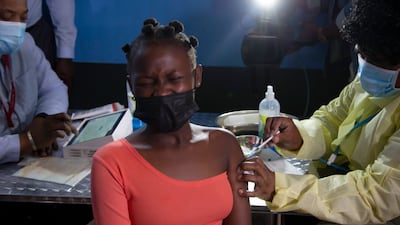
A young woman receives a Pfizer jab in Diepsloot Township near Johannesburg, South Africa. AP Photo -

A girl wearing a face mask rides on a merry-go-round at the Christmas market in Frankfurt, Germany. AP Photo -

People travel on a London underground tube train on the Jubilee Line, in London, during the pandemic. AP Photo -

People wait for the tram in Vienna, Austria, amid the crisis. AP Photo -
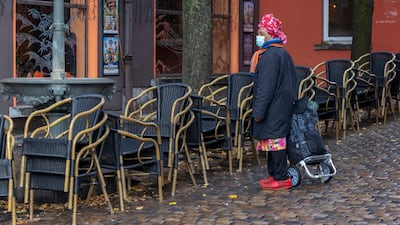
A woman passes by an empty terrace in the Marrolles quarter in Brussels, Belgium. AP Photo -
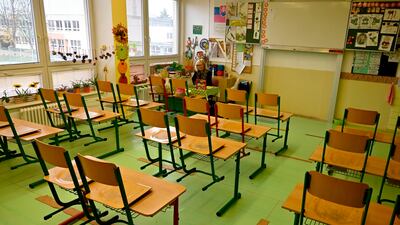
A teacher gives online lessons via webcam at the temporarily closed elementary school in the town of Trebisov, eastern Slovakia. TASR via AP -
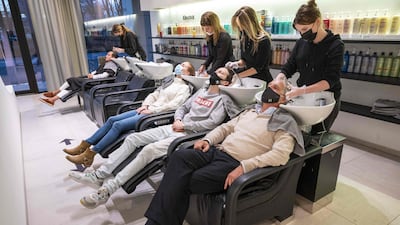
Hairdressers and clients wear masks in Amsterdam, Netherlands. AFP -
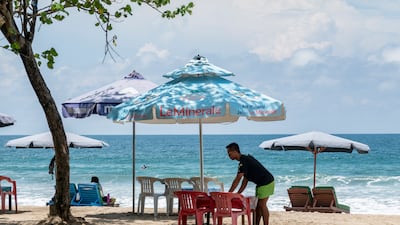
A man disinfects seats for tourists at a beach in Kuta, Bali, Indonesia. EPA -
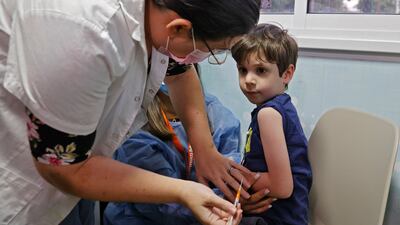
Israeli boy Itamar, 5, receives a dose of the Pfizer/BioNTech Covid-19 vaccine at the Meuhedet Healthcare Services Organisation in Tel Aviv. AFP -
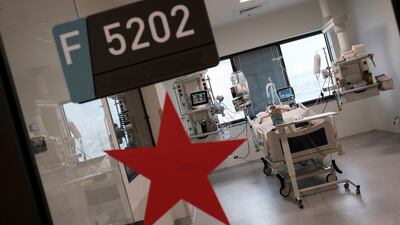
A patient suffering from Covid-19 is admitted in the intensive care unit of the Basaksehir Cam and Sakura City Hospital in Istanbul, Turkey. Reuters -
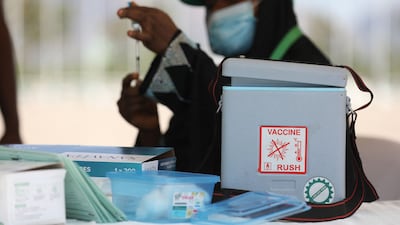
A health worker prepares to administer the AstraZeneca jab in Abuja, Nigeria. AFP


WHO published reports on Sunday that found the poor around the globe had fallen deeper into debt and poverty.
With the spread of the Omicron variant, experts have advised countries to ensure eligible people complete each Covid-19 vaccine course – usually two doses – and have a booster shot when able to do so.
Dr Hajjeh said most nations had fallen behind with immunisation.
She said many countries had not reached the recommended percentage of coverage of the vaccination.
“We said we need to reach 40 per cent in all the countries,” she said.
“Maybe nine countries in the region out of 22 have reached the ratio of 40 per cent, but six have not even reached 10 per cent.
“Most of our effort will go to provide at least two shots to cover 40 per cent of the population until the end of 2021 around the world and in the region.”
The Eastern Mediterranean region as defined by the UN comprises 22 members, including the UAE, Saudi Arabia, Egypt, Pakistan, Morocco and Sudan.
The WHO officials are also speaking to governments for an essential health benefit package to ensure everyone has access not only to necessary services but also to high-quality care.
Dr Hajjeh said several countries, including the UAE, had developed innovative processes that allowed children to be immunised and pregnant women to receive regular antenatal advice without having to visit primary health care centres or clinics.
The WHO has emphasised the right of every person to have access to high-quality health services without suffering financial ruin.
But officials said the pandemic had forced people into greater hardship, causing many to postpone addressing health concerns owing to high medical costs.
Governments must act to protect vulnerable
They said governments had the responsibility to build equitable health systems so the poorest were taken care of.
The reports showed that 12.5 per cent of population in the Eastern Mediterranean region were spending more than 10 per cent of their income on health care for which they paid directly to access the service.
“This is a very high percentage. It means one out of eight people are spending a catastrophic amount and so they will ask themselves twice before they take care of their health,” said Dr Awad Mataria, director, universal health coverage, WHO Regional Office for the Eastern Mediterranean.
“We would like people to have access to good quality health care and financial protection so they don’t spend their savings. It should not be that they cannot eat well, cannot send children to school because they have to spend to take care of their health.”
Dr Samira Asma, assistant director general, data, analytics, WHO headquarters, said it was imperative to remind policymakers that health was a political priority and a basic human right.
“What we have learnt is no country was well prepared,” Dr Asma said.
“The bottom line is this is an opportunity for every country to step up not only global health security but having universal health coverage.
“We know that half of the world is falling behind and many people in billions are experiencing catastrophic hardships financially leading to poverty. The bottom line is we should race to meet universal health coverage target by 2030. We have a responsibility and an opportunity that should not go waste.”
Speaking about deaths in Africa, she said nine in 10 deaths in African nations were not registered.
“If deaths are not registered, the cause of death is not known and if the cause of death is not known it is hard to find out how the virus or bacteria affected the individual,” she said.
“We need integrated surveillance and data collection healthy information systems.”

