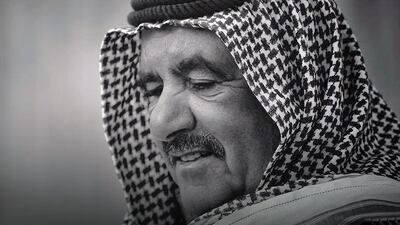

The death of Sheikh Hamdan bin Rashid marks the end of a lifetime of service to Dubai and the UAE.
Appointed as Minister of Finance in the Cabinet under Founding President Sheikh Zayed after the formation of the country in December 1971, Sheikh Hamdan held the post until his death, which was announced on Wednesday. He was in his mid-70s.
Like his brothers, Sheikh Maktoum bin Rashid, the late Ruler of Dubai, and Sheikh Mohammed bin Rashid, Vice President and Ruler of Dubai, Sheikh Hamdan was prepared for the responsibilities of office from an early age.
The second of four sons of Sheikh Rashid, Sheikh Hamdan was part of a rising generation of young Emiratis from the ruling families whose duties required them to articulate the vision and ambition of their new country on a global stage.
Even as a teenager, he was always at his father’s side, as Sheikh Rashid pursued his goal of turning Dubai into a world centre of trade and business.
A photograph from 1959 shows Sheikh Hamdan, not yet 15, standing by his father's side at London's Heathrow Airport as they arrived for an official visit to the UK.
His formal education began in Dubai, studying mathematics and science as well as Islamic and Arabic studies at a school in the city.
In his early 20s, he spent a year at language school in Cambridge to further develop his proficiency in English.
It was during his time in this ancient university city that Sheikh Hamdan was likely to have developed one of his lifelong passions, for nearby was the town of Newmarket, arguably the world centre of thoroughbred horse breeding.
The popularity of racing in the UAE is widely attributed to Sheikh Hamdan. In 1981, he founded Shadwell Racing, with a breeding and racing operation that eventually expanded to eight stud farms and hundreds of Arabian and thoroughbred horses across the UK, Ireland and the US.
British Flat Racing Champion Owner five times between 1990 and 2005, his triumphs included the English and Irish derbies, the 2,000 Guineas, the Ascot Gold Cup and the Dubai World Cup in 1999 and 2007.
But his love of racing never distracted him from the duties of government, as a minister, and Deputy Ruler of Dubai from 1995.
From the start of public life, he followed Sheikh Rashid’s vision of developing Dubai as a diverse economy that would become a world city.
He was placed in charge of key institutions by Sheikh Rashid, including Dubai Aluminium (now EGA), Dubai Natural Gas (Dugas), Dubai Cable and the Dubai World Trade Centre.
His responsibilities would expand to encompass the Dubai Municipality, president of the Dubai Ports Authority and the information and health departments.
As a minister, Sheikh Hamdan had the responsibility of making sure the UAE’s new oil wealth was used to develop an infrastructure that would benefit all its people, funding roads, hospitals, electricity and water.
On the world stage, he was the UAE’s chief representative to the International Monetary Fund and the Opec Fund for International Development.
Sheikh Hamdan will also be remembered for his contribution to education, science and philanthropy, giving generously throughout his life.
In partnership with Unesco, the United Nations' cultural organisation, he created the Hamdan bin Rashid Al Maktoum Award for Distinguished Academic Performance, to improve the quality of education and teaching.
His involvement in science included the Sheikh Hamdan bin Rashid Al Maktoum Award for Medical Sciences, rewarding medical research that serves all humanity.
His support for medicine resulted in honorary fellowships from the Royal British College in London and Edinburgh, and an honorary fellowship for internal medicine and surgery from the Royal British College in Glasgow.
Sheikh Hamdan was also the patron of Al Maktoum College of Education in Dundee, Scotland, created to promote cross-cultural understanding, and including a Dh6 million ($1.6m) grant to serve the local Muslim community.
The year 1996 marked the opening of the Islamic Cultural Centre of Ireland, the first project of Sheikh Hamdan's Al Maktoum Foundation, which now supports dozens of charitable and philanthropic projects worldwide, building schools, providing scholarships and offering financial and material aid from Africa and Asia to Europe and the Americas.
Of its work, Sheikh Hamdan said: "I feel extremely happy and comfortable when I help fill the heart of a deprived individual with joy and happiness in building a school for those who couldn’t get education or construct a masjid to the faithful who couldn’t raise enough funds to build their own house of worship.”

