
Sheikh Mohammed bin Rashid, Vice President and Ruler of Dubai, said the government has approved 10 economic principles that will guide the country in the coming decade.
On the second day of the two days of government meetings in Abu Dhabi, Sheikh Mohammed said there was a focus on the economic agenda to improve growth.
Ten economic principles were approved at the meetings that Sheikh Mohammed said would guide the country over the next 10 years to achieve its economic targets.
The principles include having an open economy without boundaries, attracting the best talent, investing in the digital economy, providing diverse opportunities for young people, building a sustainable and balanced economy, protecting state financial systems and having the world's best logistics system.
“Today, we concluded the annual meetings of the UAE government, during which we decided to focus significantly in the coming period on the economic agenda with the aim of enhancing the country's developmental momentum, reinforcing and solidifying it, and reaching new levels of growth,” Sheikh Mohammed said on X.
“The UAE government today approved the economic principles for the state over the next 10 years to serve as the general framework in which we will concentrate on achieving our economic targets.”

More than 500 dignitaries, including heads of UAE executive boards, ministers and senior officials in the federal and local governments, gathered in Abu Dhabi for talks at federal and local levels to discuss and review strategies and initiatives.
“We want to see the UAE at the forefront of the global economies, with a strong digital infrastructure, secure systems, flexible legislative framework, and a renewable futuristic mindset,” Sheikh Mohammed said.
“We urge everyone to work according to these principles, commit to them and use them as a guide in all policies, legislations, and new economic initiatives.”
Key economic principles
Sheikh Mohammed's post on social media was accompanied by two pages that outlined the 10 principles in detail under the heading: UAE Economic Principles Document.
The introduction says the document was derived from the 50 principles of the UAE, which say it is “a unified economic and investment destination, with a focus on building the world's best and most active economy in the coming period, the Economic Principles Document for the UAE is born”.
The document outlines a plan that defines the features and pillars of the next stage of the country's economy.
“We aspire to see the UAE as a global economic powerhouse with a digital infrastructure, secure systems, flexible laws, and a futuristic mindset – appealing to creative minds,” the document says.
“We aim for the UAE to be a world within a country and an influential player in the global economy.”
The first principle: An economy open to the world without boundaries
The UAE is an exemplary free-market economy, open to the world without limitations. It welcomes international and regional economic and trade exchange without restrictions, building economic bridges with everyone.
It provides a global economic environment with attractive advantages and competitive incentives, ensuring the diverse flow of investments to and from the country.
Additionally, it explores new economic destinations to increase the country's exports, diversify import sources, and establish extensive trade and economic partnerships. This solidifies the UAE's position at the core of the global free-market economy.

The second principle: Attracting the best economic talent
The UAE is an economic environment where local and global minds and innovations converge. It possesses attractive factors for skilled individuals, innovators, and creative minds in vital economic fields.
It fosters a conducive climate for transforming creative ideas into innovative applications and solutions. The UAE also retains top global talents through diverse incentive programmes that facilitate easy transition, living, and working in the country. This is made possible by offering world-class quality of life and services for skilled individuals and their families.
The third principle: Investing in the digital economy
The UAE is a hub for the global digital economy, serving as an international platform for digital transactions and an attractive investment environment for technology companies, big data institutions, and future technologies.
This is achieved through continuous development and updating of the country's digital infrastructure and related regulations. The field is open for the application of artificial intelligence revolution technologies, with unlimited investment in a competitive digital Emirati economy that shapes the future.
The fourth principle: Providing diverse opportunities for youth
Placing young national talent at the core of the Emirati economic model, the UAE aims to actively involve them in various economic sectors.
This is achieved through the development of programmes that equip them with essential skills and knowledge meeting the demands of the job market. It enhances their competitiveness in a globally open economic environment.
Additionally, it encourages both public and private sector institutions to create diverse employment paths and professional development opportunities for the youth.
Fifth Principle: Building a sustainable and balanced economy while preserving resources for future generations
Our focus is on ensuring the sustainability of the UAE's economy through advanced legislation and policies that guarantee the sustainability of resources and environmentally-friendly energy sources.
Focus should also be on government plans and strategies that are designed to preserve our natural resources for future generations, reflecting our commitment to building a lasting and balanced economy that leaves a legacy of environmental responsibility and the conservation of wealth for our future.
UAE annual government meetings 2023 – in pictures
-
Sheikh Mohammed bin Rashid, Prime Minister and Ruler of Dubai, said the first priority would be a continued focus on economic growth and development, with 'streamlined procedures, improved services and a fresh set of incentives'. Photo: Dubai Media Office -
The second priority will be youths, whom Sheikh Mohammed bin Rashid, Prime Minister and Ruler of Dubai, said will be given support for their initiatives and improved job opportunities. Photo: Dubai Media Office -
The third priority involves having projects that embrace sustainability, conserve resources and safeguard the environment. Photo: Dubai Media Office -

Sheikh Khaled bin Mohamed, Crown Prince of Abu Dhabi and Chairman of the Abu Dhabi Executive Council, attends the UAE government annual meetings. Photo: Dubai Media Office -
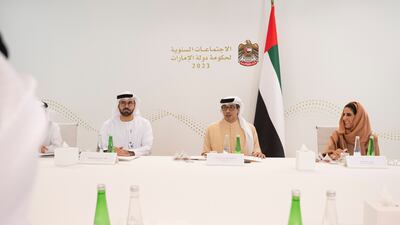
Sheikh Mansour bin Zayed, Vice President, Deputy Prime Minister and Chairman of the Presidential Court, meets Executive Council secretaries during the UAE government annual meetings. Photo: UAE Presidential Court


The sixth principle: Protecting the stability of state financial systems
Our goal is to ensure the stability of all state financial systems, ensuring their sustained development, strength, and adherence to high global standards of efficiency and security.
This enhances the trust of local, regional, and global investors.
We achieve this through continuous improvement and updating, in collaboration with international financial institutions, to ensure efficient management of current and future risks. Additionally, we work towards attracting more banks and financial institutions to reinforce these systems.
The seventh principle: Continuous development of economic legislation
We strive for ongoing enhancement and development of economic legislation to ensure a robust investment environment supported by flexible laws and policies.
This aims to consistently position it as a secure and attractive destination for establishing, developing, and stabilising businesses in the region and globally. Its laws represent updatable legislative frameworks that keep pace with current and future global changes, fostering a business-friendly climate and the attractiveness of markets and various sectors in the country for investments.
The eighth principle: Transparency, credibility, and rule of law
We commit to transparency, the principle of the rule of law, and high standards of economic transparency. This involves ensuring access to information from reliable sources and providing accurate data related to the performance of various sectors in the country. This enhances the confidence of investors, business owners, as well as international economic and financial entities, increasing opportunities for investment inflow into the country and driving economic growth indicators upwards year after year.
The ninth principle: The best banking system to boost economic growth momentum
Our banking system is robust and advanced, adhering to the highest global standards. It prioritises the protection of personal savings and financial transactions for clients, whether individuals or institutions. We collaborate with international specialised organisations to implement best practices in the field of banking data protection. This contributes to attracting capital inflows, supporting global confidence in the UAE economy and the banking sector, and positively impacting the economic stability climate.
The 10th principle: The best logistic infrastructure in the world
We persist in developing the world's best logistic infrastructure, including ports, airports, airlines, and navigational routes.
This solidifies the UAE's position as a key hub for global cargo and human movement, connected to prominent international destinations. We provide high-level services in the transportation, travel, and logistics sectors, enhancing global trade and establishing the UAE as a crucial link between the East and West and the North and South.

