

Dubai Municipality has set a target of recycling 100 per cent of the emirate's wastewater by 2030 as part of its sustainability strategy.
It said 90 per cent of wastewater – used domestic and commercial water – in the emirate is recycled.
The authority said it will also reduce its use of desalinated water and related power consumption by 30 per cent and achieve annual savings of about Dh2 billion ($544 million).
Dubai said it plans to double its recycling of water to more than eight billion cubic metres by 2030.
Wastewater is collected and processed through treatment plants to remove contaminants.
The reclaimed water, which has many uses in the emirate, is used to irrigate green spaces and landscaping through Dubai Municipality's network of around 2,400 kilometres, which covers most areas of the city.
It uses about 265 million cubic metres of water for green spaces every year.
In 2022, Dubai used six million cubic metres of reclaimed water in central cooling stations, resulting in cost-savings of about Dh7.1m (47 per cent).
The water is also used for firefighting as a more eco-friendly alternative to desalinated water and for man-made lakes in the emirate. It is also used in treatment processes such as washing operations in sewage treatment plants and pumping stations.
World Water Day around the world – in pictures
-

A man washes clothes on the banks of the river Brahmaputra on World Water Day (March 22) in Guwahati, India. AP Photo -

The cracked earth of the Sau reservoir north of Barcelona, Spain. AP Photo -
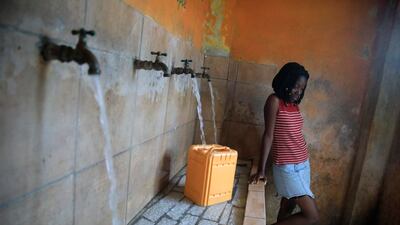
With no running water at home, a woman fills a container at a water fill station in Port-au-Prince, Haiti. AP Photo -

Carmelo Del Valle, displaced from his home by the rising waters of the Paraguay River, fills buckets to haul to his temporary shelter in Asuncion, Paraguay. AP Photo -

Women carry water on the outskirts of Sanaa, Yemen. More than 17 million of Yemen's 30-million population lack access to safe water, the UN says. EPA -

A woman returns home after collecting drinking water from a tanker on World Water Day in New Delhi, India. Wednesday is the 30th anniversary of World Water Day. AP Photo -
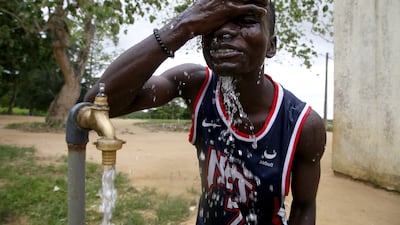
A man in Abidjan, Ivory Coast, a day before World Water Day. Ivorian Prime Minister Patrick Achi announced an investment of about $5 billion to achieve universal access to drinking water by 2030. EPA -
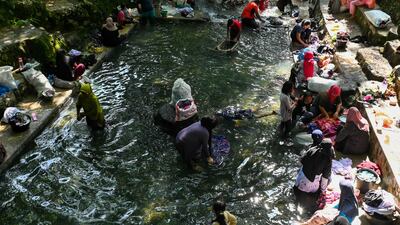
People wash clothes in a public pool of spring water in Japakeh, Indonesia, on World Water Day. AFP -

A photograph taken on March 16, 2023 shows the dried-up lake Serre-Poncon, near Embrun in the French Alps. AFP -

A woman washing up outside her house in a slum on the eve of World Water Day in Mumbai, India. AP Photo -

The Satluj river in the valley below the snowy peaks in Kinnaur district of the Himalayan state of Himachal Pradesh, India. AP Photo -

Wind pumps in Kinderdijk, Netherlands. The pumps prevent the region from being flooded, since a third of the Netherlands lies below sea level. AP Photo -

Franklin Caceres checks a water pump used to collect water from a well in the Petare neighborhood of Caracas, Venezuela. Caceres supplies water to more than 400 people. AP Photo -

A man puts empty water containers back on a lorry belonging to a private distributor in Caracas, Venezuela. AFP


Dubai Municipality started its water reclamation programme in 1969, when the emirate’s first treatment plant was built in Al Khawaneej.
To meet the rising demand for wastewater treatment and recycled water, a plant was built in Warsan that was increased to a capacity of 260,000 cubic metres a day.
A third plant, in Jebel Ali, built in 2006, took the city's water recycling capacity to 560,000 cubic metres daily.
The Warsan plant was expanded in 2015 to 325,000 cubic metres daily, while the capacity at Jebel Ali was increased in 2016 to now produce 675,000 cubic metres daily.
Between 1980 and 2022, Dubai produced more than 4.5 billion cubic metres of recycled water.
Dubai Municipality has reduced carbon emissions from sewage treatment processes by using anaerobic digestion in central treatment plants. This is a process that involves breaking down organic matter, such as animal or food waste, to produce biogas and bio-fertiliser.
Dubai Municipality completed a project this year to use biogas as fuel to power 50 per cent of the electricity needs at the treatment plant in Warsan.
Wastewater treatment explained
Wastewater treatment is often divided into three phases: primary - in which most of the solids are removed, followed by secondary and tertiary treatment, which improve the purity.
Primary treatments often involve the water being passed through several tanks and filters.
Organica, a company based in Hungary that builds wastewater treatment plants, said that secondary treatments may involve water aeration with microorganisms. Alternatively, the water may be passed through oxidation ponds, perhaps for two weeks or more.
Luiza Campos, professor of environmental engineering at University College London, said that another method involves membrane bioreactors.
With these, a membrane captures remaining solid material, which is processed by microorganisms.
One form of tertiary treatment is reverse osmosis (RO), a process in which pressure forces water through a membrane. Separately, RO is also used to produce drinking water by desalination.
“Reverse osmosis is another filtration – it removes most of the solids,” Prof Campos said.
NetSol Water, a wastewater treatment company in India, is among the firms that offer RO technology.
“With proper pre-treatment in the primary and secondary phases, tertiary RO wastewater recycling has been found to dramatically reduce total dissolved solids, trace heavy metals, bacteria, viruses, and other dissolved pollutants,” the company said.
Prof Campos said that the technology that is used may depend on where the water ends up.
“When discharging to rivers, you cannot use chlorine because it's going to be harmful,” she said.
The level of purification that is carried out depended on what the treated water was being used for, Prof Campos added.
“If it's drinking water, obviously you need to have additional treatment. If it's for agriculture, secondary treatment may [be sufficient],” she said.
“For drinking water, it's more effective technology [that is needed] and it [entails additional] costs.”

