
The UAE is to create the world’s largest artificial reef off the east coast of Fujairah.
Conservationists from the Florida Keys in the United States will join marine biologists in the Emirates to establish the 300,000 square metre project.
Last week, two scientists from the Florida Keys National Sanctuary toured the Fujairah coastline, diving at natural reefs and speaking with experts.
The visit was the first step in the new partnership between the sanctuary and the UAE’s Ministry of Climate Change and Environment.
“We saw this as a unique opportunity because the UAE is proposing to undertake the largest creation of the largest artificial reef anywhere in the world,” said Andy Bruckner, the Florida sanctuary’s lead scientist.
“That involves growing and planting a lot of corals, which is exactly what we’re trying to do on our reefs [in the US].”
The UAE announced plans to begin growing the enormous reef project in April last year.
It is hoped the initiative could be completed within a decade, although exact details on time and scale have yet to be finalised.
Currently, the world’s largest artificial reef sits on the former aircraft carrier USS Oriskany, which was sunk off the coast of Pensacola, Florida, in 2006.
Reefs in Florida and the UAE face similar threats, from human disruptions like land reclamation and dredging to global stresses including rising sea temperatures.
Both the US state and the Emirates have committed to ambitious restoration projects, with Florida recently launching a 10-year plan called the Mission Iconic Reefs project.
Research in the state has shown coral cover has decreased by more than 90 per cent in just four decades.
But, if successful, their new project will restore coral coverage to original levels by putting half a million one metre colonies at seven locations over the next decade.
By comparison, the UAE plan proposes about 300,000 mature adult colonies — about the size of three football pitches — in a single location.

"Corals are basically the trees of the oceans," Mr Bruckner told The National, who has worked on reef conservation since 1979.
“Without those corals the fish have all disappeared. Our goal is to bring those things back and we see a unique opportunity here [in the UAE] because the environment is very similar.
“Because a lot of the stressors are the same and the environment is the same, we feel a lot of the knowledge gained here can be applied to Florida and vice versa.”
Scientists hope to build a long-standing exchange programme between experts in Florida and the Emirates.
The Floridians can help Fujairah scientists set up propagation areas in the ocean, where it is less expensive to grow coral compared with aquariums.
Most importantly, however, they will help the UAE implement a technique that enables coral to grow more quickly.
Coral consists of a colony of thousands of tiny, interconnected animals called polyps. Fragments can be broken off to form a new colony, like a plant-clipping.
Once the fragment grows large enough, it can be planted on to a reef.
Branching coral, the type that has the appearance of antlers, grows quickly at a rate of five to 20 centimetres a year.
But natural reefs are usually built on a foundation of large, solid corals known as boulder corals and may only grow millimetres annually.
At the Florida sanctuary, researchers accelerate coral growth with a trick called micro-fragmenting.
Scientists put one or two individual polyps — which are about the quarter of a size of a fingernail — on to ceramic disks.
Once in situ, the coral invests all its energy into growing laterally and covering the surface of the disc as quickly as possible. Two polyps can grow to a thin layer with a five centimetre span in just six to eight months.
These dirham sized samples are then spaced five centimetres apart on a larger surface, such as a rock and, once again, begin putting all their energy into covering its surface.
By being encouraged to grow outward instead of up, as coral does under natural conditions, a reef can be created at a much faster speed.

Naturally, a mature colony can take about 25 years to reach the size of a football, but by using micro-fragmenting it needs only three to four years.
“The trick is you have to use only the same species and the same genetic strain because if you mix them, corals will fight,” said Mr Bruckner.
“When two different genetic strains come in contact, they don’t want to be overgrown or killed so they produce these specialised tentacles that kill their neighbour and you don’t want that.”
Once coral is planted, it needs attention to survive.
“Doing restoration is much like if you’re to plant a flower or vegetable garden,” said Mr Bruckner.
“When you put your corals into the water, you can’t just leave them because there’s a lot of stresses out there that will affect them.
“Algae can overgrow, there are coral eating snails. So you have to do maintenance on it.”
Researchers fear the future of the UAE’s natural reefs could be in doubt after a study found rising temperatures killed almost three quarters of Abu Dhabi’s coral.
Record temperatures in the summer of 2017 left more than 90 per cent of Abu Dhabi’s coral cover bleached and struggling to survive, New York University Abu Dhabi found.
Dr John Burt, associate professor of biology, said there was a remarkable amount of damage.
“The results were catastrophic. I had never seen anything like it in my career.”
Damage to the reefs off Abu Dhabi reflects a global trend, driven by high emissions and rising temperatures.
The destruction witnessed in the summer of 2017 was caused by winds being weaker than normal, reducing evaporation from the sea, which usually cools water down.
______________
The UAE and Middle East from space
-

Najran in the southwest of Saudi Arabia. All images courtesy Maxar Technologies / Google -
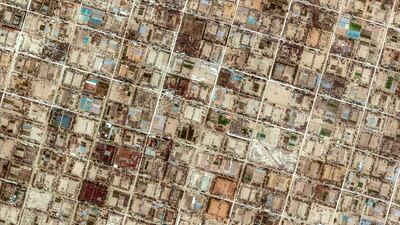
Farming sites located between Abu Dhabi and Dubai. -
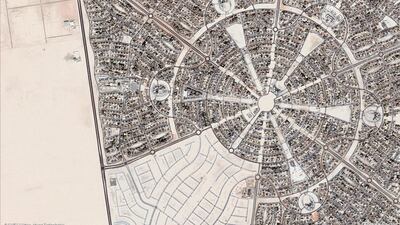
New Al Falah, close to Abu Dhabi International Airport. -
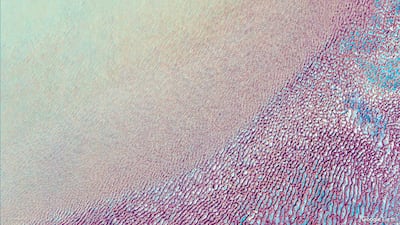
Al Ahsa in Saudi Arabia. -
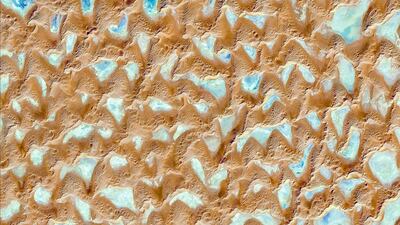
Al Ahsa in Saudi Arabia. -

Baalbek in Lebanon. -
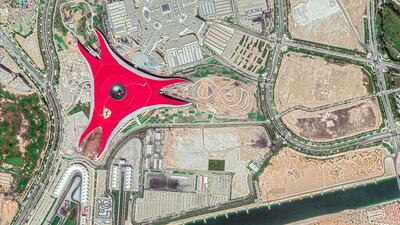
Yas Island in Abu Dhabi. -
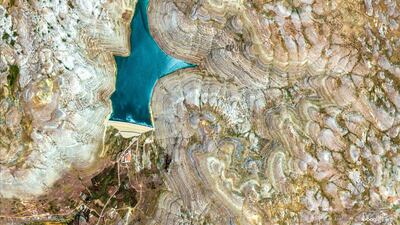
Kesrouane in Lebanon. -
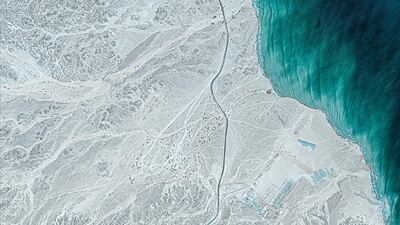
Al Wusta Governate in Oman. -

Seeb in Oman. -
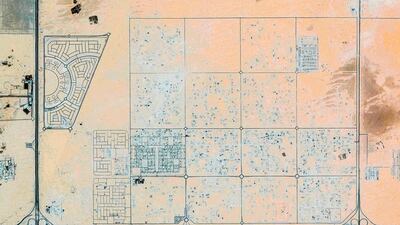
Sharjah in the UAE. -
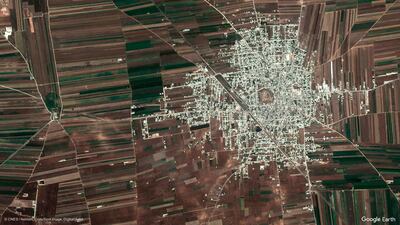
Tall Rifat in Syria. -

Hail Province in Saudi Arabia. -
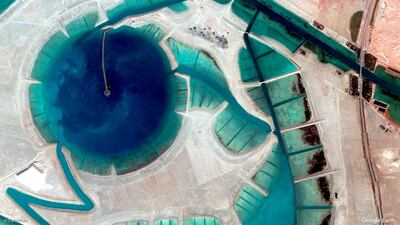
Al Gharbia in the Western Region, UAE. -
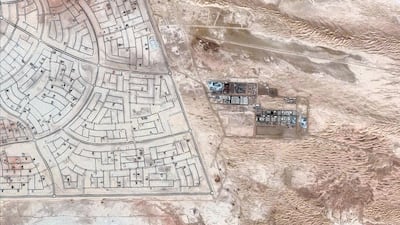
Abu Dhabi out towards Al Ain. -
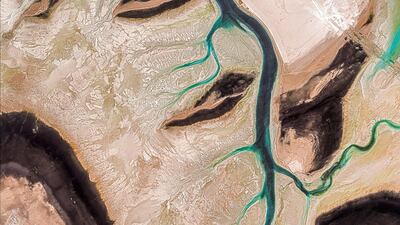
Abu Dhabi, just north of Yas Island. -
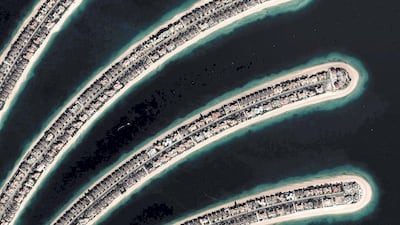
The fronds on Dubai's Palm Jumeirah. -
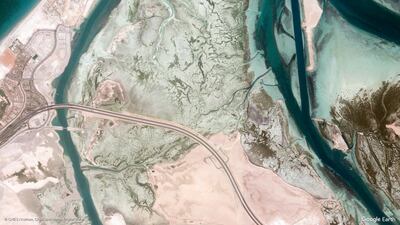
The Sheikh Khalifa bin Zayed Highway crossing on to Abu Dhabi's Saadiyat Island. -
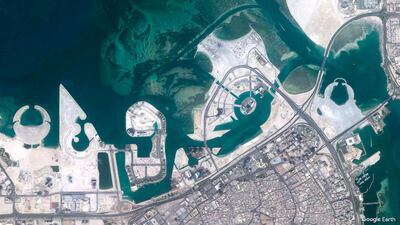
Manama in Bahrain. -
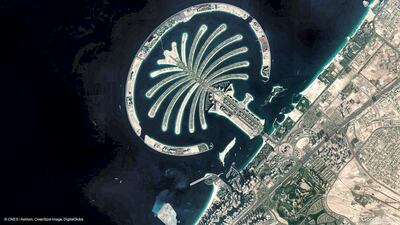
The Palm Jumeirah in Dubai. -
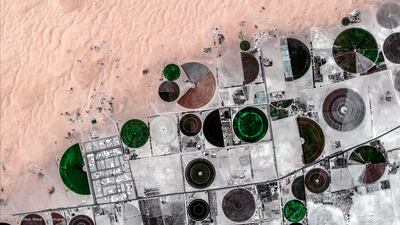
Hail Province in Saudi Arabia. -

Dubai's The World Islands. -
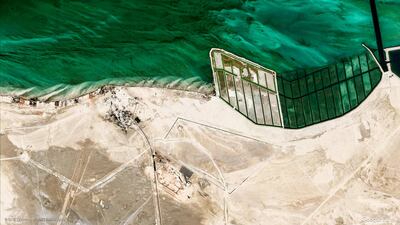
Tarif in Abu Dhabi. -
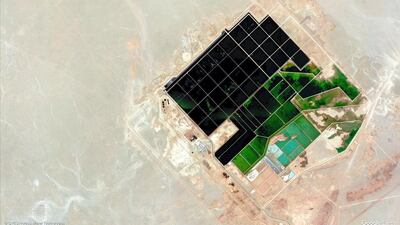
Dhofar Governate in Oman. -
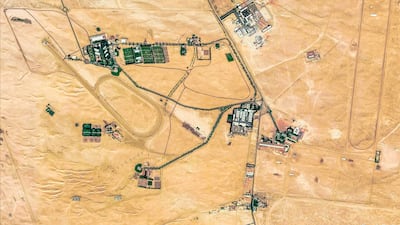
Al Asayel Stables in Abu Dhabi. -
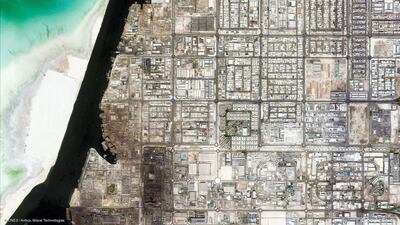
Musaffah industrial area in Abu Dhabi.



