• ALGERIA: The report studied not only food scarcity but how much a household must spend on food to get by. In Algeria, the average family spent 42.5% of their monthly income on food, placing them fifth from the bottom of the global chart. AFP
    ALGERIA: The report studied not only food scarcity but how much a household must spend on food to get by. In Algeria, the average family spent 42.5% of their monthly income on food, placing them fifth from the bottom of the global chart. AFP
  • KAZAKHSTAN: Kazakhstan came fourth from the bottom, with a household spending 43% of their income on food. Anadolu Agency via Getty Images
    KAZAKHSTAN: Kazakhstan came fourth from the bottom, with a household spending 43% of their income on food. Anadolu Agency via Getty Images
  • CAMEROON: A farmer grows mushrooms in to diversify his crop. Cameroon was third from the bottom, with the average household spending 45.6% of their budget on food. AFP
    CAMEROON: A farmer grows mushrooms in to diversify his crop. Cameroon was third from the bottom, with the average household spending 45.6% of their budget on food. AFP
  • KENYA: Despite its position as one of Africa's stronger economies, food shortages left the average family spending 46.7% of their income on food. AFP
    KENYA: Despite its position as one of Africa's stronger economies, food shortages left the average family spending 46.7% of their income on food. AFP
  • NIGERIA: With one of the world's fastest growing populations, Nigeria struggles to feed its 200 million people. It languished at the bottom of the global table, with the average family spending 56% of their income on food. AFP
    NIGERIA: With one of the world's fastest growing populations, Nigeria struggles to feed its 200 million people. It languished at the bottom of the global table, with the average family spending 56% of their income on food. AFP

Middle East and Africa have 'highest levels of food insecurity'


Kelly Clarke
  • English
  • Arabic

The Middle East and Africa have some of the highest levels of food insecurity in the world, according to a new global report.

Findings from the Global Food Security Q2 2022 report by Deep Knowledge Analytics, showed that Yemen and Syria are in the midst of food crises fuelled by war.

On top of the conflict, climate change and water shortages are affecting Algeria, Iraq, and Yemen too, limiting the availability of resources needed for food production and development of agriculture.

Of the 171 countries evaluated, Syria and Yemen were among the lowest scoring, ranking 148th and 160th, respectively. Central Africa remains the most food scarce region.

Russia's invasion of Ukraine in late February dramatically worsened the outlook for food prices
Global Food Security report

The report assessed the drivers of food insecurity focusing on key trends, including food dependency, inflation, and policy developments.

It said the Mena region will remain one of the most "import-dependent regions in the world", with about 50 per cent of its food imported.

However, some progress in the field of agri-food technology is being made in countries such as the UAE and Israel.

The report evaluated all countries based on three main categories: access to food; crisis level; and food system and economic resilience.

The UAE ranked first among Arab countries in the Food System and Economic Resilience section, ranking 19th globally and beating Austria, Switzerland and the UK.

Overall, the UAE ranked 26th globally in the Index with a score of 7.07 out of 10.

Lack of food globally

Looking globally, the report found that 868 million people do not have sufficient food and 25 countries were considered high risk and deteriorating.

Additionally, the report identified a 30 per cent increase in fertiliser prices since the beginning of the year, which contributed to a decrease in crop production around the world.

“Global food prices and fertilisers started to rise in mid-2020 when businesses shut down due to the Covid-19 pandemic, straining supply chains,” the report said.

“Since then, there have been problems with key crops in many parts of the world.

“Russia's invasion of Ukraine in late February dramatically worsened the outlook for food prices.”

People most affected by the rise of food prices live in developing countries, where a larger share of income is spent on food, it said.

Today, 35 countries have food export restrictions in place. This number rose by 25 per cent this year owing to the Russian war in Ukraine.

As of the end of March, 53 new policies affecting food trade had been adopted around the world, 31 of which restricted exports and nine curbed wheat exports.

Major food exporters such as Argentina, India, Indonesia, Kazakhstan and Russia, as well as smaller exporters such as Algeria, Turkey and Serbia, have introduced food export restrictions on products including pasta, oil, sugar and lentils.

With more countries imposing restrictions, the report said there is a greater risk of “price volatility, panic buying, shortages, and hoarding”.

As a result, 15 countries were deemed “unable to produce their own food”, including Afghanistan, Eritrea and Iraq.

Countries that spend least on food?

Of the nations that are most food secure, the US, Singapore and the UK spend the least household income on food.

In the US, about 6.4 per cent of income is spent on food, rising to 6.7 per cent in Singapore and 8.2 per cent in the UK.

“The more developed a country, the less income is spent by its citizens on food,” the report said.

“Developing countries will have even greater food insecurity and hunger levels with the most vulnerable paying more for less food.”

According to the findings, only eight countries in the world spend less than 10 per cent of their household income on food, four of which are in Europe ― the UK, Switzerland, Ireland and Austria.

The remaining four countries are the US, Singapore, Australia and Canada.

Spending most on food is Nigeria, with more than half of household income (56.4 per cent) going towards produce.

There are nine other countries that spend more than 40 per cent of their income on food including Kenya, Cameroon, Kazakhstan and Algeria.

Countries that fared best overall in the Global Food Security Q2 2022 report were the US, Norway and Ireland, respectively.

Coming in last was Somalia, with an overall score of 2.97 out of 10, following by the Democratic Republic of Congo and Mozambique.

UN food supplies – in pictures

  • A Palestinian worker from the United Nation Relief and Works Agency (UNRWA) handles food supplies, in Gaza City. EPA
    A Palestinian worker from the United Nation Relief and Works Agency (UNRWA) handles food supplies, in Gaza City. EPA
  • Displaced Yemenis get emergency food aid provided by a local relief group, Mona Relief Yemen in the western province of Hajjah, Yemen. EPA
    Displaced Yemenis get emergency food aid provided by a local relief group, Mona Relief Yemen in the western province of Hajjah, Yemen. EPA
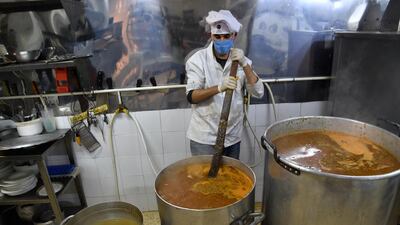
  • A volunteer of the "Nass el-Khir" association prepares food for meals to be distributed among those in need in Algeria's capital Algiers. AFP
    A volunteer of the "Nass el-Khir" association prepares food for meals to be distributed among those in need in Algeria's capital Algiers. AFP
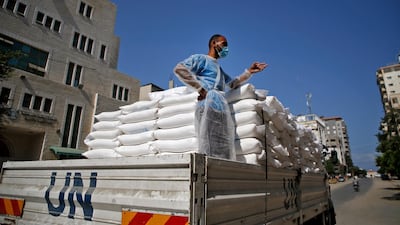
  • A worker of the United Nations Relief and Works Agency for Palestine Refugees stands in the back of a truck delivering food aid to families in need in Gaza City. AFP
    A worker of the United Nations Relief and Works Agency for Palestine Refugees stands in the back of a truck delivering food aid to families in need in Gaza City. AFP
  • A Palestinian worker at the United Nation Relief and Works Agency (UNRWA) distributes food aid rations for refugee families, in Gaza City. EPA
    A Palestinian worker at the United Nation Relief and Works Agency (UNRWA) distributes food aid rations for refugee families, in Gaza City. EPA
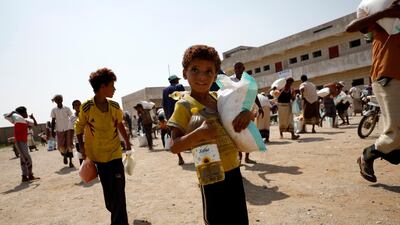
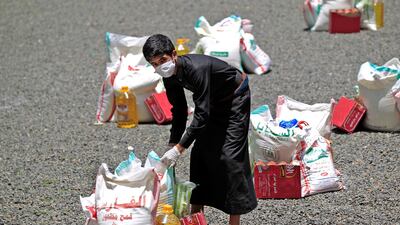
  • A Yemeni boy carries a portion of food aid, distributed by Yadon Tabney development foundation, in Yemen's capital Sanaa. AFP
    A Yemeni boy carries a portion of food aid, distributed by Yadon Tabney development foundation, in Yemen's capital Sanaa. AFP
  • A Palestinian worker at the United Nation Relief and Works Agency distributes food aid rations for refugee families, in Gaza City. EPA
    A Palestinian worker at the United Nation Relief and Works Agency distributes food aid rations for refugee families, in Gaza City. EPA
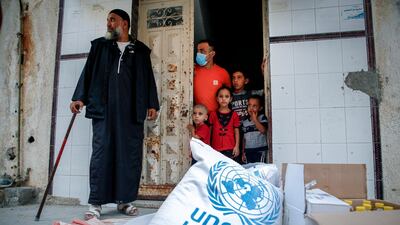
  • Members of a Palestinian family stand through the door of their home as they receive food aid provided by the United Nations Relief and Works Agency for Palestine Refugees in Gaza City. AFP
    Members of a Palestinian family stand through the door of their home as they receive food aid provided by the United Nations Relief and Works Agency for Palestine Refugees in Gaza City. AFP
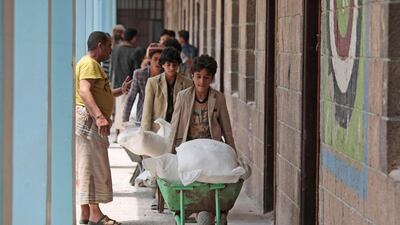
  • Displaced Yemenis receive food supplies provided by the World Food Programme, at a school in Sanaa, Yemen. AP Photo
    Displaced Yemenis receive food supplies provided by the World Food Programme, at a school in Sanaa, Yemen. AP Photo
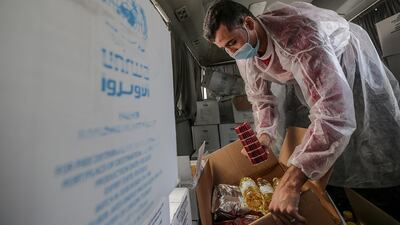
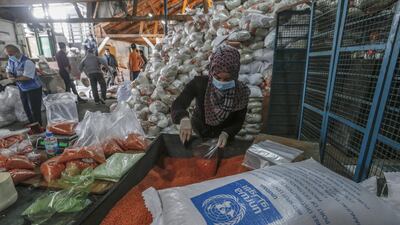
  • Palestinian employees at the United Nations Relief and Works Agency for Palestinian Refugees prepare food aid rations. AFP
    Palestinian employees at the United Nations Relief and Works Agency for Palestinian Refugees prepare food aid rations. AFP
T20 World Cup Qualifier

October 18 – November 2

Opening fixtures

Friday, October 18

ICC Academy: 10am, Scotland v Singapore, 2.10pm, Netherlands v Kenya

Zayed Cricket Stadium: 2.10pm, Hong Kong v Ireland, 7.30pm, Oman v UAE

UAE squad

Ahmed Raza (captain), Rohan Mustafa, Ashfaq Ahmed, Rameez Shahzad, Darius D’Silva, Mohammed Usman, Mohammed Boota, Zawar Farid, Ghulam Shabber, Junaid Siddique, Sultan Ahmed, Imran Haider, Waheed Ahmed, Chirag Suri, Zahoor Khan

Players out: Mohammed Naveed, Shaiman Anwar, Qadeer Ahmed

Players in: Junaid Siddique, Darius D’Silva, Waheed Ahmed

11 cabbie-recommended restaurants and dishes to try in Abu Dhabi

Iqbal Restaurant behind Wendy’s on Hamdan Street for the chicken karahi (Dh14)

Pathemari in Navy Gate for prawn biryani (from Dh12 to Dh35)

Abu Al Nasar near Abu Dhabi Mall, for biryani (from Dh12 to Dh20)

Bonna Annee at Navy Gate for Ethiopian food (the Bonna Annee special costs Dh42 and comes with a mix of six house stews – key wet, minchet abesh, kekel, meser be sega, tibs fir fir and shiro).

Al Habasha in Tanker Mai for Ethiopian food (tibs, a hearty stew with meat, is a popular dish; here it costs Dh36.75 for lamb and beef versions)

Himalayan Restaurant in Mussaffa for Nepalese (the momos and chowmein noodles are best-selling items, and go for between Dh14 and Dh20)

Makalu in Mussaffa for Nepalese (get the chicken curry or chicken fry for Dh11)

Al Shaheen Cafeteria near Guardian Towers for a quick morning bite, especially the egg sandwich in paratha (Dh3.50)

Pinky Food Restaurant in Tanker Mai for tilapia

Tasty Zone for Nepalese-style noodles (Dh15)

Ibrahimi for Pakistani food (a quarter chicken tikka with roti costs Dh16)

Living in...

This article is part of a guide on where to live in the UAE. Our reporters will profile some of the country’s most desirable districts, provide an estimate of rental prices and introduce you to some of the residents who call each area home.

Cry Macho

Director: Clint Eastwood

Stars: Clint Eastwood, Dwight Yoakam

Rating:**

Islamophobia definition

A widely accepted definition was made by the All Party Parliamentary Group on British Muslims in 2019: “Islamophobia is rooted in racism and is a type of racism that targets expressions of Muslimness or perceived Muslimness.” It further defines it as “inciting hatred or violence against Muslims”.

Updated: July 27, 2022, 3:32 PM