
A hardy plant grown using salt water is thriving in the UAE's desert farms and helping to create "healthy" burgers, showing sustainable agriculture's potential in the toughest conditions.
Salicornia, a succulent, is already being used as a salt replacement in burger patties — a farming success in the UAE, which imports nearly all of its food.
"You have the salty flavour with less sodium, but you also have other benefits," Tina Siegismund, head of marketing and innovation at Global Food Industries, a frozen food manufacturer, told AFP news agency.
The asparagus-like plant reduces sodium content by 40 per cent in the company's healthy burgers, which also contain chicken, quinoa and kale.
Native to parts of North America, Europe, South Africa and South Asia, the plant is ideal for the UAE's climate, and contains anti-bacterial and anti-inflammatory properties, according to Ms Siegismund.
-

Salicornia plants grow on a farm in the desert outside Dubai. From desert farm to fork, the UAE is cultivating the plant, which grows in saline conditions, preparing for the future of agriculture in an arid climate. All photos: AFP -
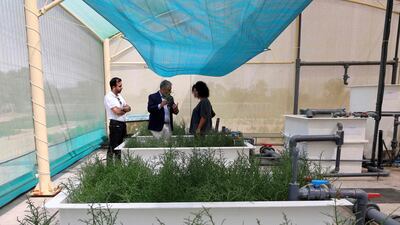
Salicornia plants at International Center for Biosaline Agriculture (ICBA) in Dubai. -
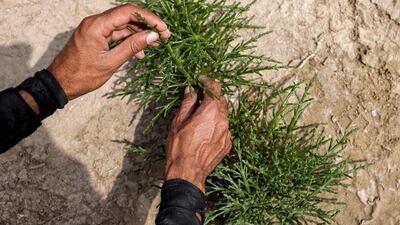
The plant is grown using saltwater, a method that is more sustainable than using fresh water -
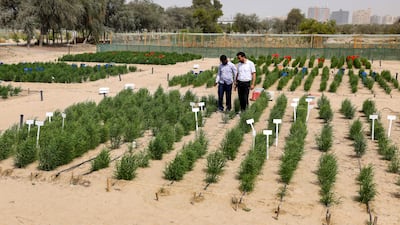
The UAE imports about half of its food, but a recent push to create more homegrown produce is already producing results. -

A worker prepares a salicornia plant-based mix to be made into burger patties at a food processing plant, in Sharjah. -

Salicornia plant-based burger patties are produced on a production line. Salicornia is added to chicken, quinoa and kale to create the patties. -

Burger patties are prepared for cooking. -
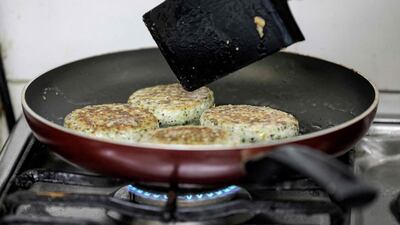
And voila, they are frying in a pan.


Salicornia cultivation began last year in a number of farms across the country as part of an experiment using brine run-off from desalination plants by the International Centre for Biosaline Agriculture in Dubai.
Augusto Becerra Lopez-Lavalle, chief scientist at ICBA, said research was now under way into generating more of the "high-value crop", which sells for $20 a kilogram in France.
"We went from ... building this prototype, to piloting at scale with eight farmers, and now the question is how to scale up," Mr Lopez-Lavalle told AFP.
In the future, salicornia could "become a really important food ingredient" he said.
"If there is an economic value and the production system is developed for this, it can become a replacement for salt and any other micronutrients that are added today artificially to processed food."
For now, salicornia remains a niche product, its health benefits unknown to most, Ms Siegismund admits.
"It's not a product that makes big, big profit, but we believe in it and we will continue," she said.
Dubai's salty farming experiment to grow asparagus: in pictures
-
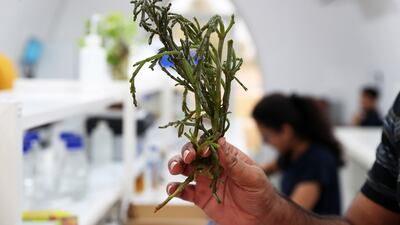
Scientists at the International Centre for Biosaline Agriculture in Dubai have been working behind the scenes to cultivate crops that leave a minimal carbon footprint. All photos: Pawan Singh / The National -
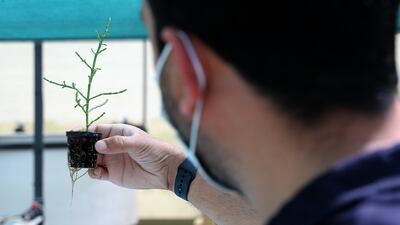
Salty greens grown from reject brine could offer an unlikely solution to some of the world’s food security problems. -
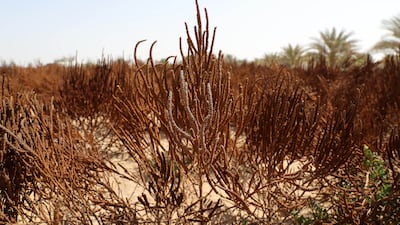
Halophytes can be irrigated with saline water and grown in poor soil. -
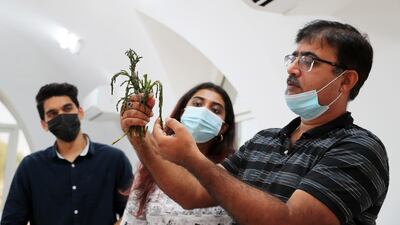
One of the scientists showing some of the salicornia to students at the International Centre for Biosaline Agriculture in Dubai. -

Using recycled water, or reject brine, the centre has been able to grow a variety of produce including salicornia and quinoa. -

Seventy per cent of the global production of reject brine is produced in the Middle East and North Africa. -

The aqua agriculture system that scientists used to help grow salicornia at the centre.



