• Plastic bags have been banned in France since July 2016. Reuters
    Plastic bags have been banned in France since July 2016. Reuters
  • Ukraine banned plastic bags in December 2021. Getty Images
    Ukraine banned plastic bags in December 2021. Getty Images
  • Bangladesh was one of the first countries to ban them, back in 2002. Getty Images
    Bangladesh was one of the first countries to ban them, back in 2002. Getty Images
  • Plastic bags have been banned in Austria since 2020. AFP
    Plastic bags have been banned in Austria since 2020. AFP
  • Thailand made the decision to ban plastic bags in 2021. AFP
    Thailand made the decision to ban plastic bags in 2021. AFP
  • The Maldives banned them in June 2021.
    The Maldives banned them in June 2021.
  • Kenya's government banned plastic bags in August 2017. AP
    Kenya's government banned plastic bags in August 2017. AP

Abu Dhabi to ban single-use plastic bags from June 1


Neil Halligan
  • English
  • Arabic

Abu Dhabi will ban the use of single-use plastic bags from June 1, the emirate's environmental agency said on Wednesday.

Environment Agency Abu Dhabi (EAD) said it plans to gradually reduce the amount of single-use plastic products used in the emirate and encourage the use of reusable products.

It said it will implement measures to reduce demand for about 16 single-use plastic products, including cups, stirrers, lids and cutlery.

The EAD said it will also phase out single-use styrofoam cups, plates and food containers by 2024.

We are encouraging Abu Dhabi citizens to use more multipurpose and re-usable materials to reduce their environmental footprint
Dr Sheikha Al Dhaheri,
Environment Agency Abu Dhabi

The initiative is based on plans announced in 2020 to phase out disposable plastics, which had been expected to come into effect earlier but was put on hold by Covid-19.

In the two years since, the agency has consulted partners from plastic producers to retailers to ensure its effective implementation.

In support of the phasing out of single-use plastic, EAD plans to carry out awareness campaigns across the emirate to educate the public on the new procedures.

Dr Sheikha Al Dhaheri, EAD’s secretary general, said the ban is being introduced because of single-use plastic's "harmful impacts on the environment and biodiversity".

“As part of our plan to completely curb the use of single-use plastics, we are encouraging Abu Dhabi citizens to use more multipurpose and re-usable materials to reduce their environmental footprint," she said.

The EAD has previously organised clean-up events and awareness campaigns about the damage done by single-use plastics and litter and their effect on beaches and marine habitats.

It is also targeting private sector companies, providing them with tools to effectively plan for the policy’s implementation.

Many restaurants are also launching initiatives to reduce the consumption of single-use plastics and some major retailers are encouraging shoppers to use reusable shopping bags.

EAD will also conduct a detailed study on the introduction of an incentive-based, single-use plastic water bottle return scheme in Abu Dhabi, in partnership with more than 30 private and public entities.

Dubai have also made moves in this area. The emirate in February announced plans to introduce a charge of 25 fils (about $0.06) for single-use plastic bags from July 1.

The emirate's Executive Council said the charge would be applied in retail, clothing, restaurants and pharmacies, as well as on delivery orders and e-commerce orders.

A tariff on such bags is applied in more than 30 countries, and a partial or complete ban has been imposed in more than 90.

Globally, almost 300 million tonnes of plastic pollution are produced each year, the equivalent weight of the human race, according to figures released by the UN Environment Programme.

Only 9 per cent of all plastic ever produced has been recycled, with the rest ending up in landfills, dumps or the natural environment.

The UN estimated if current trends continue, the ocean could contain more plastic than fish by the year 2050.

Alternatives to plastic bags – from canvas totes to keychain bags

  • Cotton reusable mesh bags can be used for fruit and vegetables. Getty Images
    Cotton reusable mesh bags can be used for fruit and vegetables. Getty Images
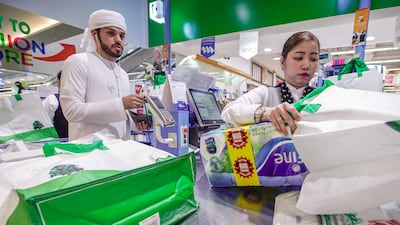
  • Reuseable plastic bags on sale at Lulu Hypermarket are thicker and more durable than single-use ones. Victor Besa / The National
    Reuseable plastic bags on sale at Lulu Hypermarket are thicker and more durable than single-use ones. Victor Besa / The National
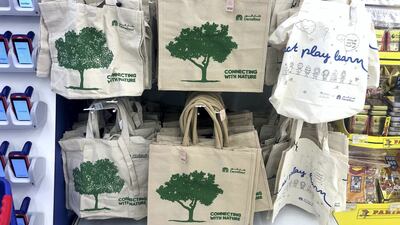
  • Reusable canvas and jute bags on display at Carrefour in Mall of the Emirates. Jute bags are one of the most durable options and are also naturally biodegradable. Canvas tote bags may not be as environmentally friendly because they require more resources to produce and distribute but can be used many times. Chris Whiteoak / The National
    Reusable canvas and jute bags on display at Carrefour in Mall of the Emirates. Jute bags are one of the most durable options and are also naturally biodegradable. Canvas tote bags may not be as environmentally friendly because they require more resources to produce and distribute but can be used many times. Chris Whiteoak / The National
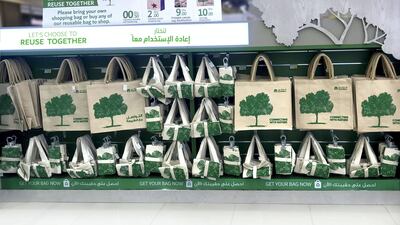
  • Carrefour is encouraging customers to bring their own recyclable bags by providing dedicated checkout counters and bonus Share points as incentives. Photo: Majid Al Futtaim
    Carrefour is encouraging customers to bring their own recyclable bags by providing dedicated checkout counters and bonus Share points as incentives. Photo: Majid Al Futtaim
  • Jute bags are both durable and biodegradable. Pawan Singh / The National
    Jute bags are both durable and biodegradable. Pawan Singh / The National
  • A customer using a trolley bag at Spinneys supermarket in Dubai Marina. Trolley bags are perfect for those walking home from the supermarket. Pawan Singh / The National
    A customer using a trolley bag at Spinneys supermarket in Dubai Marina. Trolley bags are perfect for those walking home from the supermarket. Pawan Singh / The National
How will Gen Alpha invest?

Mark Chahwan, co-founder and chief executive of robo-advisory firm Sarwa, forecasts that Generation Alpha (born between 2010 and 2024) will start investing in their teenage years and therefore benefit from compound interest.

“Technology and education should be the main drivers to make this happen, whether it’s investing in a few clicks or their schools/parents stepping up their personal finance education skills,” he adds.

Mr Chahwan says younger generations have a higher capacity to take on risk, but for some their appetite can be more cautious because they are investing for the first time. “Schools still do not teach personal finance and stock market investing, so a lot of the learning journey can feel daunting and intimidating,” he says.

He advises millennials to not always start with an aggressive portfolio even if they can afford to take risks. “We always advise to work your way up to your risk capacity, that way you experience volatility and get used to it. Given the higher risk capacity for the younger generations, stocks are a favourite,” says Mr Chahwan.

Highlighting the role technology has played in encouraging millennials and Gen Z to invest, he says: “They were often excluded, but with lower account minimums ... a customer with $1,000 [Dh3,672] in their account has their money working for them just as hard as the portfolio of a high get-worth individual.”

Who's who in Yemen conflict

Houthis: Iran-backed rebels who occupy Sanaa and run unrecognised government

Yemeni government: Exiled government in Aden led by eight-member Presidential Leadership Council

Southern Transitional Council: Faction in Yemeni government that seeks autonomy for the south

Habrish 'rebels': Tribal-backed forces feuding with STC over control of oil in government territory

The biog

Favourite book: Animal Farm by George Orwell

Favourite music: Classical

Hobbies: Reading and writing


Updated: May 31, 2022, 6:47 AM