• Oasis Greens is a hydroponic farm located in the Jebel Ali free Zone. Photo: Antonie Robertson / The National
    Oasis Greens is a hydroponic farm located in the Jebel Ali free Zone. Photo: Antonie Robertson / The National
  • Hydroponics is a method of growing plants without soil; instead, nutrients are provided via a water-based system.
    Hydroponics is a method of growing plants without soil; instead, nutrients are provided via a water-based system.
  • The produce is pesticide and herbicide-free.
    The produce is pesticide and herbicide-free.
  • An Agricultural engineer inspects some of the plants at Oasis Greens.
    An Agricultural engineer inspects some of the plants at Oasis Greens.
  • The UNS hydroponic farm in Al Quoz, Dubai, is one of the largest in the country.
    The UNS hydroponic farm in Al Quoz, Dubai, is one of the largest in the country.
  • Custom LED lighting mimics the rays of the sun to help the plants grow indoors.
    Custom LED lighting mimics the rays of the sun to help the plants grow indoors.
  • Seeds are planted directly into a foam-based substance, bypassing the need for soil, fertilisers and pesticides.
    Seeds are planted directly into a foam-based substance, bypassing the need for soil, fertilisers and pesticides.
  • UNS farms supply salad leaves to supermarkets in Dubai.
    UNS farms supply salad leaves to supermarkets in Dubai.
  • Operations at Fish Farm's centre in Jebel Ali.
    Operations at Fish Farm's centre in Jebel Ali.
  • Fish Farm has been supporting the local aquaculture industry since 2013.
    Fish Farm has been supporting the local aquaculture industry since 2013.
  • The farm in Jebel Ali currently produces about 3,000 tonnes of fish per year.
    The farm in Jebel Ali currently produces about 3,000 tonnes of fish per year.
  • Atlantis The Palm is incorporating locally grown produce from Green Oasis, UNS Farms and Fish Farm on the menus of nine of its restaurants. Photo: Atlantis The Palm
    Atlantis The Palm is incorporating locally grown produce from Green Oasis, UNS Farms and Fish Farm on the menus of nine of its restaurants. Photo: Atlantis The Palm
  • Locally produced Burrata, organic tomatoes, sundried tomato pesto and focaccia are now available at Bread Street Kitchen restaurant in the Atlantis. Photo: Atlantis The Palm
    Locally produced Burrata, organic tomatoes, sundried tomato pesto and focaccia are now available at Bread Street Kitchen restaurant in the Atlantis. Photo: Atlantis The Palm
  • Sweet potato and locally handpicked chestnut mushroom dim sum from Hakkasan restaurant's sustainable menu. Photo: Atlantis The Palm
    Sweet potato and locally handpicked chestnut mushroom dim sum from Hakkasan restaurant's sustainable menu. Photo: Atlantis The Palm
  • Organic salmon from Nobu's sustainable menu. Photo: Atlantis The Palm
    Organic salmon from Nobu's sustainable menu. Photo: Atlantis The Palm

UAE, Jordan and Netherlands unite to grow food in the desert


Ramola Talwar Badam
  • English
  • Arabic

The UAE, Jordan and the Netherlands have issued a joint call to work together on food, water and energy security by strengthening critical resources.

Government ministers, leading researchers and youth participated in person and online for the first trilateral meeting of the three nations during a session at Expo 2020 Dubai on Tuesday.

Mariam Al Mheiri, Minister of Climate Change and Environment and Minister of State for Food Security, spoke of the urgent need to develop solutions without placing an additional burden on the environment.

Scientists and researchers are involved in the partnership to find innovative techniques and share data on growing crops in arid climates in the Middle East.

There is nothing more essential than reducing water and energy for food
Prof Louise Fresco,
Wageningen University in the Netherlands

"Though interconnected, these resources [water, food, energy] are managed separately, not recognising that a change in one severely affects the other two,” Ms Al Mheiri said.

The three nations will explore agricultural processes that increase productivity sustainably, conserve resources and reduce greenhouse gas emissions.

The co-operation will focus on strengthening food security efforts in the Middle East, where people are heavily dependent on energy-intensive desalinated water.

The collaboration will include a Dutch consortium of Wageningen University & Research, Deltares and the Netherlands Organisation for Applied Scientific Research, researchers from the National Agriculture Research Centre in Jordan and the International Centre for Biosaline Agriculture in the UAE.

Groups will work together to learn from the experience of the Netherlands, a small country that overcame a shortage of space to become one of the largest exporters of agricultural products.

Ms Al Mheiri told the audience that although most of the UAE’s food is imported, the country now has salmon farms and grows kale, quinoa, blueberries and raspberries.

The UAE, Jordan, Netherlands Trilateral Summit at Expo 2020. From left to right: Mohammad Al Najjar, Jordan's Minister of Water and Irrigation, Mariam Al Mheiri, UAE's Minister of Climate Change and Environment and Minister of State for Food Security and Liesje Schreinemacher, the Netherlands' Minister for Foreign Trade. Photo: Nexus Pavilion at Expo 2020 Dubai

“We can’t do this alone, we have come together, put our minds together to find solutions,” she said.

“We need to transform to more sustainable food systems so we are on this mission. We want to show our audience and other partners that it is important to share knowledge.

“Working together in this joint shared vision will be a cornerstone of our success."

Speakers addressed the need to redouble efforts to reach the UN’s sustainable development goals as the world moves towards a 10 billion population by 2050.

Making radical changes in global water, food and energy systems is viewed by experts as the path to limit global warming to 1.5°C.

Liesje Schreinemacher, the Netherlands' Minister for Foreign Trade, spoke of the need to develop more drought-tolerant crops and new seed varieties that require less water.

“International co-operation is key,” she said. “We need strong partnerships between governments, the private sector and civil society.”

She said the three countries were already working on a database that keeps track of water needed for drinking and to grow vegetables in extreme weather conditions.

Saleh Al Kharabsheh, Minister of Energy and Mineral Resources of Jordan, said collaboration and collective action would increase understanding of the interdependent relationships between water, energy, and food security.

“In the coming decades, the world will need increasing amounts of resources. Population growth, resource-intensive lifestyles, and the damaging effects of climate change will lead to water, energy, and food insecurity across the globe,” he said.

Prof Louise Fresco, president of Wageningen University in the Netherlands, said an interdisciplinary approach would not be easy due to the number of players involved in the public and private sectors in the water, food and energy sectors.

“This is the starting point,” she said. “The goals set out for us are very clear. We need more innovation, we need tools and methodology to share our results. We need data to judge which techniques are best and we need capacity for building and training.

“We need not just food but better food. We need food that is healthy, sustainable and affordable to all and that is not an easy feat. But we must do this because there is nothing more essential than reducing water and energy for food.”

Youth voices were heard too with an acknowledgement that young people should be involved in decision-making.

Jayathma Wickramanayake, the United Nation’s secretary general’s youth envoy, urged governments to empower and train young people.

“There is an enormous potential for food systems and the energy transition to provide decent work for young people and help eliminate generational inequalities in access to resources,” she said.

“What the youth need is support from governments, academic institutions and adults to integrate their inputs."

Scientists grow rice in remote Sharjah desert - in pictures

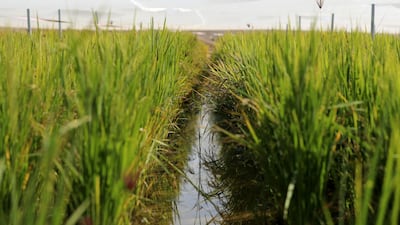
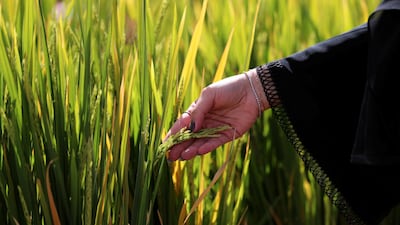
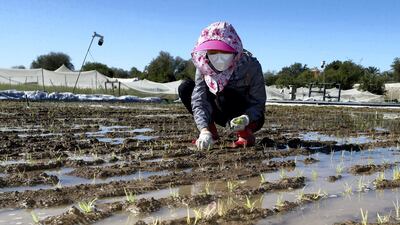
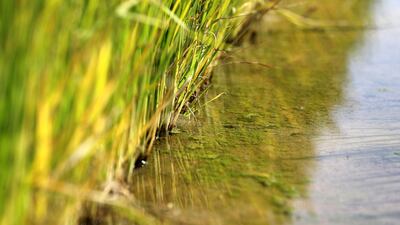
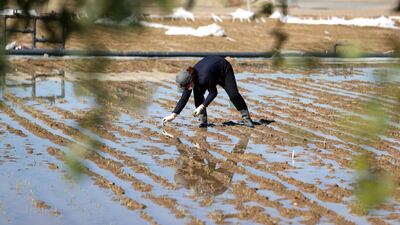
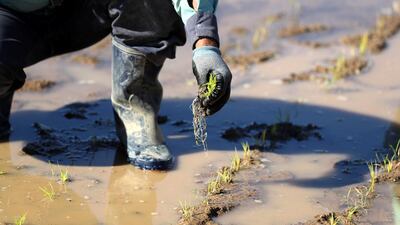
  • Emirati and Korean scientists have successfully grown rice crops in a remote Sharjah desert. All photos: Chris Whiteoak / The National
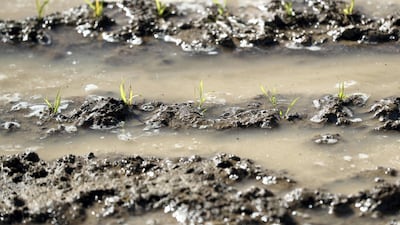
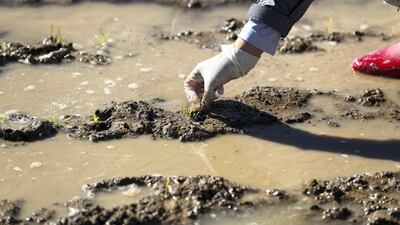
    Emirati and Korean scientists have successfully grown rice crops in a remote Sharjah desert. All photos: Chris Whiteoak / The National
  • In 2020, 763 kilograms of crops were harvested.
    In 2020, 763 kilograms of crops were harvested.
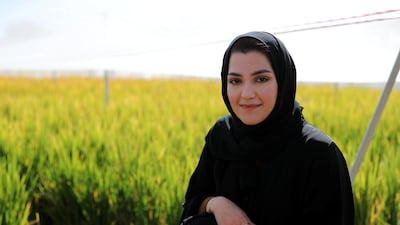
  • Amal Al Ahmadi, head of agricultural research section at Ministry of Climate Change and Environment, said the efforts are part of a research project to enhance the UAE's food security.
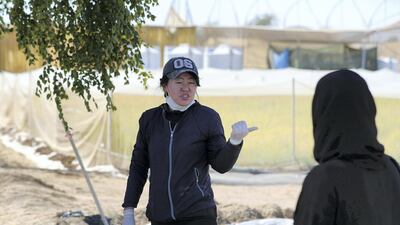
    Amal Al Ahmadi, head of agricultural research section at Ministry of Climate Change and Environment, said the efforts are part of a research project to enhance the UAE's food security.
  • The UAE is one of the largest importers of rice. Due to the country's hot climate, rice is difficult to cultivate and is better suited for nations with high rainfall.
    The UAE is one of the largest importers of rice. Due to the country's hot climate, rice is difficult to cultivate and is better suited for nations with high rainfall.
  • The ministry has partnered with South Korea's Rural Development Administration to create innovative ways to grow rice.
    The ministry has partnered with South Korea's Rural Development Administration to create innovative ways to grow rice.
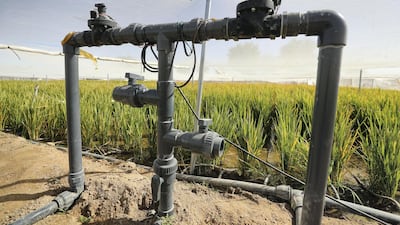
  • An underground drop irrigation system is used to water the crops. There are four methods used, including drip and furrows (canals with drips), normal drip system, flooding with a protective layer and flooding in furrows.
    An underground drop irrigation system is used to water the crops. There are four methods used, including drip and furrows (canals with drips), normal drip system, flooding with a protective layer and flooding in furrows.
  • Korean scientists are at the farm nearly every day to monitor the crops.
    Korean scientists are at the farm nearly every day to monitor the crops.
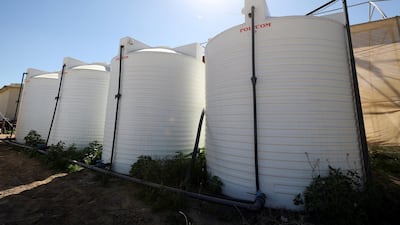
  • The goal is to grow the crops in a sustainable way by using 50 per cent less water than what would be required. Pictured are water tanks that are used for farming.
    The goal is to grow the crops in a sustainable way by using 50 per cent less water than what would be required. Pictured are water tanks that are used for farming.
  • Technology is also used to help monitor the crops' health, including cameras, sensors and weather systems.
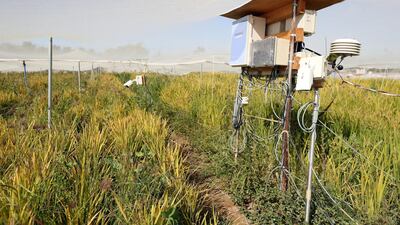
    Technology is also used to help monitor the crops' health, including cameras, sensors and weather systems.
  • The main challenge have been seed-eating birds that damage the crops.
    The main challenge have been seed-eating birds that damage the crops.
  • The Asemi variety of rice has been the most successful out of the two main ones that were tested, but there are 33 other types that are also being researched in smaller patches.
    The Asemi variety of rice has been the most successful out of the two main ones that were tested, but there are 33 other types that are also being researched in smaller patches.
  • The project is also meant to help farmers grow rice sustainably in the future.
    The project is also meant to help farmers grow rice sustainably in the future.
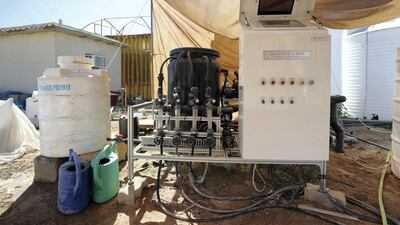
  • A machine designed to distribute nutrients to the plants at the rice farm.
    A machine designed to distribute nutrients to the plants at the rice farm.
  • The rice is only for research purposes and will not be available for commercial use.
    The rice is only for research purposes and will not be available for commercial use.
Libya's Gold

UN Panel of Experts found regime secretly sold a fifth of the country's gold reserves. 

The panel’s 2017 report followed a trail to West Africa where large sums of cash and gold were hidden by Abdullah Al Senussi, Qaddafi’s former intelligence chief, in 2011.

Cases filled with cash that was said to amount to $560m in 100 dollar notes, that was kept by a group of Libyans in Ouagadougou, Burkina Faso.

A second stash was said to have been held in Accra, Ghana, inside boxes at the local offices of an international human rights organisation based in France.

UAE v Gibraltar

What: International friendly

When: 7pm kick off

Where: Rugby Park, Dubai Sports City

Admission: Free

Online: The match will be broadcast live on Dubai Exiles’ Facebook page

UAE squad: Lucas Waddington (Dubai Exiles), Gio Fourie (Exiles), Craig Nutt (Abu Dhabi Harlequins), Phil Brady (Harlequins), Daniel Perry (Dubai Hurricanes), Esekaia Dranibota (Harlequins), Matt Mills (Exiles), Jaen Botes (Exiles), Kristian Stinson (Exiles), Murray Reason (Abu Dhabi Saracens), Dave Knight (Hurricanes), Ross Samson (Jebel Ali Dragons), DuRandt Gerber (Exiles), Saki Naisau (Dragons), Andrew Powell (Hurricanes), Emosi Vacanau (Harlequins), Niko Volavola (Dragons), Matt Richards (Dragons), Luke Stevenson (Harlequins), Josh Ives (Dubai Sports City Eagles), Sean Stevens (Saracens), Thinus Steyn (Exiles)

RACE CARD

6.30pm: Al Maktoum Challenge Round-3 – Group 1 (PA) $65,000 (Dirt) 2,000m

7.05pm: Handicap (TB) $65,000 (Turf) 1,800m

7.40pm: Meydan Classic – Listed (TB) $88,000 (T) 1,600m

8.15pm: Nad Al Sheba Trophy – Group 3 (TB) $195,000 (T) 2,810m

8.50pm: Dubai Millennium Stakes – Group 3 (TB) $130,000 (T) 2,000m

9.25pm: Meydan Challenge – Listed Handicap (TB) $88,000 (T) 1,400m

Global state-owned investor ranking by size

1.

United States

2.

China

3.

UAE

4.

Japan

5

Norway

6.

Canada

7.

Singapore

8.

Australia

9.

Saudi Arabia

10.

South Korea

Squad: Majed Naser, Abdulaziz Sanqour, Walid Abbas, Khamis Esmail, Habib Fardan, Mohammed Marzouq (Shabab Al Ahli Dubai), Khalid Essa, Muhanad Salem, Mohammed Ahmed, Ismail Ahmed, Ahmed Barman,  Amer Abdulrahman, Omar Abdulrahman (Al Ain), Ali Khaseif, Fares Juma, Mohammed Fawzi, Khalfan Mubarak, Mohammed Jamal, Ahmed Al Attas (Al Jazira), Ahmed Rashid, Mohammed Al Akbari (Al Wahda), Tariq Ahmed, Mahmoud Khamis, Khalifa Mubarak, Jassim Yaqoub (Al Nasr), Ali Salmeen (Al Wasl), Yousef Saeed (Sharjah), Suhail Al Nubi (Baniyas)

Living in...

This article is part of a guide on where to live in the UAE. Our reporters will profile some of the country’s most desirable districts, provide an estimate of rental prices and introduce you to some of the residents who call each area home.

The specs
Engine: 2.0-litre 4-cyl turbo

Power: 201hp at 5,200rpm

Torque: 320Nm at 1,750-4,000rpm

Transmission: 6-speed auto

Fuel consumption: 8.7L/100km

Price: Dh133,900

On sale: now 

The burning issue

The internal combustion engine is facing a watershed moment – major manufacturer Volvo is to stop producing petroleum-powered vehicles by 2021 and countries in Europe, including the UK, have vowed to ban their sale before 2040. The National takes a look at the story of one of the most successful technologies of the last 100 years and how it has impacted life in the UAE.

Part three: an affection for classic cars lives on

Read part two: how climate change drove the race for an alternative 

Read part one: how cars came to the UAE

UAE currency: the story behind the money in your pockets
Dubai Women's Tour teams

Agolico BMC
Andy Schleck Cycles-Immo Losch
Aromitalia Basso Bikes Vaiano
Cogeas Mettler Look
Doltcini-Van Eyck Sport
Hitec Products – Birk Sport 
Kazakhstan National Team
Kuwait Cycling Team
Macogep Tornatech Girondins de Bordeaux
Minsk Cycling Club 
Pannonia Regional Team (Fehérvár)
Team Auvergne-Rhône-Alpes
Team Ciclotel
UAE Women’s Team
Under 23 Kazakhstan Team
Wheel Divas Cycling Team

ACL Elite (West) - fixtures

Monday, Sept 30

Al Sadd v Esteghlal (8pm)
Persepolis v Pakhtakor (8pm)
Al Wasl v Al Ahli (8pm)
Al Nassr v Al Rayyan (10pm)

Tuesday, Oct 1
Al Hilal v Al Shorta (10pm)
Al Gharafa v Al Ain (10pm)

Remaining Fixtures

Wednesday: West Indies v Scotland
Thursday: UAE v Zimbabwe
Friday: Afghanistan v Ireland
Sunday: Final

Mercer, the investment consulting arm of US services company Marsh & McLennan, expects its wealth division to at least double its assets under management (AUM) in the Middle East as wealth in the region continues to grow despite economic headwinds, a company official said.

Mercer Wealth, which globally has $160 billion in AUM, plans to boost its AUM in the region to $2-$3bn in the next 2-3 years from the present $1bn, said Yasir AbuShaban, a Dubai-based principal with Mercer Wealth.

Within the next two to three years, we are looking at reaching $2 to $3 billion as a conservative estimate and we do see an opportunity to do so,” said Mr AbuShaban.

Mercer does not directly make investments, but allocates clients’ money they have discretion to, to professional asset managers. They also provide advice to clients.

“We have buying power. We can negotiate on their (client’s) behalf with asset managers to provide them lower fees than they otherwise would have to get on their own,” he added.

Mercer Wealth’s clients include sovereign wealth funds, family offices, and insurance companies among others.

From its office in Dubai, Mercer also looks after Africa, India and Turkey, where they also see opportunity for growth.

Wealth creation in Middle East and Africa (MEA) grew 8.5 per cent to $8.1 trillion last year from $7.5tn in 2015, higher than last year’s global average of 6 per cent and the second-highest growth in a region after Asia-Pacific which grew 9.9 per cent, according to consultancy Boston Consulting Group (BCG). In the region, where wealth grew just 1.9 per cent in 2015 compared with 2014, a pickup in oil prices has helped in wealth generation.

BCG is forecasting MEA wealth will rise to $12tn by 2021, growing at an annual average of 8 per cent.

Drivers of wealth generation in the region will be split evenly between new wealth creation and growth of performance of existing assets, according to BCG.

Another general trend in the region is clients’ looking for a comprehensive approach to investing, according to Mr AbuShaban.

“Institutional investors or some of the families are seeing a slowdown in the available capital they have to invest and in that sense they are looking at optimizing the way they manage their portfolios and making sure they are not investing haphazardly and different parts of their investment are working together,” said Mr AbuShaban.

Some clients also have a higher appetite for risk, given the low interest-rate environment that does not provide enough yield for some institutional investors. These clients are keen to invest in illiquid assets, such as private equity and infrastructure.

“What we have seen is a desire for higher returns in what has been a low-return environment specifically in various fixed income or bonds,” he said.

“In this environment, we have seen a de facto increase in the risk that clients are taking in things like illiquid investments, private equity investments, infrastructure and private debt, those kind of investments were higher illiquidity results in incrementally higher returns.”

The Abu Dhabi Investment Authority, one of the largest sovereign wealth funds, said in its 2016 report that has gradually increased its exposure in direct private equity and private credit transactions, mainly in Asian markets and especially in China and India. The authority’s private equity department focused on structured equities owing to “their defensive characteristics.”

Stamp duty timeline

December 2014: Former UK finance minister George Osbourne reforms stamp duty, replacing the slab system with a blended rate scheme, with the top rate increasing to 12 per cent from 10 per cent:
Up to £125,000 - 0%; £125,000 to £250,000 – 2%; £250,000 to £925,000 – 5%; £925,000 to £1.5m: 10%; Over £1.5m – 12%

April 2016: New 3% surcharge applied to any buy-to-let properties or additional homes purchased.

July 2020: Rishi Sunak unveils SDLT holiday, with no tax to pay on the first £500,000, with buyers saving up to £15,000.

March 2021: Mr Sunak decides the fate of SDLT holiday at his March 3 budget, with expectations he will extend the perk unti June.

April 2021: 2% SDLT surcharge added to property transactions made by overseas buyers.

UAE currency: the story behind the money in your pockets
COMPANY PROFILE
Name: ARDH Collective
Based: Dubai
Founders: Alhaan Ahmed, Alyina Ahmed and Maximo Tettamanzi
Sector: Sustainability
Total funding: Self funded
Number of employees: 4
Updated: January 19, 2022, 8:07 AM