



Salty greens grown from reject brine may not sound appetising, but it could offer an unlikely resolution to some of the world’s food security issues.
For the past few years, agronomists at the International Centre for Biosaline Agriculture in Dubai have been working to cultivate crops that leave a minimal carbon footprint.
Using recycled water, or reject brine, from its on-site desalination plant, the centre has been able to grow a variety of produce including salicornia, also known as sea asparagus, and quinoa.
In six months, it was able to grow more than 12 tonnes of produce from brine that would have otherwise been dumped.
halophyte agronomist
“Reject brine is the by-product of removing salts from groundwater,” said Dr Dionysia Angeliki Lyra, an agronomist at the centre.
“Seventy per cent of the global production of reject brine is produced in the Middle East and North Africa. That translates to millions of cubic metres per day.
“The brine is usually dumped into the sea and it can disrupt the balance of microorganisms in the marine ecosystem.
“It is considered environmental waste but researchers and scientists like myself are working on ways to manage it and utilise it as a water source for agriculture.”
Are halophytes the crop of the future?
In a hot and arid desert such as the UAE, farmers are often limited with the amount of crop they can produce using traditional farming methods.
Since there is little rainfall, the groundwater is often saline, and the levels of salinity increase over time because of seawater intruding into mainland areas.
Food producers are forced to bring in additional freshwater to grow crops such as potatoes, rice and tomatoes, but that puts a strain on the already dwindling global freshwater resources because of climate change.
That is where halophytes come in. These salt-loving plants show promise for unconventional agriculture in marginal environments.
Dr Lyra said they could be irrigated with "saline water resources and grown on poor soils", which could “complement and contribute substantially towards today’s food security issues".

Examples of halophytes include quinoa, samphire, sea spinach and salicornia, and they can be eaten or used as raw materials for cosmetics, biofuels and sea-plant animal fodder.
“Even though we are in a desert, we still have to produce food, so we have to think of other land and water practices to produce crops,” said Dr Lyra.
“In a climate where there is limited fresh water and high concern to produce local food, reject brine can constitute one of the available resources for agriculture.
“In a pilot project from December 2019 to June last year, our centre utilised 38,000 cubic metres of reject brine to grow salicornia, and small amounts of quinoa, across eight of our farms.
“From that we harvested half a tonne of salicornia fresh tips and 12 tonnes of dry salicornia biomass, which is the part of the crop that grows above ground.”
During the desalination process, she said if you had 100 litres of water going in, about 40 per cent would come out as fresh water and the remaining 60 per cent as reject, high-salinity brine.
But simply dumping it is no longer an option.
Because of the climate change impact and decrease of freshwater reserves around the world, Dr Lyra said there was an “increasing trend towards saline farming” but education on its benefits was vital.
“Water and soil are becoming saltier because of worsening drought, so we need to find solutions for using high salinity water to grow food,” she said.
“The challenge right now though is that there is no market segment established for it.
“For instance, if you say samphire to a British or French person, they may know what it is, but overall halophytes are not that well known.
“Since we have this rising urgency about local food, apart from looking at this new farming approach, we have to also look at value chains and raise awareness about halophytes and their benefits."
UAE takes firm stance to reduce food insecurity
It is no secret that our food systems are facing substantial challenges because of several factors.
The world’s population is growing, projected to rise by two billion in the next 30 years to reach nearly 10 billion. In the UAE, less than five per cent of land is fertile and water is scarce.
The Covid-19 pandemic has forced policymakers around the world to rethink their food resilience, underlining the importance of investment in local food production and a robust integrated value chain to meet growing food demand.
The UAE is taking critical actions needed to address these issues and increasing local production and its regional interconnectivity are critical for the next phase of the nation’s food ecosystem.
This latest project was funded by Expo Live and ICBA also partnered with the Environmental Agency in Abu Dhabi and the Khalifa Fund for Enterprise Development and Abu Dhabi Agriculture and Food Safety Authority to run the project.
Scientists grow rice crops in a remote Sharjah desert - in pictures
-
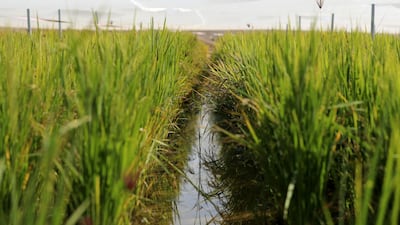
Emirati and Korean scientists have successfully grown rice crops in a remote Sharjah desert. All photos: Chris Whiteoak / The National -
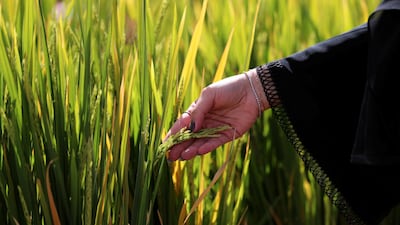
In 2020, 763 kilograms of crops were harvested. -
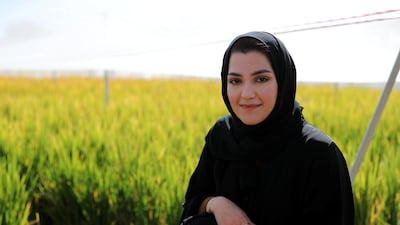
Amal Al Ahmadi, head of agricultural research section at Ministry of Climate Change and Environment, said the efforts are part of a research project to enhance the UAE's food security. -
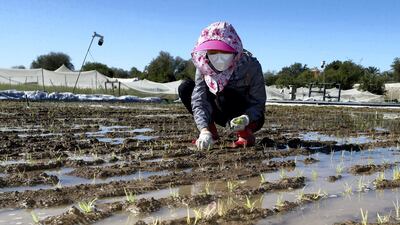
The UAE is one of the largest importers of rice. Due to the country's hot climate, rice is difficult to cultivate and is better suited for nations with high rainfall. -
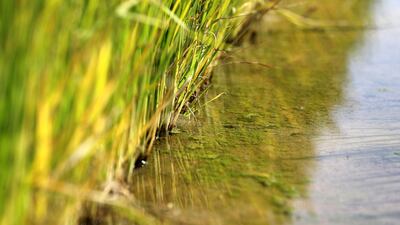
The ministry has partnered with South Korea's Rural Development Administration to create innovative ways to grow rice. -
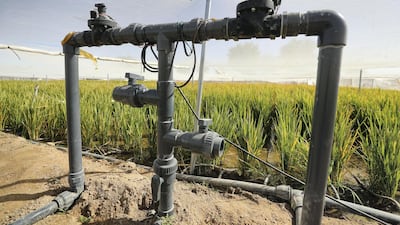
An underground drop irrigation system is used to water the crops. There are four methods used, including drip and furrows (canals with drips), normal drip system, flooding with a protective layer and flooding in furrows. -
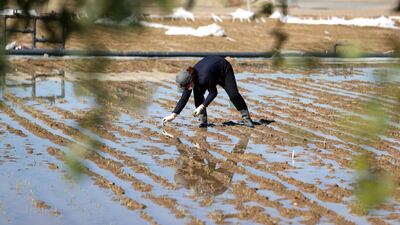
Korean scientists are at the farm nearly every day to monitor the crops. -
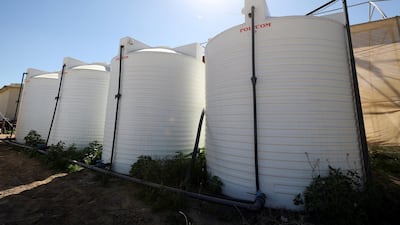
The goal is to grow the crops in a sustainable way by using 50 per cent less water than what would be required. Pictured are water tanks that are used for farming. -
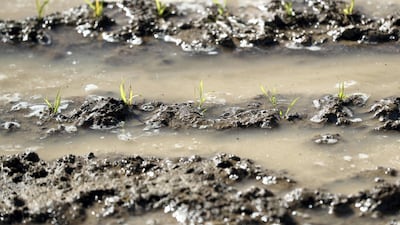
Technology is also used to help monitor the crops' health, including cameras, sensors and weather systems. -
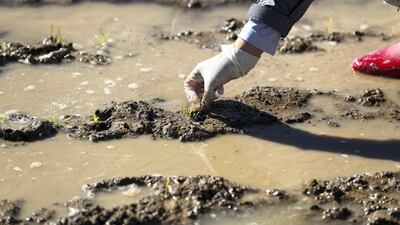
The main challenge have been seed-eating birds that damage the crops. -
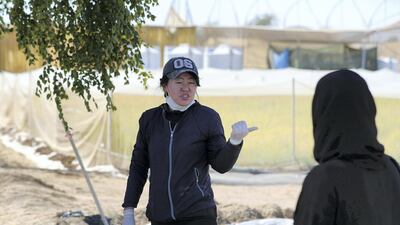
The Asemi variety of rice has been the most successful out of the two main ones that were tested, but there are 33 other types that are also being researched in smaller patches. -
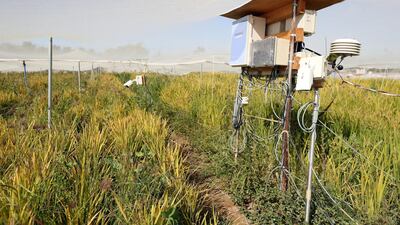
The project is also meant to help farmers grow rice sustainably in the future. -
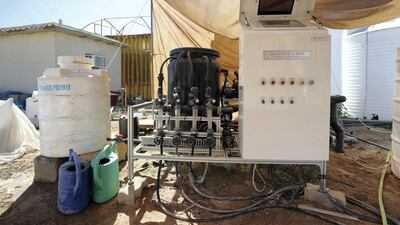
A machine designed to distribute nutrients to the plants at the rice farm. -
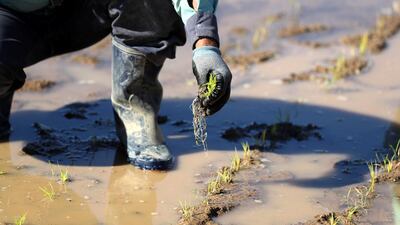
The rice is only for research purposes and will not be available for commercial use.



