Former Irish President Mary McAleese told an education forum in Dubai about the importance of putting differences aside. Photo: Education Affairs Office of the Crown Prince Court

Don't fear those who are different, former Irish president says at Expo 2020 Dubai


Patrick Ryan
  • English
  • Arabic

Mary McAleese, the former president of Ireland, told a Dubai forum that school pupils must be taught not to fear people from different backgrounds if their education is to be fully realised.

She was speaking at the Qudwa-Pisa education forum at Expo 2020 Dubai on Saturday.

“Seeing the diversity that the world has offers us an opportunity to have phenomenal creative energies that can be used for problem solving,” said Ms McAleese, chancellor of Trinity College Dublin.

The threat of violence must be seen as failure, not as a convenient tool of social, cultural and political control
Mary McAleese

“The more time we waste on hatred, intolerance and bullying, the less likely we are to create the world our children deserve.”

She drew on her experience growing up in the north of Ireland as an example of how focusing on differences can hold people back.

“I grew up in Belfast, Northern Ireland, part of the island of Ireland that remains in the United Kingdom,” Ms McAleese said.

“The political and religious differences between the Protestant majority and Catholic minority made strangers and enemies of people who lived close by one another but behind walls designed to keep them apart.

“Those walls are still there today and are unhappy evidence of how generation after generation of political leaders failed to invest in equality, justice and parity of esteem.”

She said for talent to be nurtured, cultural diversity must be embraced not repressed.

“The threat of violence must be seen as failure, not as a convenient tool of social, cultural and political control,” she said.

Appreciation of other cultures is a vital step in creating a better tomorrow, Ms McAleese said.

“We want our children to understand there are others in the classroom sitting beside them of different genders and ethnicities who they can engage with,” she said.

“We need to encourage the good in people to avoid stereotyping, bullying and hurting one another.”

The forum was organised by the Education Affairs Office of the Crown Prince Court of Abu Dhabi in association with the Organisation for Economic Co-operation and Development (OECD).

The UAE is uniquely placed to offer perspective on diversity in education given the country’s multicultural make-up, an expert said.

“The UAE is at the centre of three continents and we have a great number of nationalities in our schools,” said Mohamed Al Nuaimi, head of the education and skills department for the Crown Prince Court of Abu Dhabi.

“The diversity we have in schools allows us to be unique and extract different perspectives to share with others.”

Also speaking at the event was Andreas Schleicher, director of special skills at the OECD, who said that education providers had looked inward for far too long.

Andreas Schleicher, director of special skills at the Organisation for Economic Co-operation and Development, said education providers needed to stop looking inwards. Photo: Education Affairs Office of the Crown Prince Court

“Education has often been treated as local and domestic when we actually live in a highly connected world,” he said.

“We need to educate children to be more open to different ways of thinking and be more appreciative of other cultures.”

It is no secret that the coronavirus pandemic has changed education across the world, but some children risk being left behind with remote learning, Mr Schleicher said.

“The [coronavirus] pandemic amplified a lot of the inequalities in our systems,” he said.

“If you had access to great digital resources with amazing supportive teachers and parents you probably found the experience to be liberating.

‘But if you did not have access to that great technology you would be badly left behind.”

The pandemic has also raised the possibility that large numbers of children, most of them girls, would never return to school, another contributor said.

“There are about one billion children at risk of never returning to school,” said Anna Diamantopoulou, chairwoman of the EU High Level Group on the Future of Social Protection and the Welfare State.

“In Africa alone, there is a risk millions of girls will never go back to school.”

She also spoke of the challenges posed by getting girls interested in digital industries, which traditionally attracted mostly males.

“Schools and universities need to have particular policies to attract girls into this area," she said.

“If they don’t, we’re going to have big problems in a few years as digital companies continue to grow.”

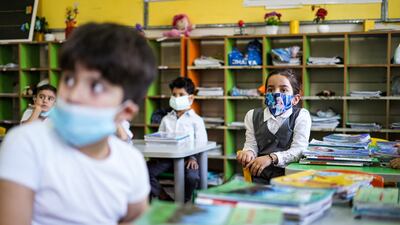
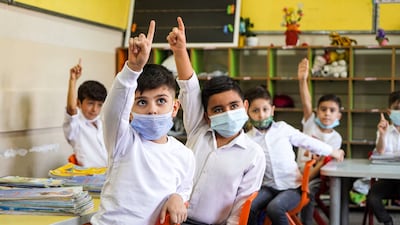
  • Pupils sit in a classroom on the first day back at school in Dohuk, Iraqi Kurdistan region. Four in 10 children in the Middle East and North Africa did not have any access to remote learning at the height of the pandemic. All photos: AFP
    Pupils sit in a classroom on the first day back at school in Dohuk, Iraqi Kurdistan region. Four in 10 children in the Middle East and North Africa did not have any access to remote learning at the height of the pandemic. All photos: AFP
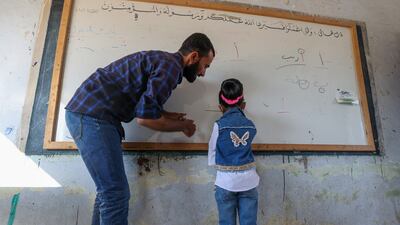
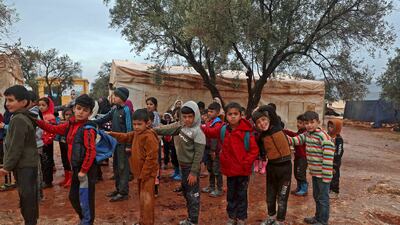
  • A teacher helps a child on the first day of school in Syria's northwestern Idlib province. Unicef has said millions of Arab children continue to live in 'digital poverty'.
    A teacher helps a child on the first day of school in Syria's northwestern Idlib province. Unicef has said millions of Arab children continue to live in 'digital poverty'.
  • About 37 million were unable to learn remotely during lockdowns in 2020, mainly because of a lack of devices and internet connection, said a report by the World Bank and UN agencies Unicef and Unesco.
    About 37 million were unable to learn remotely during lockdowns in 2020, mainly because of a lack of devices and internet connection, said a report by the World Bank and UN agencies Unicef and Unesco.
  • The Mena region had one of the world’s highest proportions of children who could not take part in remote learning.
    The Mena region had one of the world’s highest proportions of children who could not take part in remote learning.
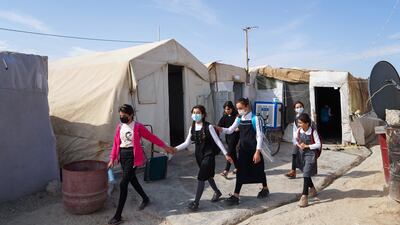
  • Girls walk to class on the first day of school in a camp for displaced Yazidi people in the Sharya area, about 15 kilometres from Dohuk, in the autonomous Iraqi Kurdistan region.
    Girls walk to class on the first day of school in a camp for displaced Yazidi people in the Sharya area, about 15 kilometres from Dohuk, in the autonomous Iraqi Kurdistan region.
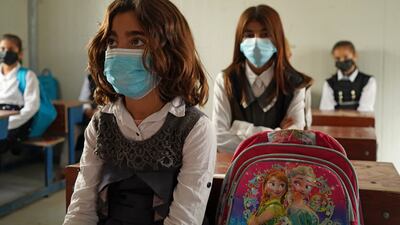
  • Girls sit in class on the first day of school in the camp for displaced people in Sharya.
    Girls sit in class on the first day of school in the camp for displaced people in Sharya.
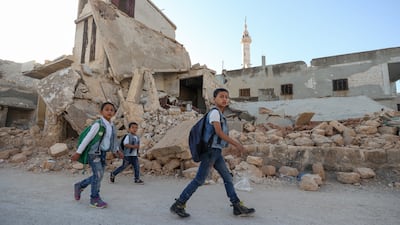
  • Children walk among the rubble as they attend the first day of school in a village in the countryside of Syria's northwestern Idlib province.
    Children walk among the rubble as they attend the first day of school in a village in the countryside of Syria's northwestern Idlib province.
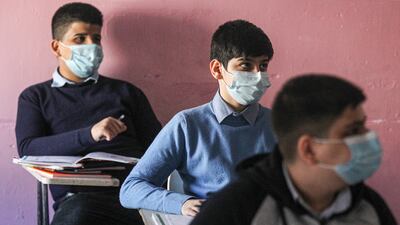
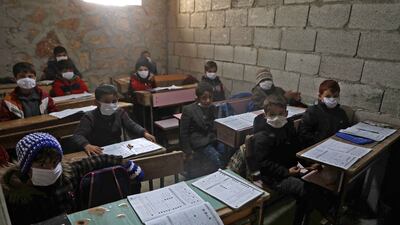
  • Syrian schoolchildren wearing masks sit in a makeshift school set up by locals in the village of Ma'arin, in the rebel-controlled northern countryside of Syria's Aleppo province.
    Syrian schoolchildren wearing masks sit in a makeshift school set up by locals in the village of Ma'arin, in the rebel-controlled northern countryside of Syria's Aleppo province.
  • Children attend class in makeshift classrooms at a camp for the displaced by the village of Killi, near the border with Turkey, in Syria's northwestern Idlib province.
    Children attend class in makeshift classrooms at a camp for the displaced by the village of Killi, near the border with Turkey, in Syria's northwestern Idlib province.
Who's who in Yemen conflict

Houthis: Iran-backed rebels who occupy Sanaa and run unrecognised government

Yemeni government: Exiled government in Aden led by eight-member Presidential Leadership Council

Southern Transitional Council: Faction in Yemeni government that seeks autonomy for the south

Habrish 'rebels': Tribal-backed forces feuding with STC over control of oil in government territory

The years Ramadan fell in May

1987

1954

1921

1888

Classification of skills

A worker is categorised as skilled by the MOHRE based on nine levels given in the International Standard Classification of Occupations (ISCO) issued by the International Labour Organisation. 

A skilled worker would be someone at a professional level (levels 1 – 5) which includes managers, professionals, technicians and associate professionals, clerical support workers, and service and sales workers.

The worker must also have an attested educational certificate higher than secondary or an equivalent certification, and earn a monthly salary of at least Dh4,000. 

Our legal consultant

Name: Dr Hassan Mohsen Elhais

Position: legal consultant with Al Rowaad Advocates and Legal Consultants.

The President's Cake

Director: Hasan Hadi

Starring: Baneen Ahmad Nayyef, Waheed Thabet Khreibat, Sajad Mohamad Qasem 

Rating: 4/5

10 tips for entry-level job seekers
  • Have an up-to-date, professional LinkedIn profile. If you don’t have a LinkedIn account, set one up today. Avoid poor-quality profile pictures with distracting backgrounds. Include a professional summary and begin to grow your network.
  • Keep track of the job trends in your sector through the news. Apply for job alerts at your dream organisations and the types of jobs you want – LinkedIn uses AI to share similar relevant jobs based on your selections.
  • Double check that you’ve highlighted relevant skills on your resume and LinkedIn profile.
  • For most entry-level jobs, your resume will first be filtered by an applicant tracking system for keywords. Look closely at the description of the job you are applying for and mirror the language as much as possible (while being honest and accurate about your skills and experience).
  • Keep your CV professional and in a simple format – make sure you tailor your cover letter and application to the company and role.
  • Go online and look for details on job specifications for your target position. Make a list of skills required and set yourself some learning goals to tick off all the necessary skills one by one.
  • Don’t be afraid to reach outside your immediate friends and family to other acquaintances and let them know you are looking for new opportunities.
  • Make sure you’ve set your LinkedIn profile to signal that you are “open to opportunities”. Also be sure to use LinkedIn to search for people who are still actively hiring by searching for those that have the headline “I’m hiring” or “We’re hiring” in their profile.
  • Prepare for online interviews using mock interview tools. Even before landing interviews, it can be useful to start practising.
  • Be professional and patient. Always be professional with whoever you are interacting with throughout your search process, this will be remembered. You need to be patient, dedicated and not give up on your search. Candidates need to make sure they are following up appropriately for roles they have applied.

Arda Atalay, head of Mena private sector at LinkedIn Talent Solutions, Rudy Bier, managing partner of Kinetic Business Solutions and Ben Kinerman Daltrey, co-founder of KinFitz

Types of bank fraud

1) Phishing

Fraudsters send an unsolicited email that appears to be from a financial institution or online retailer. The hoax email requests that you provide sensitive information, often by clicking on to a link leading to a fake website.

2) Smishing

The SMS equivalent of phishing. Fraudsters falsify the telephone number through “text spoofing,” so that it appears to be a genuine text from the bank.

3) Vishing

The telephone equivalent of phishing and smishing. Fraudsters may pose as bank staff, police or government officials. They may persuade the consumer to transfer money or divulge personal information.

4) SIM swap

Fraudsters duplicate the SIM of your mobile number without your knowledge or authorisation, allowing them to conduct financial transactions with your bank.

5) Identity theft

Someone illegally obtains your confidential information, through various ways, such as theft of your wallet, bank and utility bill statements, computer intrusion and social networks.

6) Prize scams

Fraudsters claiming to be authorised representatives from well-known organisations (such as Etisalat, du, Dubai Shopping Festival, Expo2020, Lulu Hypermarket etc) contact victims to tell them they have won a cash prize and request them to share confidential banking details to transfer the prize money.

Turkish Ladies

Various artists, Sony Music Turkey 

INDIA SQUAD

Virat Kohli (capt), Rohit Sharma, Shikhar Dhawan, KL Rahul, Vijay Shankar, MS Dhoni (wk), Kedar Jadhav, Dinesh Karthik, Yuzvendra Chahal, Kuldeep Yadav, Bhuvneshwar Kumar, Jasprit Bumrah, Hardik Pandya, Ravindra Jadeja, Mohammed Shami

Other acts on the Jazz Garden bill

Sharrie Williams
The American singer is hugely respected in blues circles due to her passionate vocals and songwriting. Born and raised in Michigan, Williams began recording and touring as a teenage gospel singer. Her career took off with the blues band The Wiseguys. Such was the acclaim of their live shows that they toured throughout Europe and in Africa. As a solo artist, Williams has also collaborated with the likes of the late Dizzy Gillespie, Van Morrison and Mavis Staples.
Lin Rountree
An accomplished smooth jazz artist who blends his chilled approach with R‘n’B. Trained at the Duke Ellington School of the Arts in Washington, DC, Rountree formed his own band in 2004. He has also recorded with the likes of Kem, Dwele and Conya Doss. He comes to Dubai on the back of his new single Pass The Groove, from his forthcoming 2018 album Stronger Still, which may follow his five previous solo albums in cracking the top 10 of the US jazz charts.
Anita Williams
Dubai-based singer Anita Williams will open the night with a set of covers and swing, jazz and blues standards that made her an in-demand singer across the emirate. The Irish singer has been performing in Dubai since 2008 at venues such as MusicHall and Voda Bar. Her Jazz Garden appearance is career highlight as she will use the event to perform the original song Big Blue Eyes, the single from her debut solo album, due for release soon.

Fitness problems in men's tennis

Andy Murray - hip

Novak Djokovic - elbow

Roger Federer - back

Stan Wawrinka - knee

Kei Nishikori - wrist

Marin Cilic - adductor

Updated: February 19, 2022, 11:41 AM