



A new school term, low coronavirus case numbers and a high vaccination rate raise the prospect of a "healthy and safe return to normal life", the government has said.
At a televised briefing on Thursday, the public was urged to take all precautions ahead of the return of hundreds of thousands of children to the classroom on Sunday.
Dr Saif Al Dhaheri, spokesperson for the National Emergency Crisis and Disasters Management Authority (Ncema), thanked teachers, lecturers and staff for their way to ensure all schools could open.
"We would like to extend our thanks to all of those who work in the UAE education sector: teachers, principles - all educators helping pupils to go back to school and stay healthy," he said.
On Thursday, the country reported 991 new Covid-19 cases, following 306,873 tests, on one of the biggest screening days to date.
With close to 75 per cent of the population now fully vaccinated, the country is close to what is regarded as 'herd immunity' - when cases spread slowly given the vast majority are protected.
__________________________________
Here are the separate back to school rules for:
Dubai
Sharjah
Abu Dhabi
________________________
Dr Al Dhaheri urged caution but said together the community can expect a "healthy and safe return to normal life" - with a normal school day a key part of that.
He further sought to clarify an earlier briefing this week that said "all schools" would be affected by a new testing regime that would see unvaccinated pupils over 12s would have to undergo weekly testing.
The regulations are largely for government schools and private schools that follow the government's Ministry of Education curriculum.
Private school regulators in Dubai, Sharjah and Abu Dhabi later set out their own rules, saying they were unaffected by the testing and vaccine rules.
"There might be different details that differ from emirate to the other," Dr Al Dhaheri said.
Pupils in the government sector - and emirates that have not set out their own regulations - must adhere to the following rules:
- all pupils aged 12 and below must have PCR or saliva test on a monthly basis, whether vaccinated or not
- all pupils aged 12 to 18 who are unvaccinated must get a weekly PCR test
- all pupils aged 12 to 18 who are vaccinated must get a monthly PCR test
- during the 30 day grace period from August 29 to September 29, all pupils must be tested every two weeks, regardless of their vaccination status
-
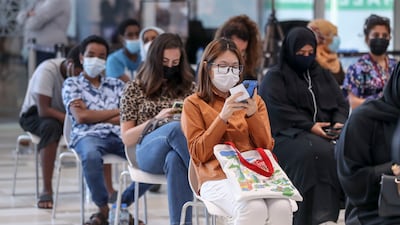
All school staff and children aged 16 and over must be vaccinated to enter school premises in Abu Dhabi. All photos: Khushnum Bhandari / The National -

Dalaa Alaa Aladwan, 14, from Rosary School is vaccinated at Seha Vaccination Centre, Abu Dhabi Cruise Terminal, Zayed Port. -
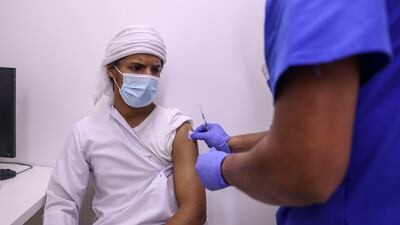
Abdullah Al Mansoori, 17, a student at Zayed University, is vaccinated before entering the army at Seha Vaccination Centre, Abu Dhabi Cruise Terminal, Zayed Port. -

Nour Khaled, 14, is vaccinated before attending Al Najah Private School in September. -

Miranda Mali, 33, a kindergarten teacher at Sharjah American International School, is vaccinated before school begins. -
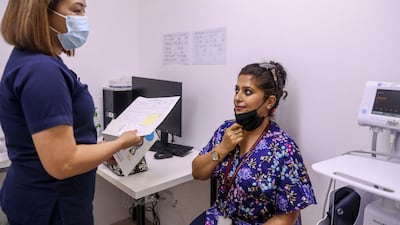
A nurse explains how vaccination works to Kavita Kumari, a Hindi teacher at Sunrise English Private School. -
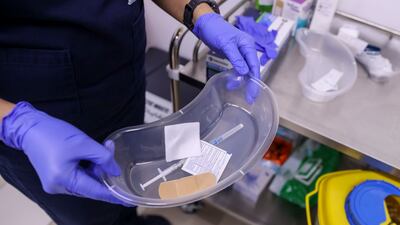
A nurse prepares the vaccine kit at Seha Vaccination Centre, Abu Dhabi Cruise Terminal, Zayed Port. -
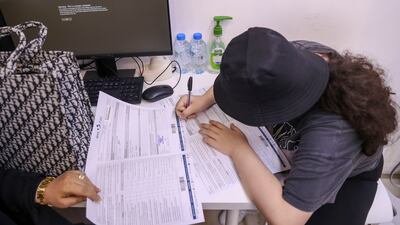
Dalaa Alaa Aladwan, 14, from Rosary School, signs forms to be vaccinated. -
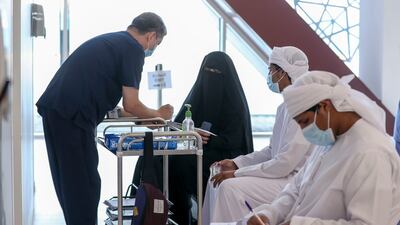
Nurses speak with patients at the Seha Vaccination Centre, Abu Dhabi Cruise Terminal, Zayed Port. -
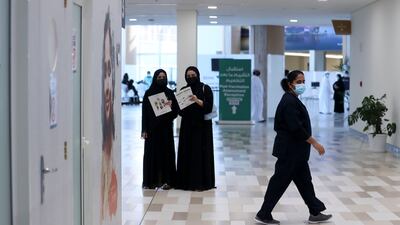
The registration area at Seha Vaccination Centre, Abu Dhabi Cruise Terminal, Zayed Port. -

Nurses work at Seha Vaccination Centre, Abu Dhabi Cruise Terminal, Zayed Port.



