


A social media influencer in Dubai has been sentenced to three months in jail for posing as a car seller and defrauding a buyer.
Dubai Criminal Court handed down the sentence last week for the crime committed in September 2021.
The Emirati buyer said the woman, who has thousands of followers, posted on her Snapchat account that she was selling luxury cars that belonged to a leading family in the UAE. The cars were being sold for significantly less than their market value.
He said once he showed interest in buying one of the vehicles, the woman asked for a deposit of Dh153,000 ($41,600) to be transferred into the bank account of her Filipina assistant, according to court documents.
“I knew the lady was promoting ads on Snapchat. She told me about cars for sale at cheap prices,” the buyer said in court.
“I discovered the scam after wiring the money to the second accused.”
The victim said he did not get a refund or the car so he filed a complaint at the Al Raffa Police Station in January 2022.
Dubai Police arrested the assistant who had received the money on behalf of the accused.
In court, public prosecutors charged the woman with fraud dealings and ordered her to pay Dh153,000, equivalent to the money she had received from the buyer.
The assistant was fined Dh10,000.
The verdict is subject to appeal within 15 days.
How criminals use technology to scam victims - in pictures
-
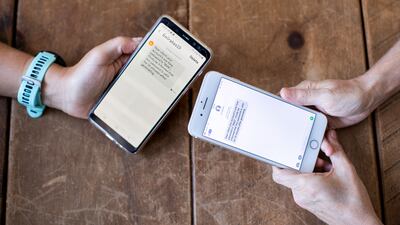
The use of technology in everyday lives has led to growth in scams and fraud. Reem Mohammed / The National -

Phishing is one of the most common methods used by fraudsters and it involves sending an unsolicited email that appears to be from a financial institution or online retailer. The National -
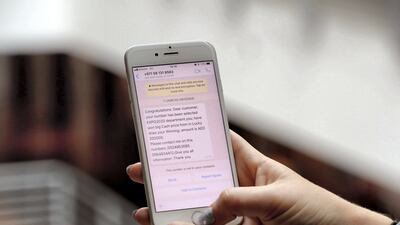
Smishing — the SMS equivalent of phishing — is where fraudsters falsify the telephone number so it appears to be a genuine text from a bank or well-known company. Chris Whiteoak / The National -

Vishing is the telephone equivalent of phishing and smishing. Fraudsters may pose as bank staff, police or government officials. Getty Images -

SIM swap involves fraudsters duplicating the SIM of your mobile number without your knowledge or authorisation, allowing them to conduct financial transactions with your bank. AP -

Identity theft is where someone illegally obtains your confidential information, through various ways such as theft of your wallet, bank and utility bill statements, computer intrusion and social networks. Getty Images -
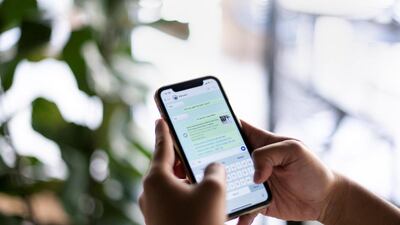
Prize scams involve fraudsters claiming to represent well-known organisations. They contact victims to tell them they have won a cash prize and request them to share confidential banking details to transfer the prize money. -
Instagram influencer Ramon Abbas, known as Hushpuppi, used a technique known as business email compromise. -

The tax authority said some bank customers in the UAE have received phishing emails impersonating financial institutions. EPA -

Jenny Ross, Which? Money editor, says: ‘Scammers are relentless when it comes to wanting our personal information and ultimately our money.’ PA -

Netflix's The Tinder Swindler tells the story of three women who say they were conned out of $500. Photo: @simon_leviev_official via Instagram



