


Six thousand kilos of explosives and 18,000 individually programmed detonators were used to blow Abu Dhabi's Mina Plaza towers in just 10 seconds, officials have revealed.
The explosives used to raze the four towers at 8am on Friday morning were a combination of plastic and detonated cordite, said Bill O'Regan, acting chief executive of Modon Properties, the company that was in charge of the demolition.
"If you can imagine we drilled 18,000 holes in the building - and each hole had a unit of explosives in it and detonator connected back to the firing points," he told The National in an interview just after the buildings came down.
“And all of that was modelled and simulated so we knew exactly how the building would come down and how long it would take.”
He said they were satisfied and "it went exactly as we expected”.
Preparing for the demolition was a lengthy multi-step process, he said.
“We started working on this project over 18 months ago.
“We started to reverse engineer the demolition using different methods, and we determined that the most safety-appropriate method was controlled implosion, using explosives.”
The company and authorities took into steps to ensure nothing would go wrong.
“The unfortunate thing with explosions is you don’t get a dummy run, but there is one point in January where we did several test blasts inside the building.”
The company built a number of columns that were not part of the original building to help them quantify how much explosive was needed per structure.
“So we had simulation done on computers, as well as physical testing.”
Ahead of the demolition, the building was stripped of existing facade, pipes and cables.
Then the holes for the 18,000 detonators were dug, and some structures inside the building were cut or partially broken “to make sure the building performed exactly as wanted it to during the demolition," Mr O'Regan said.
And the last step was charging the building and placing the explosives.
The end result was a Guinness World Record for Modon for the 'Tallest building demolished using explosives (in a controlled demolition)', which was 165 metres.
Judges counted the combined 144-floors over the four towers.
-
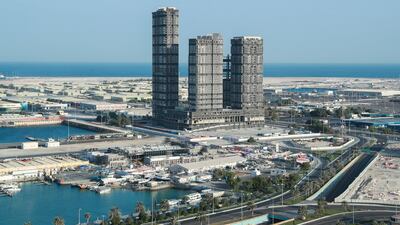
Four unfinished towers in Mina Zayed Plaza pictured just before the detonation at 8am on Friday. All photos by Victor Besa / The National -
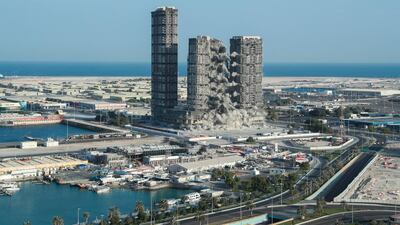
Hundreds of explosive charges are detonated inside the structures -
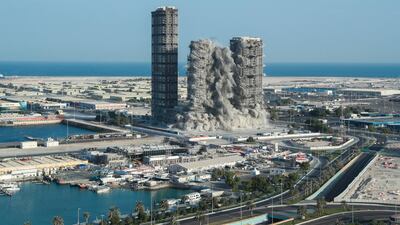
The buildings collapse in a controlled operation sending debris into a cordoned off port area -
Work on the towers began in 2007 but stalled in the 2009 financial crisis and have stood empty for the past decade -
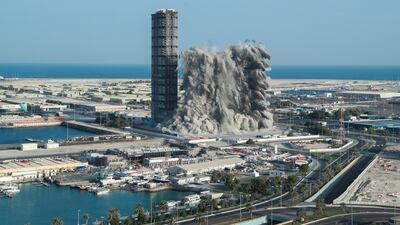
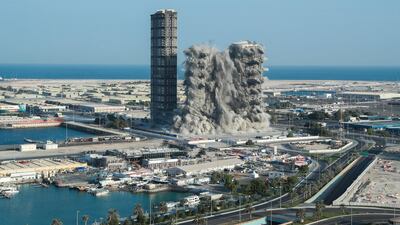
The three smaller towers topple followed by the taller fourth -
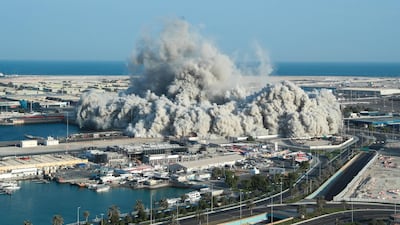
In total 144 floors between the four towers were brought down -
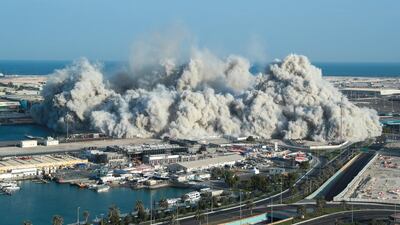
Dust and debris cascades into the surrounding streets, which were cleared by police on Thursday -

Regeneration work is set to begin almost immediately to transform the area into a bustling shopping and entertainment district -
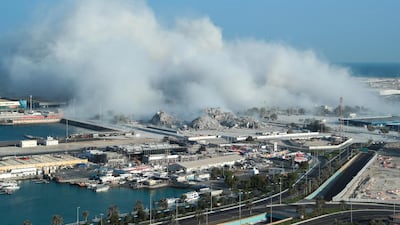
Regeneration work is set to begin almost immediately to transform the area into a bustling shopping and entertainment district


The market's much-loved local traders had been told they would have to relocate their stores. But they were given a reprieve last week and promised by the government that they can keep trading while regeneration takes place.
Bill O'Regan said the developer was working to retailers back into their stores as the adjacent blast area is cleared.
“We are expecting them to be back in business very soon," he said.
“They did not have to evacuate anything, the only protection the plant souk needed was just to place tarpaulin to protect the plants from the dust.”
Officials expect to re-open the roads around Mina Zayed port later on Friday.
“If we don’t open it doesn’t mean there is a safety issue, it just means it is not ready yet, we need to check and double check and triple check.”
He said everything had gone as planned: “very little debris, and it is being cleaned up as we speak”.
Traffic was back to normal at the Corniche an hour after the blast.
“Really, the city of Abu Dhabi was not affected by the blast - apart from waking up with a loud bang,” he said.
The fact that “the dust blew offshore”, also helped.
“We did not select the date based on the weather, but we have watching and simulating the weather all week.
“We could have exploded it even in severe weather conditions but if we had strong wind onshore it would have caused too much dust,” he said.

