

A new Etihad Rail passenger service station will be built in Sharjah, it has been announced.
The facility will be situated close to the emirate's University City and be connected to the main UAE-wide line.
The area is a key location being close to Sharjah Airport and home to scores of educational institutions.
Once up and running, the new station will help to increase the number of passengers on Etihad Rail to about 14,000 a day during the week.
Illustrations from the signing ceremony on Wednesday showed a sleek Etihad Rail train passing through Sharjah with the emirate's skyline in the background.
Sheikh Dr Sultan bin Muhammad Al Qasimi, Ruler of Sharjah, and Sheikh Theyab bin Mohamed, chairman of the Etihad Rail board, witnessed the signing.
-

Etihad Rail's freight network is now operational. It can transport 60 million tonnes of goods a year. All photos: Etihad Rail -
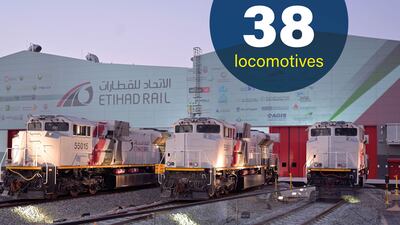
The new freight service has 38 locomotives -

The freight trains will run up to 120kph, with each locomotive operating at 4,500 horsepower -
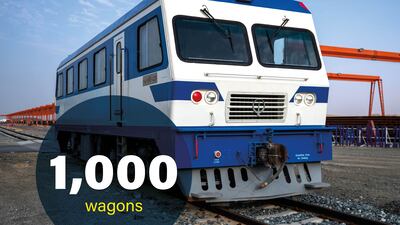
The locomotives pull a total of 1,000 wagons, transporting goods ranging from shipping containers to industrial material -
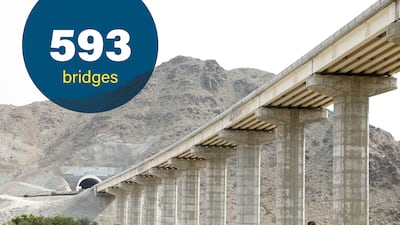
The tracks cross the UAE and feature 593 bridges -

The network will contribute Dh200 billion ($54.4 billion) to the UAE economy and save Dh8 billion in road maintenance costs -
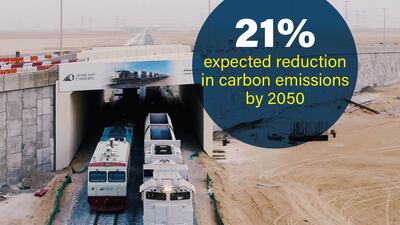
The project also aims to reduce carbon emissions from the road transport sector by 21 per cent by 2050, boosting the country's efforts to become net zero


“This step enhances the connection between residential communities in the emirates and makes it easier for passengers to move among the stations in the network, especially as Sharjah is strategically located, connecting Dubai with the other Northern Emirates and hosting vital centres and landmarks,” Sheikh Theyab said.
Shadi Malak, chief executive of Etihad Rail, and Naji Al Harthi, chairman of Tristar Engineering and Construction Company, signed the agreement.
The Etihad Rail passenger network aims to link 11 cities and regions across the country, from Al Sila to Fujairah, taking in Sharjah, Al Ruwais, Al Mirfa, Fujairah, Al Dhaid, Abu Dhabi and Dubai.
No date has been confirmed for when the UAE-wide passenger rail service will start running.

But the first passenger journey on Etihad Rail took place between Abu Dhabi and Al Dhannah in January.
Dr Sultan Al Jaber, Minister of Industry and Advanced Technology, and managing director and group chief executive of Adnoc, was among the first passengers.
The route will enable Adnoc workers to travel by train from Abu Dhabi to Al Dhannah, 250km west of the capital.
Passenger trains will travel at up to 200kph, with a capacity for about 400 people.
Customers were told to expect travel time of 50 minutes between Abu Dhabi and Dubai and about 100 minutes from Abu Dhabi to Fujairah, cutting commutes significantly.
Etihad Rail’s freight network, meanwhile, is already up and running.

