



Few – if any – cities in the world are more closely associated with the shopping mall than Dubai.
From long-established favourites such as Mazaya Shopping Centre in Al Wasl and Mercato Mall in Jumeirah, through to mega-malls like Mall of the Emirates, Ibn Battuta Mall, and of course the flagship Dubai Mall, the city is a shopaholic’s paradise.
And there is more to come. According to a recent paper in the journal Sustainability, Dubai has 10 malls under construction to add to the 65 that already exist.
“Shopping malls have emerged as de facto community centres and public squares where Dubai residents can congregate, socialise, and participate in various events,” the researchers wrote.
In the UAE, shopping mall culture began in the early 1980s, with the opening of the Al Ghurair Centre, and accelerated in the 1990s and 2000s.
The rise of the mega mall

The “City Centre” outlets from Majid Al Futtaim were among the standard bearers and the company took things up a gear with the Mall of the Emirates, which opened in 2005 beside Sheikh Zayed Road with well over 600 shops and the Ski Dubai venue.
Ibn Battuta Mall, launched further up Sheikh Zayed Road the same year courtesy of the developer Nakheel.
Another mega-mall, Dubai Mall, developed by Emaar and located beside the Burj Khalifa, opened in 2008 and attracts tens of millions of visitors each year to its more than 1,200 retail units.
“The retail experience … overall in the UAE, particularly in Dubai, is at the pinnacle of what you would find,” David Macadam, chief executive of the Middle East Council of Shopping Centres and Retailers, said.
“Dubai Mall and Mall of the Emirates … it’s the best retail experience that you can find anywhere. They keep getting the details correct to make the shopper come back for more.”
As an example, he cited the “absolutely exquisite” bathroom facilities, comparable to those in a five-star hotel.
Recent years have seen the continued opening of malls in the country, especially of malls within new communities, such as on the islands around Abu Dhabi.
The UAE’s embrace of all that is luxurious and shiny in its malls appears not to have been mirrored in the US, according to Prof Mark Cohen, director of retail studies at Columbia Business School in New York.
US market takes online hit
-

The Lord & Taylor department store at White Flint Mall in Rockville, Maryland, which shut its doors in December 2020. All photos: EPA -
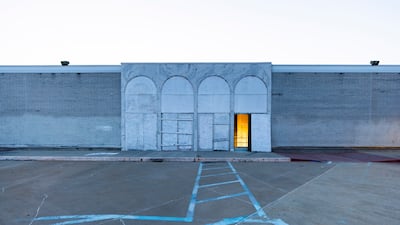
So-called 'dead malls', once bustling shopping centres that have now lost their tenants, are a growing phenomenon in the US -

The White Flint Mall in Rockville, Maryland, opened in 1977 -

A research group has estimated that 25 per cent of the US's approximately 1,000 malls will close by 2025 -

Economists attribute the decline of brick-and-mortar outlets to the proliferation of online retail -
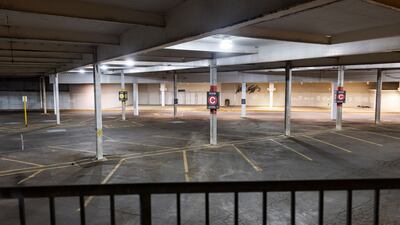
The abandoned car park at a Lord & Taylor department store in Washington, DC that closed in January 2021 -

The empty atrium of Chevy Chase Pavilion in Washington, DC, which is down to one retailer -
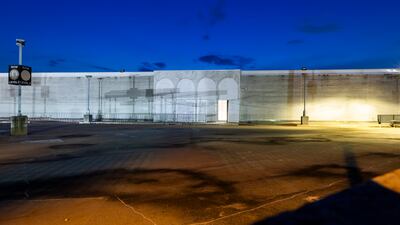
An abandoned Lord & Taylor department store in Washington, DC -
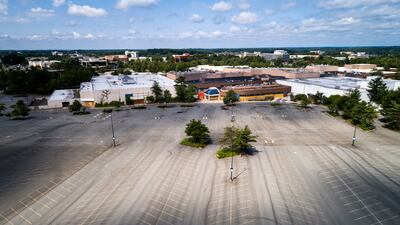
The empty car park at Lakeforest Mall in Gaithersburg, Maryland, which closed in March 2023, 45 years after opening -
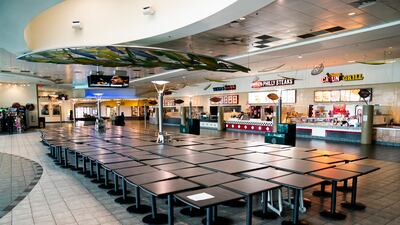
The food court at Lakeforest Mall -

Parking spaces aplenty outside the abandoned Lakeforest Mall in Gaithersburg, Maryland


The US essentially invented the shopping mall in the 1950s, and growth there has been about increased choice rather than glitz.
“The newer malls had more space,” Prof Cohen said. “They were bigger, had more parking facilities, typically tiered so the customer didn’t have to walk as far to the mall.
“They had more amenities, but not to the extent of places like Dubai, [where] it’s new and glitzy, it’s a luxury and it presents itself as a luxury hotel.”
In the US, there have been many reports of the struggles faced by shopping malls, hit by oversupply and, in recent times, the growth of online retail. The number of malls in the US is said to have fallen from 2,500 in the 1980s to around 700 now, with further decline likely.
“When you overbuild relative to available demand for customers, you face the spectre of a decline in productivity, which is what has [affected] hundreds and hundreds of US malls,” Prof Cohen said.
Could malls in the UAE, which also face the risk of business moving to the web, be set for the type of contraction seen in North America?
Experts back UAE malls to thrive

There are reasons to think that they could be more resilient, not least because malls in the Gulf are much more than places to shop.
“They are large indoor spaces where people can go during the summer months when the heat is too strong to even take a stroll outside,” Dr Laure Assaf, an assistant professor at New York University Abu Dhabi who researches mall culture, particularly among young people, said.
“This environmental factor is important in explaining the continuing success of malls in Gulf countries in general and in the UAE in particular.
“Shopping malls in the Gulf … can also be seen as public spaces where people go not only for shopping but for experiences like taking a stroll, meeting friends, going on a family outing.”
Another factor, Dr Assaf said, is that shopping malls are “a very integral part of the branding” of cities in the UAE.
“They’ve become very identified with the cities, very integrated to the form of urbanity that is being developed in the Gulf, and they’re also very central to the project of economic diversification,” she said.
“The sectors that governments have turned to are real estate, finance and tourism, and malls concentrate all of this urban development. They are large real estate properties that drive tourism.”
Among the malls set to open in future, Dubai Square, an Emaar development, will take the UAE mall experience to another level with an enormous roof and wide internal avenues.
Described as a 2.6 million square metre “indoor city”, it will face Dubai Creek Tower and will have 10,000 residential units, more than 1,500 hotel rooms and a similar amount of retail space to Dubai Mall.
In an echo of ski slope at Mall of the Emirates, Dubai Square will have an “Ice Adventure” centre alongside an art district and what is said to be the largest Chinatown in the Middle East.
Other parts of the Mena region beyond the Gulf are seeing the inauguration of new mega-malls, such as Egypt, where Mall of Egypt, which is owned and managed by Majid Al Futtaim, opened six years ago.
In its latest half-yearly results, released in August, the properties division of Majid Al Futtaim announced a 12 per cent increase in shopping malls footfall, with Mall of the Emirates recording its highest-ever figures for the first half of the year, well over 15 years after the venue opened.
“Tenant sales grew seven per cent, with UAE-based malls making the largest contribution,” the company said in a statement.
So, with more people visiting existing malls and with additional malls planned, the UAE’s love affair with the shopping mall, far from waning, appears to be growing ever stronger.

