

Emirati astronaut Sultan Al Neyadi was part of another first on board the International Space Station on Tuesday after a power cut on Earth disrupted communication with Nasa's Mission Control.
It was case of Houston having a problem on this occasion, with the temporary fault caused by upgrade work at the Johnson Space Centre.
The power failure meant Mission Control lost command and voice communications with the ISS.
It forced the space agency to rely on back-up controls for the first time since the space station was launched in 1998.
The ground team was able to talk to the crew through channels provided by Russia's Roscomos space agency within 20 minutes of the power cut.
Nasa said the issue did not pose a safety risk to the crew.
“A power issue in Mission Control Houston resulted in the loss of command, telemetry and voice from the ground to the International Space Station,” Nasa said in a blog post.
“The issue was isolated to the ground, flight controllers were able to talk to the crew on board the station through Roscosmos channels and at no point was the crew in any danger.
“The Mission Control team worked to transition to back-up hardware.”
Sultan prepares for return to Earth
-
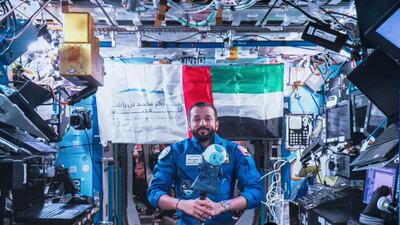
Emirati astronaut Sultan Al Neyadi speaks to students at UAE University in Al Ain on a live call from the International Space Station on May 23. Ryan Lim/The National -

Dr Al Neyadi with the mission's commander, Stephen Bowen, on February 23, days before their flight to the ISS. Sarwat Nasir / The National -
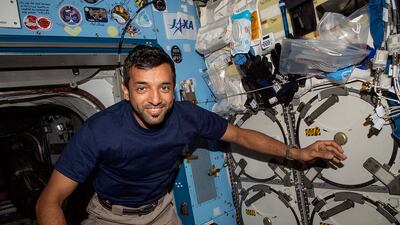
Dr Al Neyadi on March 4, a day after he arrived on the ISS. Photo: MBRSC -

Dr Al Neyadi on March 7, holding small tomatoes grown on the ISS. Photo: Nasa -
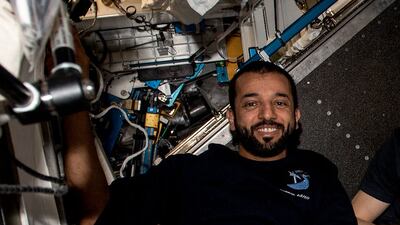
Dr Al Neyadi on March 16. -
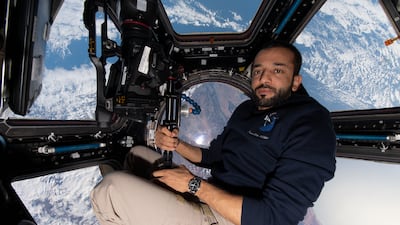
Dr Al Neyadi in front of the cupola on March 14. Photo: Nasa


Dr Al Neyadi is due to come back to Earth in mid-August after a historic voyage in space.
He and his fellow Crew-6 astronauts, America's Stephen Bowen and Woody Hoburg and Russian Andrey Fedyaev, arrived on the ISS on March 3.
Dr Al Neyadi became the first Arab to carry out a long-duration space mission, as well as the first to perform a spacewalk in April.
He ventured outside for a seven-hour walk mission with Mr Bowen to prepare an area of the ISS for a solar array installation.
The crew has carried out more than 200 experiments for scientists on the ground.
Dr Al Neyadi has been assigned 19 more by UAE universities for the remainder of his stay in space.
He has taken on a number of roles since his mission began, including plumbing when he fixed the station's toilet.
He has been taking stunning images and videos of Earth, including of the UAE, Saudi Arabia, Egypt, the UK and the Sahara.
He has also helped to inspire the next generation of adventurers, holding regular live calls with school pupils in the Emirates.

