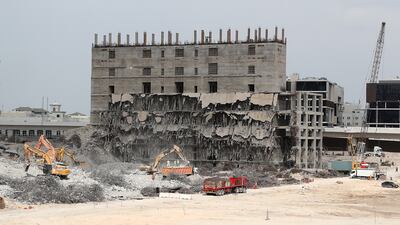
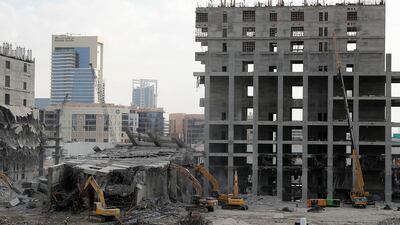
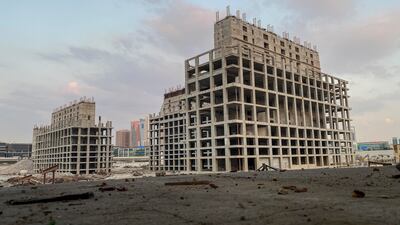
Social media users asked whether it was an earthquake, or shaking from a nearby demolition site mimicking the effects of seismic activity. Silvia Razgova / The National

Earthquake-like tremors felt in Dubai Media City


  • English
  • Arabic

Residents and office workers in Dubai Media City reported feeling the ground shaking on Monday, just before 10am.

Social media users asked whether it was an earthquake, or shaking from a nearby demolition site mimicking the effects of seismic activity.

People in the area are familiar with the demolition of Dubai's The Pearl and were questioning whether the ground tremors they felt were the result of work in that area.

In May, people living in nearby areas such as JVC, The Greens, Dubai Marina and Barsha Heights said on social media they had felt what seemed like seismic activity, when it was actually nearby demolition work.

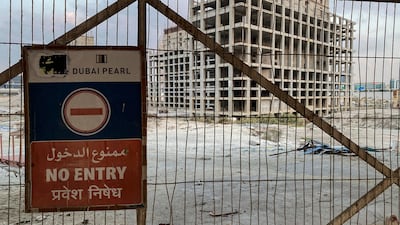
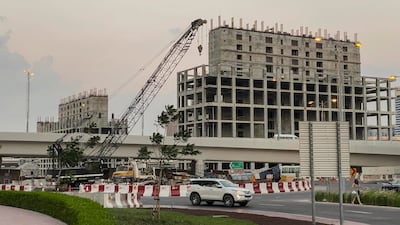
Unfinished buildings in the long-abandoned project are being cleared.

Contractors using diggers and a wrecking ball have been pulling down half a dozen buildings in the area since November.

The Pearl is on valuable land adjacent to The Palm Jumeirah – where there has been a dramatic increase in property prices since the end of the pandemic.

Work on the project stalled around 2011, as several investors in a complex consortium pulled out. At least 1,500 flats and seven hotels were planned at one stage.

Two Canadian architects made headlines around the world last year when they proposed building an enormous resort that resembled the Moon on the Pearl site.

In September, Michael Henderson, one of the designers, told The National there were no firm plans yet for the project, which would cost an estimated $5 billion to build.

  • Demolition work under way at the Dubai Pearl on Monday. Pawan Singh / The National
    Demolition work under way at the Dubai Pearl on Monday. Pawan Singh / The National
  • Diggers are clearing the site, which is adjacent to Palm Jumeirah. Pawan Singh / The National
    Diggers are clearing the site, which is adjacent to Palm Jumeirah. Pawan Singh / The National
  • The Dubai Pearl development is being knocked down. All photos: The National
    The Dubai Pearl development is being knocked down. All photos: The National
  • A section of building can be seen on its side here. The National
    A section of building can be seen on its side here. The National
  • Buildings at the site are being cleared this week
    Buildings at the site are being cleared this week
  • This image from November shows initial demolition work on the Pearl
    This image from November shows initial demolition work on the Pearl
  • It is not yet known what will be built on the site
    It is not yet known what will be built on the site
Ten tax points to be aware of in 2026

1. Domestic VAT refund amendments: request your refund within five years

If a business does not apply for the refund on time, they lose their credit.

2. E-invoicing in the UAE

Businesses should continue preparing for the implementation of e-invoicing in the UAE, with 2026 a preparation and transition period ahead of phased mandatory adoption. 

3. More tax audits

Tax authorities are increasingly using data already available across multiple filings to identify audit risks. 

4. More beneficial VAT and excise tax penalty regime

Tax disputes are expected to become more frequent and more structured, with clearer administrative objection and appeal processes. The UAE has adopted a new penalty regime for VAT and excise disputes, which now mirrors the penalty regime for corporate tax.

5. Greater emphasis on statutory audit

There is a greater need for the accuracy of financial statements. The International Financial Reporting Standards standards need to be strictly adhered to and, as a result, the quality of the audits will need to increase.

6. Further transfer pricing enforcement

Transfer pricing enforcement, which refers to the practice of establishing prices for internal transactions between related entities, is expected to broaden in scope. The UAE will shortly open the possibility to negotiate advance pricing agreements, or essentially rulings for transfer pricing purposes. 

7. Limited time periods for audits

Recent amendments also introduce a default five-year limitation period for tax audits and assessments, subject to specific statutory exceptions. While the standard audit and assessment period is five years, this may be extended to up to 15 years in cases involving fraud or tax evasion. 

8. Pillar 2 implementation 

Many multinational groups will begin to feel the practical effect of the Domestic Minimum Top-Up Tax (DMTT), the UAE's implementation of the OECD’s global minimum tax under Pillar 2. While the rules apply for financial years starting on or after January 1, 2025, it is 2026 that marks the transition to an operational phase.

9. Reduced compliance obligations for imported goods and services

Businesses that apply the reverse-charge mechanism for VAT purposes in the UAE may benefit from reduced compliance obligations. 

10. Substance and CbC reporting focus

Tax authorities are expected to continue strengthening the enforcement of economic substance and Country-by-Country (CbC) reporting frameworks. In the UAE, these regimes are increasingly being used as risk-assessment tools, providing tax authorities with a comprehensive view of multinational groups’ global footprints and enabling them to assess whether profits are aligned with real economic activity. 

Contributed by Thomas Vanhee and Hend Rashwan, Aurifer

Updated: July 10, 2023, 11:48 AM