

An Abu Dhabi scientist has detected water on a planet 400 light years from Earth, using the James Webb Space Telescope.
The discovery raises more hopes that water – and life – may be found on other planets.
The water vapour was located on Wasp-18b using data from the James Webb, which offers a much more detailed view of distant planets than earlier telescopes.
Wasp-18b is what scientists call the gas giant and temperatures on its surface are 2,700°C – and higher inside.
Dr Jasmina Blecic, of New York University Abu Dhabi's Centre for Astro, Particle and Planetary Physics, and her co-authors, have published their findings on Wasp-18b in the scientific journal, Nature.
New York University Abu Dhabi's Centre for Astro, Particle and Planetary Physics
“This is the first time we could see very small amounts of water in the atmosphere of this planet,” Dr Blecic told The National.
“This demonstrates the capability of the James Webb Space Telescope to identify minuscule quantities of certain chemical species, opening the possibility of detecting these molecules in smaller, Earth-sized planets,” she said.
The planet has been observed since 2009 with a variety of telescopes, but astronomers were unable to tell whether it contained water or not.
Most water on Wasp-18b is destroyed by the heat, but the high sensitivity of Nasa's James Webb Space Telescope, which has impressed researchers with high quality data since it was launched into space on a rocket in December 2021, meant that it is capable of detecting even subtle indications of water vapour.
Detecting water on Earth-sized planets may be significant because it could indicate that these planets – unlike Wasp-18b – harbour life.
Wasp-18b has a radius (the distance from the centre to the surface) about 10 times that of Earth, but it has a mass 3,000 times that of our planet.

“This is one of the densest planets we have ever observed,” Dr Blecic said. “This is one reason why it’s super interesting. It’s dense but it’s still only made from gas. It doesn’t have any solid surface.”
Scientists think that Wasp-18b formed from gas when its star formed, because the two are of similar composition.
The water was detected by analysing the infrared light emitted by Wasp-18b as it passed behind its star and reappeared.
The same side of Wasp-18b, known as the dayside, always faces the star, causing a significant temperature difference of about 1,000°C between the hottest part of the surface and the terminator, the dividing line between the day and night sides.
In the study, the scientists created a detailed temperature map.
One unusual feature of the planet is that winds do not flow from the hottest parts to the cooler areas, as would normally be expected.
A strong magnetic field that causes winds to instead blow from the equator over each of the poles could be the reason for this.
“It’s not easily understandable from solar system examples – most are blowing from high pressure, hot to low pressure, cold,” Dr Blecic said.
She plans to continue detailed studies of Wasp-18b in the hope of confirming that material is in fact transferred from the equator to the poles.
At 400 light years from Earth, Wasp-18b is at a distance that is difficult for the human mind to comprehend, given that one light year is about 150 million kilometres.
Yet Wasp-18b is extremely near to us in the context of our galaxy, the Milky Way, which is about 100,000 light years across.
“It’s very close to our sun,” Dr Blecic said.
There are an estimated 200 billion galaxies in the observable universe, which is about 94 billion light years across, according to data published by Nasa.
Dr Blecic has also published research on Wasp-39b, a planet that orbits a star about 700 light years from Earth.
Also using data from the James Webb, Dr Blecic and her colleagues detected carbon dioxide in the atmosphere of Wasp-39b.
This made it the first exoplanet, which is a planet orbiting a star outside our solar system where carbon dioxide has been detected.
Space activities in the Middle East – in pictures
-
UAE astronaut Sultan Al Neyadi was surprised with a birthday cake on May 23 during his stay on the International Space Station. Photo: Sultan Al Neyadi Twitter -
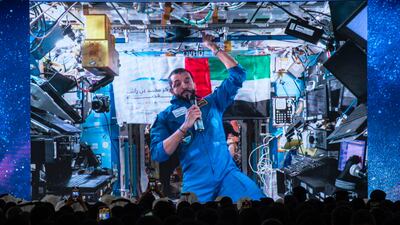
Dr Al Neyadi speaks with students at UAE University in Al Ain during a live call from the ISS. Ryan Lim for The National -
Saudi astronaut Rayyanah Barnawi shows off her grandmother's earrings in space. Photo: Rayyanah Barnawi Twitter -
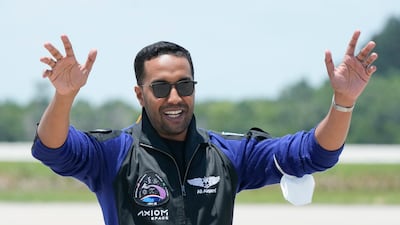
Saudi astronaut Ali Al Qarni waves to family and friends as he arrives at the Kennedy Space Centre in Cape Canaveral, Florida, on May 21. AP -
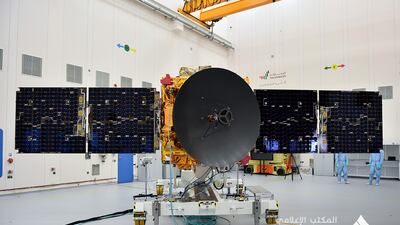
The Hope probe was built by 150 Emirati engineers, researchers and scientists. Photo: MBRSC -
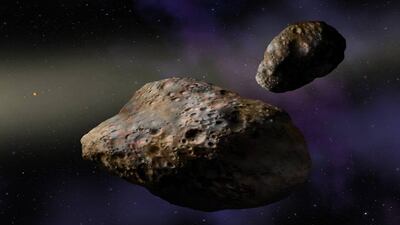
The UAE plans to send a spacecraft to the main asteroid belt. Photo: Lynette Cook/ W M Keck Observatory/ Room -
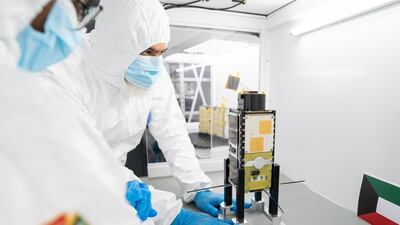
KuwaitSat-1 was launched into space on January 4, 2023. Photo: Kuna -
Bahrain's Light-1 CubeSat during a testing phase. Photo: Screenshot



