

Flights from China to Middle Eastern countries have recovered strongly, with some surpassing pre-pandemic levels, according to a report from Japanese investment bank Nomura.
The report, referring to data from aviation data company Variflight, showed flights between China and Egypt had overtaken pre-pandemic levels at 116.7 per cent; flights to Saudi Arabia were at 93.3 per cent; and those between China and UAE had climbed back to 73 per cent.
It found the Middle East trend contrasted sharply with the US where fewer than 6 per cent of US flights to and from mainland China in 2019 have resumed.
Nomura said it could be explained mostly by “geopolitical factors” such as “ongoing warm diplomatic ties between China and these Arabic countries”, and a 2019 low base for flights between China and these countries, although the latter was not the case for the UAE.
In March, for example, China brokered the restoration of diplomatic ties between Saudi Arabia and Iran and is ramping up economic ties and investment across the region.
Peggy Li, UAE-based Chinese marketing strategist and managing partner of consultancy SPS Affinity, told The National the trend is being fuelled by politics and commerce and in terms of Saudi Arabia, the visit of Chinese President Xi Jinping in 2022 cemented this.
“The country’s Vision 2030 has also shown great commercial opportunities for Chinese companies trading in Saudi Arabia,” she said, referring to the country's plan to overhaul the economy by that date.
“Chinese companies are winning bids from all the major infrastructure projects. All this travel is being fuelled by commerce.”
The UAE and China are also expanding and deepening links across trade and tourism with tourist numbers roaring back this year.
Helal Al Marri, director general of Dubai's Department of Economy and Tourism (DET) in March said the number of visitors from China could return to pre-pandemic levels by next Chinese New Year. Tour groups have also returned.
"The Chinese have started coming back," he said.
"Until they get the whole aviation network from their country fully operational again, you're always going to have supply pressures, it's not a demand issue ... we're looking forward to Chinese New Year next year, hopefully by then [we should be] back up to the levels we were at pre-Covid.”
UAE airlines Emirates and Etihad have increased operations to China since it relaxed its Covid-19 rules and ended quarantine for travellers in January.
Emirates boosted connectivity to Guangzhou, Shanghai and Beijing earlier this year, while Etihad added flights on its route to Shanghai and even added Wuhan as a fourth cargo destination in April.
However, Ms Li said flights between the two stand at about 18 a day, down from 40 to 50 before Covid-19, and she expected tourism numbers to further increase ahead of the Chinese national holiday on October 1.
-

Chinese tourists enjoy the sights of Abu Dhabi at the UAE Heritage Village. Victor Besa / The National -

Meraas launched ‘Hala China’, a programme to showcase Dubai and the UAE to Chinese tourists, before the coronavirus pandemic hit global travel. The National -
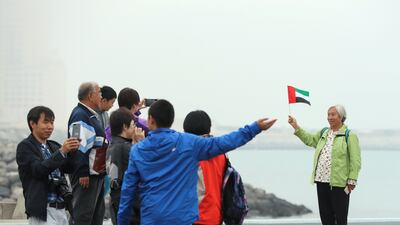
Chinese tourists from Beijing enjoy the Abu Dhabi winter weather in 2018. Victor Besa / The National -
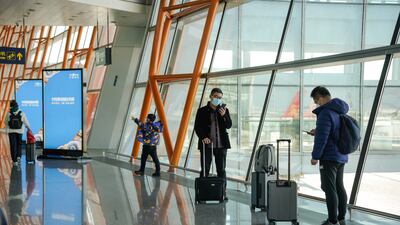
Passengers at Beijing Capital International Airport after Chinese authorities announced an end to travel restrictions in place to contain Covid-19. EPA -

Passengers get set to board flights in Beijing. EPA -

Tourists from China head for the Gold Souk, one of the most popular spots in the UAE. Victor Besa / The National -

Chinese visitors use skateboards on a sand dune in Al Ain. AFP -

Chinese dancers at the China pavilion in Global Village, Dubai. Chris Whiteoak / The National -

Visitors try on jewellery at the China pavilion in Global Village, Dubai. Chris Whiteoak / The National


China has ranked among the top-five source markets for Dubai over the past 10 years. The number of Chinese visitors to the tourism and business hub reached 177,000 last year, up 131 per cent from 2021, data from DET indicates. Dubai welcomed about 17 million visitors in 2019, with Chinese tourists making up about 990,00 - a rise of about 15 per cent from 2018.
Commenting on the report, hoteliers in the UAE told The National that they had already noticed a rise in visitors from China and they expected the numbers to shoot up this year and potentially match 2019 levels.
Khaled Amer, cluster director of sales and marketing at InterContinental Abu Dhabi, said it had seen a “consistent increase” in the Chinese market, from group bookings and individual travellers, since the beginning of last year.
Mr Amer said he expected a healthy increase in Chinese tourist numbers by the final three months of the year based on current bookings.
“It is more likely that a full recovery to surpass the 2019 levels would occur in 2024. These projections are based on the current trends and the information available.”
Mr Amer said Chinese tourists were drawn to the UAE for its rich cultural experiences, luxury amenities, beautiful landscapes and the safety.
“To cater to their preferences, we offer dedicated Chinese and Asian buffet options for breakfast, as well as a pan-Asian restaurant within the hotel.
"We also provide specialised Chinese amenities upon request and offer Mandarin language materials to facilitate communication,” he said.
“In addition, we accept UnionPay to ensure convenient payment during their stay,” he said, referring to the payment system and card network that originated in China that allows travellers to use their domestic bank cards.
Aligi Gardenghi, vice president of operations for the Arabian Peninsula at Hilton, said numbers of Chinese tourists were soaring. "We have seen an approximately 225 per cent increase in room nights stayed by Chinese travellers in 2023 compared to the same period last year," said Mr Gardenghi.
"Across our extensive UAE portfolio of 35 hotels across nine brands and five emirates, we look forward to continuing to host Chinese travellers and are committed to making sure their stay is everything they need it to be.”
Paul Bridger, chief operating officer of Rove Hotels, said the group was excited to see the Chinese market returning to Dubai.
“We have already started welcoming some Chinese travellers again in our hotels,” said Mr Bridger.
“Demand has been growing steadily month-on-month, and at Rove we are forecasting to see Chinese visitors back to 2019 levels by the end of the year.”

