

A Sudanese couple have named their newborn twins after the Ruler of Dubai and his wife as a tribute to the support they received after being unable to return home due to the conflict in their home country.
Aasim Omer and his wife Duaa Mustafa called the babies, who were born on May 13, Mohammed and Hind in honour of Sheikh Mohammed bin Rashid, Vice President and Ruler of Dubai, and his wife.
The couple arrived in Dubai on March 12 from Sudan, along with their two-year-old son. They were planning a two-week stay in the emirate while Ms Mustafa, a dentist, prepared to sit Dubai Health Authority’s professional practice exam.
Ms Mustafa passed her exam but the couple's plans to return home changed after she became unwell and was advised by doctors in Dubai to delay her return.
By the time she had recovered, the conflict in Sudan had broken out and the family were unable to leave Dubai, but authorities in the emirate provided them with free accommodation.
On May 3, Sheikh Mohammed ordered that all Sudanese people in the UAE who were unable to return home be given support, including accommodation and health care.
He said authorities should also ensure their safe return to their country at a later date.
The special working group that was established in Dubai to assist Sudanese citizens called to see the couple and arranged a hospital check-up for Ms Mustafa.
She was advised that the babies would arrive earlier than expected. She was admitted to hospital where she later underwent a Caesarean section.
Naming their newborn twins Mohammed and Hind was the couple's way of expressing their deep appreciation for the support they received, which included covering all medical costs.
“This is a drop in the ocean compared to the generosity that UAE has showered all Sudanese on its soil with following the conflict,” said Mr Omer.
-

Aasim Omer and his wife Duaa Mustafa with their twins and two-year-old son Aasir. Photo: Chris Whiteoak/The National -

The family welcome twins in Dubai when the war began in Sudan. Photo: Chris Whiteoak/The National -

The twins were named Mohammed and Hind after the Dubai Ruler and his wife. Photo: Chris Whiteoak/The National -
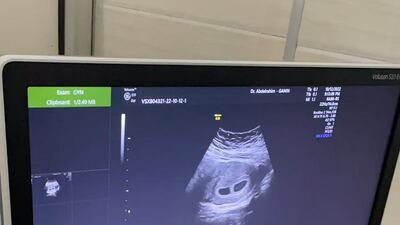
An ultrasound revealing two heartbeats. -

Mr Omer shows off his teeth after having dental work carried out by his wife, who is a dentist. -
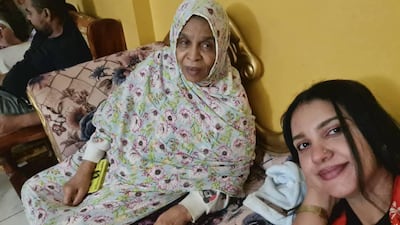
Ms Mustafa with her late mother-in-law back in Sudan right after she learnt she was expecting twins. -
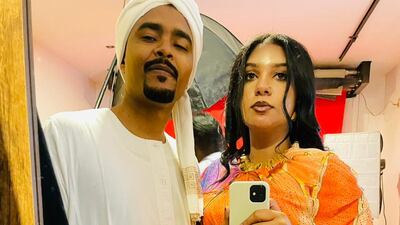
Husband and wife, Mr Omer and Ms Mustafa.


“We wanted to show gratitude for the extraordinary hospitality we received during our unexpected stay.”
The couple offered thanks to Abdulla Lashkari, secretary general of Dubai's Permanent Committee for Labour Affairs, and Jamee Mohammed, from Dubai Academic Health Corporation, for regularly checking on their wellbeing.
Ms Mustafa said the UAE stood as a beacon of hope for many with its unwavering commitment to promoting goodwill.
“May God safeguard the UAE, amplify its prosperity and preserve its continued progress,” she said.
The family are looking forward to the day when they can safely return home to Sudan.
Ms Mustafa said she was filled with sadness for her country and feared for her family and friends.
“I was also filled with anxiety, fear and confusion about what the future holds for me, my husband, our child, and my mother. And I was shaken at the uncertainty of the fate of the twins I was carrying,” she said.
Warm welcome
For now, however, Mr Omer said he and his family considered themselves blessed to be in the UAE and were grateful for the UAE's hospitality.
“For now we cherish the warm welcome we have received,” he said. “This is symbolising a deep-rooted bond between the two countries and showing the world the power of unity and compassion.”
Dubai Airports has also offered temporary accommodation to Sudanese transit passengers who have been unable to complete their journey to Khartoum.
The airport authority said last week that it has extended “various kinds of support to the passengers” to Sudanese transit passengers who flew into Dubai from many countries.
“The passengers have been offered temporary accommodation until they are able to travel to Khartoum or they choose to travel to other destinations,” a Dubai Airports representative said.
Emirates, flydubai and Air Arabia have extended their suspension of flights to Khartoum.
The UAE on Friday announced that it would waive fines incurred in the past month by Sudanese citizens in the country with expired visas, as the conflict in their homeland continues.
The Federal Authority for Identity and Citizenship said financial penalties accrued since April 15 would be lifted under the directive.
The decision affects Sudanese citizens who have lapsed residency and work permits or have overstayed their planned departure date.

