


Extensive research by Dutch students who were trying to reduce climate control costs in greenhouses bore fruit when their findings were used by horticultural companies in the Netherlands trying to keep energy costs down.
In a massive greenhouse, home to one of the oldest and largest lily cultivators in the Netherlands, pink lights on the ceiling are trained on rows of green pots.
The lights gradually brighten and dim, mimicking the cycle of sunset and sunrise.
Experts say variable lighting has vastly improved the quality and yield of the pink and white flowers, and has also reduced energy usage compared to traditional high-pressure sodium lamps.
“Energy prices were so high and we made a decision to switch to LED lights when production was hit last year,” said Michel van Kester, sales manager at Van Schie, which grows more than three million pots of lilies and a million chrysanthemums annually, mostly for export.
“We were testing the LED option but the energy crisis sped up decisions.
“With the old lamps, it was either on or off. Now we can dim or increase it like the sun.
“There is no stress on the plants. It's as if the plants like it, they say to us, ‘Let it always be natural like the sun.’”
This is only one example of how students have collaborated with companies to cut energy costs at horticultural companies.
University studies were rapidly put to use over the past year by companies hit by skyrocketing energy bills after Russia restricted gas supplies in response to western sanctions over its invasion of Ukraine.
Horticultural businesses in the Netherlands were forced to switch off lights in their greenhouses or delay planting. Supplies to overseas markets were affected when some growers shut down or cut production of crops including tomatoes, cucumbers and flowers.
Sense of urgency
The energy crisis was a wake-up call for the Dutch industry and has prompted renewed experimentation.
“The energy crisis is so big that nobody can solve it on their own,” said Raymond Hedges, horticulture manager at Inholland University of Applied Sciences, whose students were involved in the LED energy research.

“It is an example of how people need to work together as there are complex problems that you cannot solve yourself.
“You have to listen to each other, really listen and understand and only then you can move forward to work on complex problems.”
Across the country, several strategies to save energy pioneered by students at institutions such as Wageningen University and Research were enacted by agricultural companies.
These strategies included using LED lights that change colour, more robust insulation of greenhouses, and the use of additional screens and curtains.
Despite its relatively small size, the Netherlands is a powerhouse in vegetable, fruit and flower exports.
At its core is a decades-long collaboration between companies, universities and government.
This is put to the test daily at the World Horti Centre in Westland, the heart of the country’s horticultural production.
The centre is where on-site research conducted and classes take place, and it also brings together businesses, which have permanent booths.
Collaboration between the UAE and the Netherlands
A team of UAE government officials and university professors recently visited horticultural centres in the Netherlands as part of an ongoing dialogue on educational co-operation.
The Emirates is keen to collaborate and learn from the recent challenges faced by the Dutch.
-

Students at the Wageningen University & Research in the Netherlands are drawn to addressing food security challenges. Photo: Wageningen University & Research / Vincent Koperdraat -

Technology used in greenhouses handled by university students in Wageningen University in the Netherlands is geared to promoting plant health and productivity. Photo: Wageningen University & Research / Vincent Koperdraat -

A researcher at a laboratory in Wageningen University in the Netherlands that has delivered projects to save energy and reduce water consumption. Photo: Wageningen University & Research / Vincent Koperdraat -

Fewer students are keen on taking agriculture as a profession worldwide and innovative research with sustainability as a focus can draw young people to farming. Photo: Wageningen University & Research / Vincent Koperdraat -
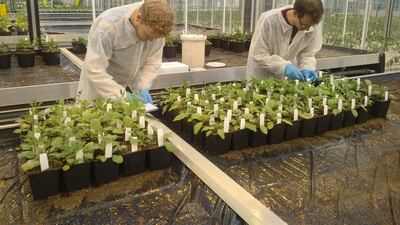
UAE professors plan to set up winter school projects and exchange programmes with colleges in the Netherlands. Photo: Wageningen University & Research / Vincent Koperdraat -

A visit by UAE government officials and academicians to the Netherlands on agriculture, technology and educational cooperation. -

Controlling the temperature in a greenhouse, monitoring water supplied to plants improves the yield. Photo: Rolf van Koppen -
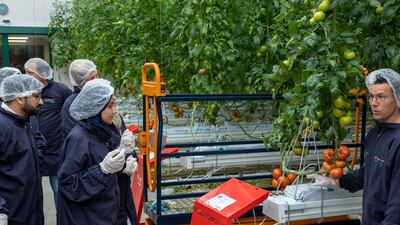
Real-time sensors and detailed data can improve the quality of a harvest and detect disease in plants. Photo: Rolf van Koppen -

Innovative technology in agriculture to boost farm productivity can raise interest in farming as a career option. Photo: Rolf van Koppen -
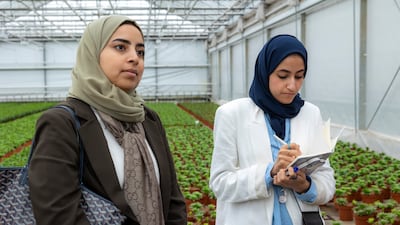
A visit by UAE government officials to the Netherlands on agriculture, technology and educational cooperation is set to lead to exchange programmes, food security technology initiatives between both countries. Photo: Rolf van Koppen -

A UAE delegation visits the Netherlands as part of ongoing partnerships to tackle water, food security and climate issues. Photo: Rolf van Koppen -
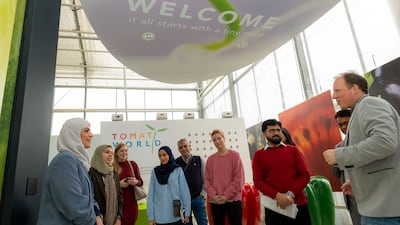
Winter school projects and exchange programmes with colleges in the Netherlands are being planned following an educational and research visit by UAE professors and government officials. Photo: Rolf van Koppen -

Netherlands is one of the world's biggest exporters of flowers. Photo: Rolf van Koppen -

Horticulture businesses in the Netherlands were hit with crippling bills after Russia restricted gas supplies in response to Western sanctions over its invasion of Ukraine. Photo: Rolf van Koppen -

LED lights that change colour, more robust insulation of greenhouses recommended for years by research students in the Netherlands were finally implemented by agricultural companies when faced with rising bills due to the energy crisis. Photo: Rolf van Koppen -

UAE academics are keen to collaborate with companies and universities in the Netherlands on robotics in agriculture. Photo: Rolf van Koppen -
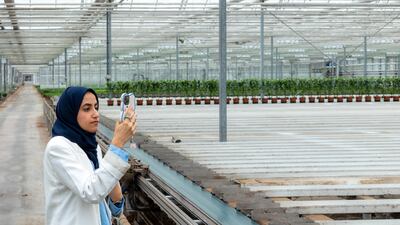
UAE government officials on a visit to the Netherlands as part of an ongoing dialogue on food security and educational cooperation. Photo: Rolf van Koppen -

Variable lighting, LED lights that change colour recommended by university research students in the Netherlands have cut energy usage and improved the health of plants and flowers. Photo: Rolf van Koppen -

UAE government officials and university professors on field visits in the Netherlands ahead of Cop 28 to be hosted in the Emirates later this year. Photo: Rolf van Koppen


The meetings with diplomats, university heads and private companies encouraged joint projects in the lead-up to Cop28 that will be held in the UAE in November.
Lakmal Seneviratne, director of the Khalifa University Centre for Autonomous Robotic Systems in Abu Dhabi, hopes to work with Dutch universities to make agriculture more sustainable and profitable.
High temperatures in the UAE as well as limited arable land and natural water resources make growing food challenging.
Developing new technologies will allow researchers to produce food economically and with a low carbon footprint.
Khalifa University researchers are exploring robotic solutions with companies in the UAE.
“We are looking at the application of AI [artificial intelligence] and robotics for farming particularly for indoor farming – greenhouse and vertical farming,” said Mr Seneviratne, a professor of mechanical engineering.
“We can use robots to inspect soil in farms, use robots for precision targeting of pesticides and also harvesting and sample collection.
“Using robotics can make agriculture efficient and cost effective.”
Afra Al Doobi, an assistant project manager with the UAE's Ministry of Climate Change and Environment, said close teamwork between different sectors in the Netherlands was a revelation.
“They continue to develop together even though they are all in the same agricultural business,” she said.
“There is no negative competition between companies as they develop research for all. It was amazing seeing sectors working together.
“This visit give us a hint of projects that can be done before Cop28 – quick wins that can be focused on food security, agriculture and education.”

