

Dubai's solar park mega project now accounts for more than 15 per cent of the emirate's energy production capacity, officials announced on Monday.
Mohammed bin Rashid Al Maktoum Solar Park is able to generate 2,327 megawatts, cementing its status as a key driver of Dubai's renewable energy push.
The park, being built by the emirate's electricity and water authority, is planned to have a total capacity of 5,000MW by 2030.
It is the world's largest single-site solar park using the Independent Power Producer model.
The project recently added 200MW from the 900MW fifth phase of the scheme using photovoltaic solar panels, contributing to the total production capacity of energy in Dubai, which has now hit 14,817MW.
The solar park is responsible for 15.7 per cent of the emirate's energy capacity, Dewa said.
The fifth phase is aimed at providing clean energy to over 270,000 Dubai residences and reducing carbon emissions by 1.8 million tonnes a year.
The emirate is working to “promote sustainability and the shift toward a sustainable green economy by increasing the share of renewable and clean energy within Dubai's energy mix,” said Saeed Mohammed Al Tayer, chief executive of Dubai Electricity and Water Authority.

Energy demand in Dubai reached 53,180 gigawatt-hours last year, compared with 50,401 in 2021. The rise in demand reflects the strong performance of all sectors in Dubai, in addition to the growth in population and expansion of key activities.
Dubai aims to generate 25 per cent of its energy requirements from renewable sources by 2030 and 100 per cent by 2050 as part of its clean energy target.
Dewa is building the world's largest solar park in the Dubai desert, the Mohammed bin Rashid Al Maktoum Solar Park, in a bid to reduce reliance on natural gas and diversify its power sources.
The solar park has attracted a total of around Dh50 billion ($13.6 billion) of investments, thanks in part to its usage of the IPP model.
When completed, it “will contribute to reducing more than 6.5 tonnes of carbon emissions annually”, said Mr Al Tayer.
Dewa set a world record in 2020 by receiving the lowest bid of $1.6953 cents per kilowatt for the 900MW fifth phase of the solar park.
The sixth phase, which is expected to operate between 2024 and 2026, will have a capacity of 1,800MW using photovoltaic solar panels.
The UAE plans to invest Dhs600 billion in clean energy projects as part of its Net Zero 2050 strategy.
It is also building the world's largest solar plant in Abu Dhabi's Al Dhafra region, with a total capacity of 2 gigawatts.
-
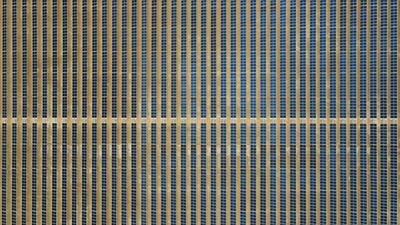
An aerial view of Mohammed bin Rashid Solar Park in Dubai in January 2022. Solar is essential to the UAE's new energy mix. All photos by Pawan Singh / The National -
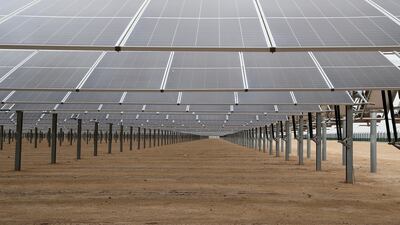
The fifth phase of a clean energy project at the Mohammed bin Rashid Solar Park will further help reduce carbon emissions. -

An aerial view of the Solar Park in the Dubai desert. -
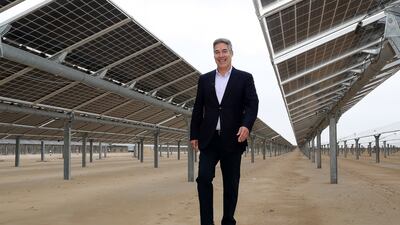
Marco Garcia, chief commercial officer of Nextracker, a US company which has provided photovoltaic technology used in the project. -
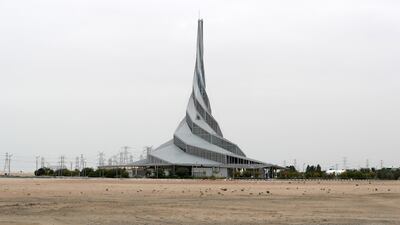
The Innovation Centre at the MBR Solar Park in Dubai, where machine learning is being utilised to track direct sunlight to maximise efficient energy capture, storage and transmission. -

The solar powered panels follow the path of the sun to help the emirate reach its clean energy transition goals. -
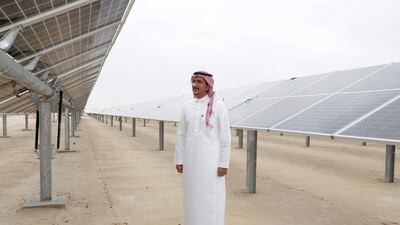
Omar Al Hassan, chief executive of Shuaa Energy 3, the company operating the scheme, says the vast project will ultimately create clean energy to power more than 250,000 houses in Dubai. -
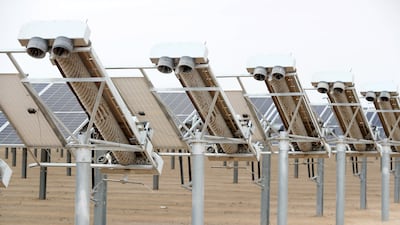
Robotic cleaning systems are installed on the solar panels. -
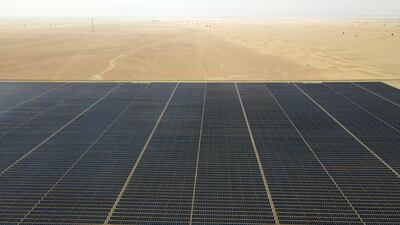
More than 2.5 million photovoltaic modules have been fitted during phase 5 of the project.



