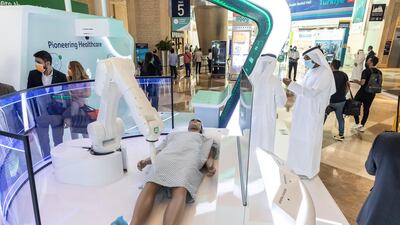
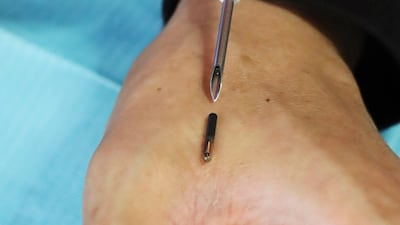
Orthopaedic consultants Dr Rashed Al Shaeel and Dr Jaber AlKhyeli with holographic headsets at Burjeel Medical City in Abu Dhabi. Victor Besa / The National

UAE healthcare providers harness power of AI


Nick Webster
  • English
  • Arabic

From holographic surgical planning for complex procedures to predictive tools to keep patients out of hospital, artificial intelligence is playing a growing role in health care.

Robots may never replicate the human touch or the bedside manner required in the care profession, but the technology is helping medics become more efficient with their time.

AI algorithms can analyse data to identify population health patterns and offer insights to improve patient care and outcomes.

Experts say that as Al and data analytics play a bigger role than ever, digitalisation has the potential to transform care.

“Digitalisation has changed the face of the healthcare industry,” said Naser Al Riyami, chief operating officer at Burjeel Medical City in Abu Dhabi.

“It has improved access to care, enhanced patient engagement, enabled personalised medicine, and driven overall efficiency in healthcare delivery.

“Al and data analytics play a bigger role than ever in health care today.”

Meanwhile, mobile apps ease the appointment process, allowing patients to access reports, and help healthcare providers manage their conditions.

Holographic surgery

Since 2021, Burjeel Medical City has used holographic technology to improve surgical planning.

Holographic surgery is an FDA-approved system used to create replicated 3D images of a patient’s organs.

It gives surgeons greater insight into a patient before surgery, allowing them a new opportunity to familiarise themselves with the patient's anatomy before surgery.

As part of its radiation oncology programme, the hospital also uses the ExacTrac dynamic patient positioning and monitoring system by German tech firm Brainlab, which combines surface, thermal and X-ray tracking technology to achieve pinpoint accuracy during treatment.

“AI algorithms can help us identify patients at risk of developing certain conditions, allowing for earlier intervention and treatment,” said Mr Al Riyami.

“In personalised medicine, AI algorithms can also identify patterns that can help healthcare providers customise treatments.”

Despite progressive steps, limitations have been found in some areas of health care.

In radiology, researchers at Hospital Cochin in Paris found the OpenAI ChatGPT interface gave incomplete or inaccurate answers to questions posed by interventional radiologists.

When asked for the treatment for bleeding after a Whipple procedure — a major surgery to remove part of the pancreas in cancer patients — the same procedure was reported three times, but with three different descriptions by the AI software.

Researchers concluded ChaptGPT and similar chatbot models were capable of generating coherent, grammatically correct text, but were unable to respond accurately to more specific, technical questions.

The findings were published in the Canadian Association of Radiologists Journal.

Elsewhere in the UAE, Prime Hospital is one centre to adopt AI to help manage patient flow.

It uses an AI global healthcare technology platform called Heaps to track deviations in a patient’s care to ensure the right interventions are made.

The system allows health professionals to monitor patients with chronic conditions and predict what could go wrong with their future care, so a more proactive approach is taken to keep them out of hospital.

“The primary objective is to reduce the rate of avoidable hospitalisation and repeat hospitalisation,” said Mohammed Hamid, regional head for Heaps.ai in the GCC and Mena.

“Traditional care co-ordination models are labour intensive and often build on manual processes.

“AI models provide a low-cost high effectiveness solution which allows organisations to expand their services and coverage elsewhere.”

While AI is efficient at analysing vast data sets of data, faster and more accurately than humans, it still lacks a humane qualities that are pivotal in healthcare.

Dr Mrudul Ramachandran, a specialist of internal medicine, at Aster Clinic in Arabian Ranches, Dubai, said incoming AI would make doctors stronger, more capable and efficient in terms of treating people, but the role of medical professional was far from obsolete.

“AI can be a smart assistant to a doctor, it cannot replace a human doctor," he said.

“Compassion and empathy are two inevitable qualities a doctor must possess.

"Treating a patient involves being compassionate and empathetic to their emotional and physiological needs, AI as a technology cannot help in this case.

“It is not fool-proof. AI analyses data and interprets it based on the data sets on which the AI models have been validated.

“If the data set is biased or lacks quality - it might generate false results so AI cannot make a final judgement on the diagnosis.

“A doctor has to use his skills to confirm the diagnosis. AI can only support the process.”

Future of healthcare - in pictures

  • Healthcare will be completely digital in less than 30 years’ time with trips to the doctor becoming unnecessary. Antonie Robertson / The National.
    Healthcare will be completely digital in less than 30 years’ time with trips to the doctor becoming unnecessary. Antonie Robertson / The National.
  • Our morning showers will also feature a daily MRI scan in the decades to come, a Dubai health conference heard. FRANCK FIFE / AFP
    Our morning showers will also feature a daily MRI scan in the decades to come, a Dubai health conference heard. FRANCK FIFE / AFP
  • Microchips will be implanted into our skin in the future to record every aspect of our life, it has been predicted. Kyodo via AP Images
    Microchips will be implanted into our skin in the future to record every aspect of our life, it has been predicted. Kyodo via AP Images
  • Microchips implanted into our bodies will replace most of the functions of mobile phones by the year 2050, Arab Health conference heard. ATTA KENARE / AFP
    Microchips implanted into our bodies will replace most of the functions of mobile phones by the year 2050, Arab Health conference heard. ATTA KENARE / AFP
  • There will be no need for physical one-to-one meetings with doctors in the future, a leading health expert predicted. Adam Berry/Getty Images
    There will be no need for physical one-to-one meetings with doctors in the future, a leading health expert predicted. Adam Berry/Getty Images
COMPANY PROFILE
Company name: BorrowMe (BorrowMe.com)

Date started: August 2021

Founder: Nour Sabri

Based: Dubai, UAE

Sector: E-commerce / Marketplace

Size: Two employees

Funding stage: Seed investment

Initial investment: $200,000

Investors: Amr Manaa (director, PwC Middle East) 

Uefa Champions League last 16 draw

Juventus v Tottenham Hotspur

Basel v Manchester City

Sevilla v  Manchester United

Porto v Liverpool

Real Madrid v Paris Saint-Germain

Shakhtar Donetsk v Roma

Chelsea v Barcelona

Bayern Munich v Besiktas

COMPANY PROFILE
Name: Kumulus Water
 
Started: 2021
 
Founders: Iheb Triki and Mohamed Ali Abid
 
Based: Tunisia 
 
Sector: Water technology 
 
Number of staff: 22 
 
Investment raised: $4 million 
The%20Specs
%3Cp%3E%3Cstrong%3EEngine%3A%20%3C%2Fstrong%3E3.6-litre%20twin%20turbocharged%20V6%3Cbr%3E%3Cstrong%3ETransmission%3A%20%3C%2Fstrong%3E10-speed%20automatic%3Cbr%3E%3Cstrong%3EPower%3A%3C%2Fstrong%3E%20472hp%3Cbr%3E%3Cstrong%3ETorque%3A%3C%2Fstrong%3E%20603Nm%3Cbr%3E%3Cstrong%3EPrice%3A%20%3C%2Fstrong%3Efrom%20Dh290%2C000%20(%2478%2C9500)%3Cbr%3E%3Cstrong%3EOn%20sale%3A%3C%2Fstrong%3E%20now%3C%2Fp%3E%0A
Results:

Men's 100m T34: 1. Walid Ktila (TUN) 15 sec; 2. Rheed McCracken (AUS) 15.40; 3. Mohammed Al Hammadi (UAE) 15.75. Men's 400m T34: 1. Walid Ktila (TUN) 50.56; 2. Mohammed Al Hammadi (UAE) 50.94; 3. Henry Manni (FIN) 52.24.

While you're here
UAE currency: the story behind the money in your pockets
West Asia Premiership

Dubai Hurricanes 58-10 Dubai Knights Eagles

Dubai Tigers 5-39 Bahrain

Jebel Ali Dragons 16-56 Abu Dhabi Harlequins

Ten tax points to be aware of in 2026

1. Domestic VAT refund amendments: request your refund within five years

If a business does not apply for the refund on time, they lose their credit.

2. E-invoicing in the UAE

Businesses should continue preparing for the implementation of e-invoicing in the UAE, with 2026 a preparation and transition period ahead of phased mandatory adoption. 

3. More tax audits

Tax authorities are increasingly using data already available across multiple filings to identify audit risks. 

4. More beneficial VAT and excise tax penalty regime

Tax disputes are expected to become more frequent and more structured, with clearer administrative objection and appeal processes. The UAE has adopted a new penalty regime for VAT and excise disputes, which now mirrors the penalty regime for corporate tax.

5. Greater emphasis on statutory audit

There is a greater need for the accuracy of financial statements. The International Financial Reporting Standards standards need to be strictly adhered to and, as a result, the quality of the audits will need to increase.

6. Further transfer pricing enforcement

Transfer pricing enforcement, which refers to the practice of establishing prices for internal transactions between related entities, is expected to broaden in scope. The UAE will shortly open the possibility to negotiate advance pricing agreements, or essentially rulings for transfer pricing purposes. 

7. Limited time periods for audits

Recent amendments also introduce a default five-year limitation period for tax audits and assessments, subject to specific statutory exceptions. While the standard audit and assessment period is five years, this may be extended to up to 15 years in cases involving fraud or tax evasion. 

8. Pillar 2 implementation 

Many multinational groups will begin to feel the practical effect of the Domestic Minimum Top-Up Tax (DMTT), the UAE's implementation of the OECD’s global minimum tax under Pillar 2. While the rules apply for financial years starting on or after January 1, 2025, it is 2026 that marks the transition to an operational phase.

9. Reduced compliance obligations for imported goods and services

Businesses that apply the reverse-charge mechanism for VAT purposes in the UAE may benefit from reduced compliance obligations. 

10. Substance and CbC reporting focus

Tax authorities are expected to continue strengthening the enforcement of economic substance and Country-by-Country (CbC) reporting frameworks. In the UAE, these regimes are increasingly being used as risk-assessment tools, providing tax authorities with a comprehensive view of multinational groups’ global footprints and enabling them to assess whether profits are aligned with real economic activity. 

Contributed by Thomas Vanhee and Hend Rashwan, Aurifer

Infobox

Western Region Asia Cup Qualifier, Al Amerat, Oman

The two finalists advance to the next stage of qualifying, in Malaysia in August

Results

UAE beat Iran by 10 wickets

Kuwait beat Saudi Arabia by eight wickets

Oman beat Bahrain by nine wickets

Qatar beat Maldives by 106 runs

Monday fixtures

UAE v Kuwait, Iran v Saudi Arabia, Oman v Qatar, Maldives v Bahrain

Sweet%20Tooth
%3Cp%3E%3Cstrong%3ECreator%3A%20%3C%2Fstrong%3EJim%20Mickle%3Cbr%3E%3Cstrong%3EStarring%3A%20%3C%2Fstrong%3EChristian%20Convery%2C%20Nonso%20Anozie%2C%20Adeel%20Akhtar%2C%20Stefania%20LaVie%20Owen%3Cbr%3E%3Cstrong%3ERating%3A%20%3C%2Fstrong%3E2.5%2F5%3C%2Fp%3E%0A
if you go

The flights 

Etihad and Emirates fly direct to Kolkata from Dh1,504 and Dh1,450 return including taxes, respectively. The flight takes four hours 30 minutes outbound and 5 hours 30 minute returning. 

The trains

Numerous trains link Kolkata and Murshidabad but the daily early morning Hazarduari Express (3’ 52”) is the fastest and most convenient; this service also stops in Plassey. The return train departs Murshidabad late afternoon. Though just about feasible as a day trip, staying overnight is recommended.

The hotels

Mursidabad’s hotels are less than modest but Berhampore, 11km south, offers more accommodation and facilities (and the Hazarduari Express also pauses here). Try Hotel The Fame, with an array of rooms from doubles at Rs1,596/Dh90 to a ‘grand presidential suite’ at Rs7,854/Dh443.

Living in...

This article is part of a guide on where to live in the UAE. Our reporters will profile some of the country’s most desirable districts, provide an estimate of rental prices and introduce you to some of the residents who call each area home.

Living in...

This article is part of a guide on where to live in the UAE. Our reporters will profile some of the country’s most desirable districts, provide an estimate of rental prices and introduce you to some of the residents who call each area home.

'Lost in Space'

Creators: Matt Sazama, Burk Sharpless, Irwin Allen

Stars: Molly Parker, Toby Stephens, Maxwell Jenkins

Rating: 4/5

The Bio

Name: Lynn Davison

Profession: History teacher at Al Yasmina Academy, Abu Dhabi

Children: She has one son, Casey, 28

Hometown: Pontefract, West Yorkshire in the UK

Favourite book: The Alchemist by Paulo Coelho

Favourite Author: CJ Sansom

Favourite holiday destination: Bali

Favourite food: A Sunday roast

Updated: April 28, 2023, 4:58 AM