A model of the Hakuto-R Mission 1 lander, which is thought to have crashed on the surface of the Moon. EPA

Japan's ispace says spacecraft carrying UAE's Rashid rover probably crashed on Moon


Sarwat Nasir
  • English
  • Arabic

Japan's ispace says its spacecraft that was carrying the UAE's Rashid rover probably crashed as it tried to land on the Moon on Tuesday.

Mission control in Tokyo lost contact with the Hakuto-R Mission 1 lander moments before touchdown was expected.

Early on Wednesday, ispace said that its engineers were still investigating what had happened.

“Based on the currently available data, the Hakuto-R Mission Control Center in Nihonbashi, Tokyo, confirmed that the lander was in a vertical position as it carried out the final approach to the lunar surface,” it said.

“Shortly after the scheduled landing time, no data was received indicating a touchdown.”

The company said the remaining propellent in the spacecraft was decreasing during the landing attempt and shortly afterwards the descent speed rapidly increased.

This could suggest that the spacecraft ran out of fuel during the attempted touchdown, causing the engines to shut down and the lander to crash on the Moon's surface.

“After that, the communication loss happened. Based on this, it has been determined that there is a high probability that the lander eventually made a hard landing on the Moon’s surface,” ispace said.

It was ispace's first Moon mission. It was carrying payloads from the UAE and other countries.

The Rashid rover was the first mission under the UAE's long-term Moon exploration programme. Emirati engineers are already working on a second rover.

The Mohammed bin Rashid Space Centre thanked ispace for its efforts.

“While the Rashid rover and other payloads onboard the lander did not get a chance to continue on their respective missions, the team at MBRSC is still proud of the achievements, including developing a rover and becoming the first Emirati and Arab lunar mission to enter the Moon's orbit,” it said.

Salem Al Marri, director general of the space centre, had told The National that his team had developed many new skills, despite what the outcome of the landing attempt would be.

“My feelings are that you know, regardless of what happens, I believe that we've succeeded already because we built a very strong team — a team that's capable of building missions that can work on the lunar surface,” he said.

“When you build a mission like that, it's not only about engineering. It's about all of the science, operations, command and control and all of those elements. We've managed to build those in-house and develop a rover built here in the UAE.”

A team of 11 engineers at the space centre had been working on the Rashid rover since 2017, hoping that the UAE would become the first Arab nation to place a spacecraft on the surface of another celestial body.

Ispace was also expecting to make history by becoming the first private company to complete a mission to the lunar surface.

The company has said that its business plan supports a second and third mission.

“Although we do not expect to complete the lunar landing at this time, we believe that we have fully accomplished the significance of this mission, having acquired a great deal of data and experience by being able to execute the landing phase,” said founder Takeshi Hakamada.

UAE's Moon mission and the Emirati team who have built it - in pictures

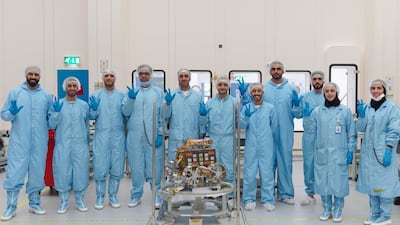
  • Emirati engineers pictured inside the clean room, along with the Rashid rover, in the Mohammed bin Rashid Space Centre on June 15, 2022. Photo: MBRSC
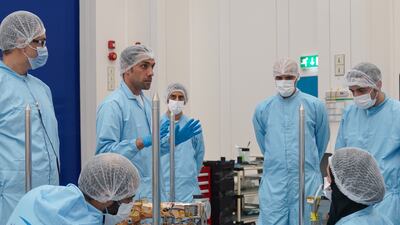
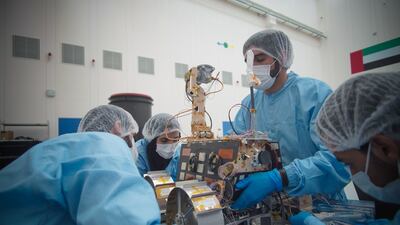
    Emirati engineers pictured inside the clean room, along with the Rashid rover, in the Mohammed bin Rashid Space Centre on June 15, 2022. Photo: MBRSC
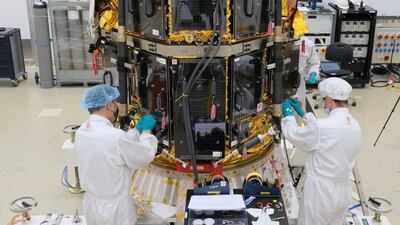
  • The flight model of the Mission 1 Hakuto-R lander by private company ispace inc. Photo: ispace
    The flight model of the Mission 1 Hakuto-R lander by private company ispace inc. Photo: ispace
  • Dr Hamad Al Marzooqi, director of the Emirates Lunar Mission. Chris Whiteoak / The National
    Dr Hamad Al Marzooqi, director of the Emirates Lunar Mission. Chris Whiteoak / The National
  • A small team of Emiratis have built the UAE's first mission to the Moon. Here, they are pictured with an old model of the Rashid rover. Chris Whiteoak / The National
    A small team of Emiratis have built the UAE's first mission to the Moon. Here, they are pictured with an old model of the Rashid rover. Chris Whiteoak / The National
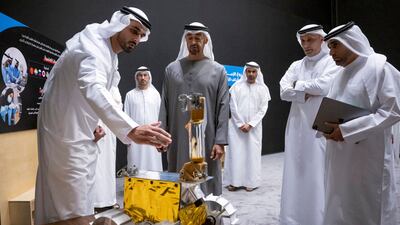
  • UAE President Sheikh Mohamed bin Zayed attends a presentation by members of the Emirates Lunar Mission in the capital Abu Dhabi on June 15, 2022. Photo: Hamad Al Kaabi / Ministry of Presidential Affairs
    UAE President Sheikh Mohamed bin Zayed attends a presentation by members of the Emirates Lunar Mission in the capital Abu Dhabi on June 15, 2022. Photo: Hamad Al Kaabi / Ministry of Presidential Affairs
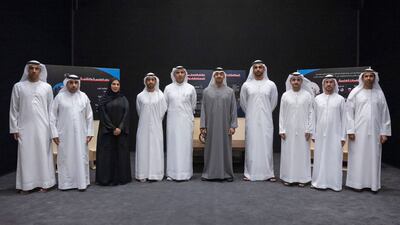
  • Sheikh Mohamed with the members of the Emirates Lunar Mission team.
    Sheikh Mohamed with the members of the Emirates Lunar Mission team.
  • The Rashid rover has now been shipped to France for final testing. Pictured are Emirati engineers at the Mohammed bin Rashid Space Centre on June 15, 2022. Photo: MBRSC
    The Rashid rover has now been shipped to France for final testing. Pictured are Emirati engineers at the Mohammed bin Rashid Space Centre on June 15, 2022. Photo: MBRSC
  • Emirati engineers carry the Rashid rover inside a clean room in the Mohammed bin Rashid Space Centre on June 15, 2022. Photo: MBRSC
    Emirati engineers carry the Rashid rover inside a clean room in the Mohammed bin Rashid Space Centre on June 15, 2022. Photo: MBRSC
  • Dr Sara Al Maeeni is the communication and science lead of the Emirates Lunar Mission. Chris Whiteoak / The National
    Dr Sara Al Maeeni is the communication and science lead of the Emirates Lunar Mission. Chris Whiteoak / The National
  • Ahmed Sharaf is the electrical systems lead for Emirates Lunar Mission. Chris Whiteoak / The National
    Ahmed Sharaf is the electrical systems lead for Emirates Lunar Mission. Chris Whiteoak / The National
  • Abdullah Al Shehi is the lead of mechanical system for Emirates Lunar Mission. Chris Whiteoak / The National
    Abdullah Al Shehi is the lead of mechanical system for Emirates Lunar Mission. Chris Whiteoak / The National
  • Amna Khalifa is the mechanical engineer for Emirates Lunar Mission. Chris Whiteoak / The National
    Amna Khalifa is the mechanical engineer for Emirates Lunar Mission. Chris Whiteoak / The National

Mercer, the investment consulting arm of US services company Marsh & McLennan, expects its wealth division to at least double its assets under management (AUM) in the Middle East as wealth in the region continues to grow despite economic headwinds, a company official said.

Mercer Wealth, which globally has $160 billion in AUM, plans to boost its AUM in the region to $2-$3bn in the next 2-3 years from the present $1bn, said Yasir AbuShaban, a Dubai-based principal with Mercer Wealth.

Within the next two to three years, we are looking at reaching $2 to $3 billion as a conservative estimate and we do see an opportunity to do so,” said Mr AbuShaban.

Mercer does not directly make investments, but allocates clients’ money they have discretion to, to professional asset managers. They also provide advice to clients.

“We have buying power. We can negotiate on their (client’s) behalf with asset managers to provide them lower fees than they otherwise would have to get on their own,” he added.

Mercer Wealth’s clients include sovereign wealth funds, family offices, and insurance companies among others.

From its office in Dubai, Mercer also looks after Africa, India and Turkey, where they also see opportunity for growth.

Wealth creation in Middle East and Africa (MEA) grew 8.5 per cent to $8.1 trillion last year from $7.5tn in 2015, higher than last year’s global average of 6 per cent and the second-highest growth in a region after Asia-Pacific which grew 9.9 per cent, according to consultancy Boston Consulting Group (BCG). In the region, where wealth grew just 1.9 per cent in 2015 compared with 2014, a pickup in oil prices has helped in wealth generation.

BCG is forecasting MEA wealth will rise to $12tn by 2021, growing at an annual average of 8 per cent.

Drivers of wealth generation in the region will be split evenly between new wealth creation and growth of performance of existing assets, according to BCG.

Another general trend in the region is clients’ looking for a comprehensive approach to investing, according to Mr AbuShaban.

“Institutional investors or some of the families are seeing a slowdown in the available capital they have to invest and in that sense they are looking at optimizing the way they manage their portfolios and making sure they are not investing haphazardly and different parts of their investment are working together,” said Mr AbuShaban.

Some clients also have a higher appetite for risk, given the low interest-rate environment that does not provide enough yield for some institutional investors. These clients are keen to invest in illiquid assets, such as private equity and infrastructure.

“What we have seen is a desire for higher returns in what has been a low-return environment specifically in various fixed income or bonds,” he said.

“In this environment, we have seen a de facto increase in the risk that clients are taking in things like illiquid investments, private equity investments, infrastructure and private debt, those kind of investments were higher illiquidity results in incrementally higher returns.”

The Abu Dhabi Investment Authority, one of the largest sovereign wealth funds, said in its 2016 report that has gradually increased its exposure in direct private equity and private credit transactions, mainly in Asian markets and especially in China and India. The authority’s private equity department focused on structured equities owing to “their defensive characteristics.”

Updated: April 26, 2023, 9:43 AM