The number of Emiratis working in the private sector has jumped substantially after the Nafis initiative was introduced last year. Pawan Singh / The National

Emiratisation in private sector jumps 11% annually in first three months


  • English
  • Arabic

The number of Emiratis working in the private sector increased by 11 per cent in Q1 2023 over 2022, the Ministry of Human Resources and Emiratisation revealed on Wednesday.

The numbers were not disclosed but by the end of last year, more than 50,000 Emiratis were employed in private companies, according to data published on the ministry's website.

Of these, 28,700 people joined after the Nafis programme was rolled out in 2022 as employers were directed to have two per cent of roles taken up by Emiratis by the end of the year.

The number of private companies that employed Emiratis increased by more than 13 per cent and 8,897 companies reached the two per cent Emiratisation target by the end of 2022.

The ministry also said on Twitter that more than 5,000 Emiratis benefited from career counselling in the first three months of the year.

The top five economic sectors where Emiratis work. Photo: MoHRE Twitter

According to the ministry's tweet, Emiratis working in the private sector are mostly employed in business services, construction, commerce and repair services, financial brokerage and manufacturing.

Under the Nafis programme, private sector companies with at least 50 employees must ensure three per cent of their workforce is made up of Emiratis by July 1.

Employers in the UAE are expected to meet a four per cent target by the end of the year as part of the government’s Emiratisation initiative.

The Emirati employment rate is to increase to six per cent in 2024, eight per cent in 2025 and 10 per cent in 2026.

Those end-of-year goals remain in place, but private businesses must now make sure they reach those targets with an increase of one per cent every six months.

The measures apply to skilled positions and companies in free zones are exempt. They are, however, encouraged to participate in the scheme.

On March 12, the government also introduced a new initiative called the Industrialist Programme that is designed to increase Emiratisation in the industrial sector, upskill national cadres and help them gain skilled jobs.

Emiratisation targets — in pictures

  • Sheikh Mansour bin Zayed and Sheikh Abdullah bin Zayed chair the National Competitiveness Council. New figures show 50,000 Emiratis now work in the UAE's private sector - a rise of more than 28,000 in one year. Photo: UAE Government Media Office
    Sheikh Mansour bin Zayed and Sheikh Abdullah bin Zayed chair the National Competitiveness Council. New figures show 50,000 Emiratis now work in the UAE's private sector - a rise of more than 28,000 in one year. Photo: UAE Government Media Office
  • As of January 2023, companies in the UAE must ensure that 2 per cent of their workforce is Emirati. This will rise by 1 per cent every six months until it is 10 per cent. Freezone companies are exempt. Christopher Pike / Bloomberg
    As of January 2023, companies in the UAE must ensure that 2 per cent of their workforce is Emirati. This will rise by 1 per cent every six months until it is 10 per cent. Freezone companies are exempt. Christopher Pike / Bloomberg
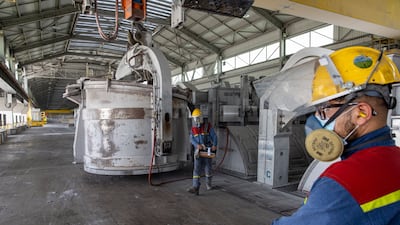
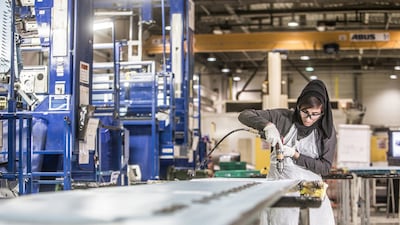
  • Semi-government owned companies such as Strata, which makes aircraft parts, are major employers of Emiratis. The government wants more privately-owned companies to hire Emiratis. Photo: Mubadala
    Semi-government owned companies such as Strata, which makes aircraft parts, are major employers of Emiratis. The government wants more privately-owned companies to hire Emiratis. Photo: Mubadala
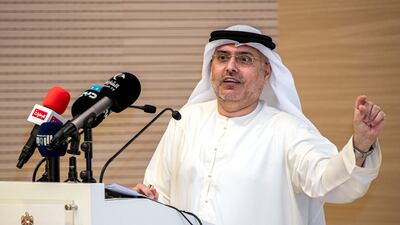
  • Dr Abdulrahman Al Awar, Minister of Human Resources and Emiratisation, said a greater mix of Emiratis and foreign talent will make the country more competitive. Victor Besa / The National
    Dr Abdulrahman Al Awar, Minister of Human Resources and Emiratisation, said a greater mix of Emiratis and foreign talent will make the country more competitive. Victor Besa / The National
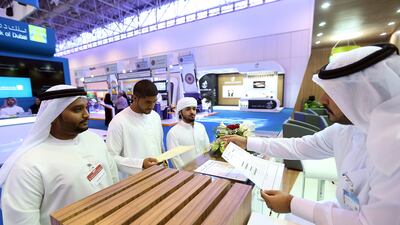
  • Young Emiratis are being urged to look to the private sector for opportunities and away from traditional jobs in government. Satish Kumar / The National
    Young Emiratis are being urged to look to the private sector for opportunities and away from traditional jobs in government. Satish Kumar / The National

Mercer, the investment consulting arm of US services company Marsh & McLennan, expects its wealth division to at least double its assets under management (AUM) in the Middle East as wealth in the region continues to grow despite economic headwinds, a company official said.

Mercer Wealth, which globally has $160 billion in AUM, plans to boost its AUM in the region to $2-$3bn in the next 2-3 years from the present $1bn, said Yasir AbuShaban, a Dubai-based principal with Mercer Wealth.

Within the next two to three years, we are looking at reaching $2 to $3 billion as a conservative estimate and we do see an opportunity to do so,” said Mr AbuShaban.

Mercer does not directly make investments, but allocates clients’ money they have discretion to, to professional asset managers. They also provide advice to clients.

“We have buying power. We can negotiate on their (client’s) behalf with asset managers to provide them lower fees than they otherwise would have to get on their own,” he added.

Mercer Wealth’s clients include sovereign wealth funds, family offices, and insurance companies among others.

From its office in Dubai, Mercer also looks after Africa, India and Turkey, where they also see opportunity for growth.

Wealth creation in Middle East and Africa (MEA) grew 8.5 per cent to $8.1 trillion last year from $7.5tn in 2015, higher than last year’s global average of 6 per cent and the second-highest growth in a region after Asia-Pacific which grew 9.9 per cent, according to consultancy Boston Consulting Group (BCG). In the region, where wealth grew just 1.9 per cent in 2015 compared with 2014, a pickup in oil prices has helped in wealth generation.

BCG is forecasting MEA wealth will rise to $12tn by 2021, growing at an annual average of 8 per cent.

Drivers of wealth generation in the region will be split evenly between new wealth creation and growth of performance of existing assets, according to BCG.

Another general trend in the region is clients’ looking for a comprehensive approach to investing, according to Mr AbuShaban.

“Institutional investors or some of the families are seeing a slowdown in the available capital they have to invest and in that sense they are looking at optimizing the way they manage their portfolios and making sure they are not investing haphazardly and different parts of their investment are working together,” said Mr AbuShaban.

Some clients also have a higher appetite for risk, given the low interest-rate environment that does not provide enough yield for some institutional investors. These clients are keen to invest in illiquid assets, such as private equity and infrastructure.

“What we have seen is a desire for higher returns in what has been a low-return environment specifically in various fixed income or bonds,” he said.

“In this environment, we have seen a de facto increase in the risk that clients are taking in things like illiquid investments, private equity investments, infrastructure and private debt, those kind of investments were higher illiquidity results in incrementally higher returns.”

The Abu Dhabi Investment Authority, one of the largest sovereign wealth funds, said in its 2016 report that has gradually increased its exposure in direct private equity and private credit transactions, mainly in Asian markets and especially in China and India. The authority’s private equity department focused on structured equities owing to “their defensive characteristics.”

The most expensive investment mistake you will ever make

When is the best time to start saving in a pension? The answer is simple – at the earliest possible moment. The first pound, euro, dollar or dirham you invest is the most valuable, as it has so much longer to grow in value. If you start in your twenties, it could be invested for 40 years or more, which means you have decades for compound interest to work its magic.

“You get growth upon growth upon growth, followed by more growth. The earlier you start the process, the more it will all roll up,” says Chris Davies, chartered financial planner at The Fry Group in Dubai.

This table shows how much you would have in your pension at age 65, depending on when you start and how much you pay in (it assumes your investments grow 7 per cent a year after charges and you have no other savings).

Age

$250 a month

$500 a month

$1,000 a month

25

$640,829

$1,281,657

$2,563,315

35

$303,219

$606,439

$1,212,877

45

$131,596

$263,191

$526,382

55

$44,351

$88,702

$177,403


The specs: 2018 Opel Mokka X

Price, as tested: Dh84,000

Engine: 1.4L, four-cylinder turbo

Transmission: Six-speed auto

Power: 142hp at 4,900rpm

Torque: 200Nm at 1,850rpm

Fuel economy, combined: 6.5L / 100km

Updated: April 19, 2023, 11:57 AM